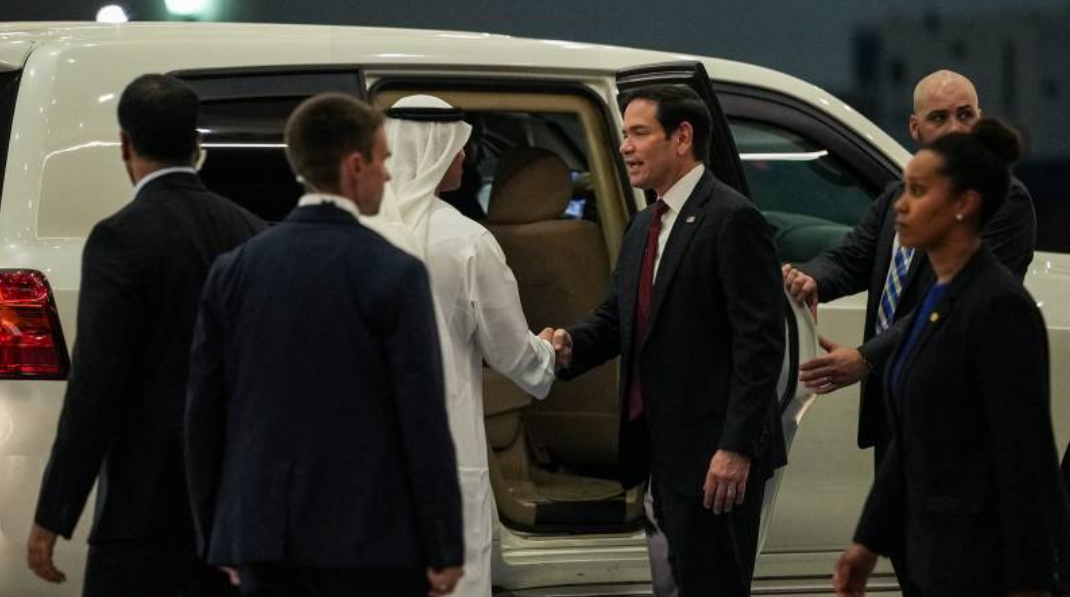

US Secretary of State Marco Rubio held talks with Kuwait’s leader on Wednesday, after renewing Washington’s commitment to the region’s security in a meeting with the UAE’s president during a tour of the Gulf.
Rubio is seeking to reassure close US allies hit hard by Iran during the Middle East war about Washington’s memorandum of understanding with Tehran, which fails to address some of the Gulf’s long-standing concerns about its missile programme and proxies.
Before meeting with Kuwaiti Emir Mishal Al-Ahmad Al-Sabah, Rubio attended a flag-raising ceremony at the US embassy marking the resumption of operations following an Iranian strike.
“Kuwait is an indispensable partner for regional security and stability,” Rubio said in a tweet afterwards, adding Washington “looks forward to strengthening our partnership”.
In Abu Dhabi, Rubio discussed the Iran deal in talks with United Arab Emirates President Mohamed bin Zayed, as well as efforts to secure safe transit through the Strait of Hormuz, State Department spokesperson Tommy Pigott said.
Rubio also “thanked the UAE for their leadership and unparalleled support, praised their courage and resilience in the face of Iran’s attacks, and reaffirmed the US commitment to the security of the Emirates”, Pigott added.
Arriving in the UAE capital on Tuesday evening, Rubio had insisted that no country was allowed to impose tolls on the Strait of Hormuz after Oman and Iran, which border the waterway, said they were considering charging “costs” for ships navigating the key conduit for Gulf oil and gas.
“It’s an international waterway. No country is allowed to charge tolls or fees on an international waterway. That’s existing international law,” he said.
After Kuwait, Rubio will travel to Bahrain, where he will attend a Gulf Cooperation Council meeting on Thursday.
His trip is the first by a senior US official to the Middle East since the Iran agreement was signed last week.
The energy-rich Gulf, home to several American military bases, bore the brunt of Iran’s attacks in retaliation for US-Israeli strikes that sparked the war on February 28.
The UAE was targeted by more than 2,800 missiles and drones — more than any other country in the region — while Kuwait and Bahrain were also badly hit relative to their small size.
During the war, the UAE doubled down on its alliance with the US and repeatedly said Iran’s missile programme and proxies should be dealt with.
Regional leaders have long maintained close ties with President Donald Trump and have pledged to invest billions of dollars in the US economy.
But experts say that they have grown wary of an unreliable US partner that left them badly exposed during Iran’s attacks.