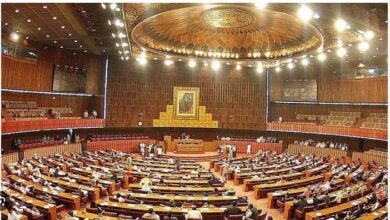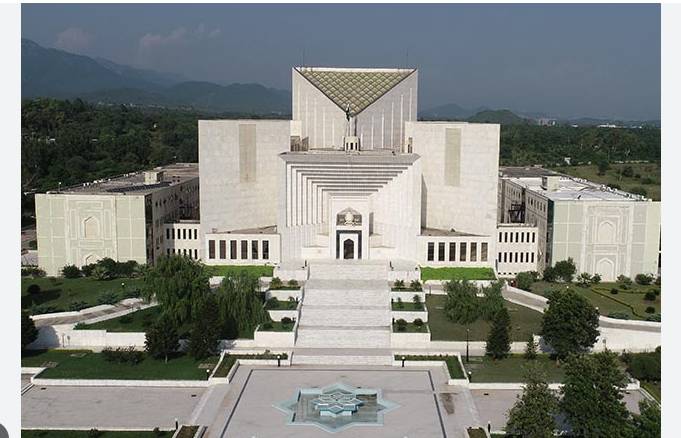

The Supreme Court of Pakistan (SCP) has ruled that it does not have jurisdiction to hear cases filed under the National Accountability Bureau (NAB) law, directing that such matters now fall within the jurisdiction of the Federal Constitutional Court (FCC).
Pronouncing the reserved verdict on Friday, Justice Muhammad Ali Mazhar, who headed the three-member bench consisting of Justice Musarrat Hilali and Justice Shahid Bilal Hassan, said the Federal Constitutional Court would hear principal appeals and bail petitions in NAB cases.
Justice Mazhar authored the 30-page judgement while Justice Hilali wrote an additional note.
The ruling stated that Sections 32 and 32A of the NAB law do not confer jurisdiction on the Supreme Court to hear such matters.
The apex court ruled that all NAB-related cases are to be treated as transferred to the Federal Constitutional Court under Articles 175A and 175F of the Constitution.
The decision also affects a bail petition filed by Pakistan Tehreek-e-Insaf (PTI) founder Imran Khan. He had approached the Supreme Court after challenging a High Court decision on his bail case, but the Supreme Court registrar had returned the petition after raising objections.
Following the latest ruling, Imran Khan’s bail case will now be heard by the Federal Constitutional Court in line with the Supreme Court’s decision.
The Supreme Court bench had reserved the verdict on July 16 regarding the jurisdictional controversy over whether it retains the authority to hear bail applications in pending NAB case, or if such pleas must be transferred to the FCC under Constitution.
During previous hearings, the Attorney General for Pakistan (AGP) Mansoor Usman Awan had argued that both appeals and bails in pending NAB cases will now be heard by the FCC. It is legally inappropriate for one part of a case to be heard by the SC and the other by the FCC, the AGP contended, adding under the NAB Amendment Act 2026, all appeals and bail applications against the decisions of the high courts in NAB cases stand transferred to the FCC.
On March 5, Section 32-A was inserted into the National Accountability (Amendment) Act, 2026, which provided for a second appeal. The amendment states that any person convicted, or the Prosecutor General Accountability (if so directed by the Chairman NAB), who is aggrieved by a decision made by the High Court under Section 32, may prefer a second appeal to the FCC within 30 days.
The AGP contended that under this amendment, the SC has no jurisdiction in NAB cases, meaning that such appeals regarding bails or sentences awarded in NAB cases will now be heard by the FCC.
Since an appeal in NAB cases is a fundamental right, this right of appeal has been routed to the FCC through the recent amendments, the AGP said, adding the right itself has not been abolished. Under Article 175(F-2), cases pending in the SC were automatically transferred to the FCC.