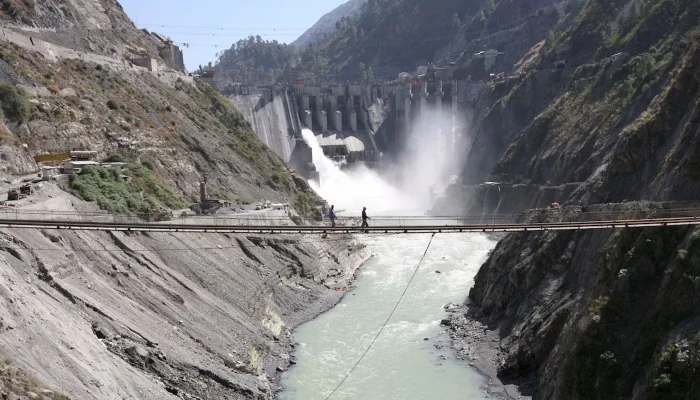

The Chenab is more than a line on a map. It’s a lifeline, a civilisational corridor, a fragile Himalayan system carrying snowmelt, sediment, memory and risk in equal measure.
So, when India talks about diverting its waters into the Beas basin, that can’t simply be waved through as an internal engineering adjustment. It is a transboundary act, with ecological, legal, geological and human consequences that reach far beyond its own borders.
Recent reports about a proposed Chenab-Beas link have understandably rattled Pakistan. The idea, as reported, is to draw water from the upper Chenab system – possibly through a tunnel near the Chandra river in Himachal Pradesh – and send it into the Beas. Wider plans talk about moving ‘surplus’ water through canal networks towards Punjab, Haryana and Rajasthan. But in the Indus basin, words like surplus and diversion are never innocent. One country’s surplus can be another country’s sowing season, aquifer recharge, delta survival or floodplain ecology.
What makes this serious is that the Chenab isn’t one of the eastern rivers under the Indus Waters Treaty. It belongs to the western river system, allocated largely to Pakistan, with only limited uses permitted to India. If India now wants to redraw these hydrological realities through tunnels and link canals, even while stepping back from the treaty itself, that goes well beyond engineering. You can’t hollow out a treaty by drilling through a mountain.
Pakistan’s response shouldn’t rest on treaty language alone. The stronger case here is environmental and scientific. No Chenab-Beas diversion should go ahead without full disclosure of design discharge, annual diversion volume, barrage storage, tunnel alignment, fault-line mapping, GLOF risk, sediment modelling, reservoir operation rules and an assessment of cumulative reservoir-induced seismicity. Call these technical details if you like; in one of the world’s most fragile mountain systems, they function as safeguards.
The Himalaya is an active seismic region. A tunnel through this terrain cuts across faulted rock, groundwater channels, stress zones and landslide-prone slopes. It can disturb drainage, sediment movement and unstable formations, especially now, with glacial melt and extreme rainfall both intensifying under a warming climate.
The tunnel itself may be short, but the ambition behind it isn’t. Even a diversion of one or two million acre-feet a year would matter downstream, and reported pre-feasibility discussions have floated numbers as high as 15 to 20 million acre-feet annually. The three eastern rivers – Ravi, Beas and Sutlej – carry roughly 33 million acre-feet a year between them. At the higher end, diverted Chenab water could amount to nearly half, perhaps three-fifths, of that entire volume. Feed that into already-large Beas-Sutlej storage systems and the question of cumulative seismic risk isn’t something to brush aside.
Reservoir-induced seismicity is a documented phenomenon: large reservoirs can alter stress in already-strained geological zones, and the weight of stored water, along with its infiltration into fractured rock, can under certain conditions help trigger earthquakes.
There’s another silence running through this water debate: pollution. For decades, Pakistan hasn’t just lost clean flows; it’s also been receiving poisoned ones in their place. The Hudiara Drain, starting near Batala and Amritsar, enters Pakistan carrying industrial effluent and municipal sewage, flows past Lahore’s expanding settlements, and empties into the dry bed of the Ravi. Its average flow is about 180 cusecs. Over the life of the treaty, that works out to nearly 10 billion cubic metres of polluted wastewater crossing into Pakistan from this single drain – an estimated 10-15% of all Ravi pollution. Heavy metals, arsenic, lead, zinc, E coli, untreated chemicals: none of it stops at the border. It ends up in groundwater, vegetables, fodder, milk, meat, and eventually human bodies.
That gives Pakistan a second claim, not just about water quantity, but water quality. Under the polluter-pays principle, India should have treated this wastewater before it ever crossed the border. Conservative estimates put the treatment cost at over $20 billion. Factor in environmental degradation, agricultural losses, groundwater damage and public health impacts across the Ravi basin, and Pakistan’s rightful compensation claim could run anywhere from $75-135 billion. None of this is rhetorical flourish and staying silent now would mean accepting both theft and poison as Pakistan’s permanent fate.
India has a right to pursue its own development. Pakistan has an equal right to survival. A river cannot be treated like a pipeline. Before the Chenab is pushed toward the Beas, every discharge figure, fault map, reservoir rule and pollution liability needs to be on the table. Anything less would be reckless – not just for Pakistan, but for the Himalaya itself.