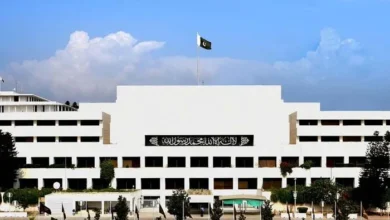

Every few years, Pakistan’s Planning Commission produces another glossy document promising a different future. Vision 2010 promised one thing. Vision 2025 promised another. Now we have Uraan Pakistan, complete with buzzwords like “Vertical Housing” — promoting high-rise development over horizontal sprawl to conserve land — and a “National Urban Planning Framework” meant to coordinate growth nationwide. On paper, these documents read like the work of a serious technocracy. In practice, not one of them has meaningfully touched how a single Pakistani city actually plans its streets, its drainage, or its housing. The Planning Commission has become exactly what its harshest critics accuse it of being: a parking lot for political appointees who produce paper, not policy, while the machinery of urban Pakistan collapses in full view of the institution supposedly responsible for planning it.
Consider what “National Urban Planning Framework” actually means on the ground. It means nothing, because the Commission has no institutional connectivity to a single civic authority in this country. Islamabad’s own master plan legally expired in 1985 and has languished through decades of failed revision, producing the unauthorized vertical construction and legal grey zones every resident of the capital now lives with. Karachi, Lahore, Faisalabad — none of them operate under a current, enforced master plan coordinated with federal planning. Pakistan still has no unified national or provincial Town and Country Planning law. Development authorities act simultaneously as developer and regulator, a structural conflict of interest that guarantees weak enforcement of the very building codes Uraan Pakistan claims to modernize. Transportation planning remains obsessively car-centric, chasing mega-boulevards while pedestrians, cyclists, and public transit are treated as afterthoughts. Encroachments on natural storm drains turn ordinary monsoon rain into citywide flooding, year after year, because no federal planning body has the authority — or apparently the interest — to stop it. Municipal governments remain financially and legally hollowed out, unable to enforce zoning or direct growth even where the will exists. And master plans everywhere are treated as suggestions, routinely bypassed the moment they become inconvenient to a developer with the right connections.
This is not incompetence born of insufficient resources. It is a Commission trapped in a paradigm that never left the 1960s — obsessed with brick-and-mortar mega-infrastructure and GDP arithmetic, while ignoring climate finance, human capability development, and the Sustainable Development Goals that the rest of the planning world has organized itself around for over a decade. It is a Commission that has never fully accepted that more than 70 percent of Pakistan’s population now lives in dense urban clusters, still narrating national policy as though this were a rural country. And it operates a Public Sector Development Program that functions less as a filter than as a bureaucratic gatekeeping exercise — approving a backlog of projects that vastly exceeds what the national treasury could ever realistically fund, a “throw-forward” trap that guarantees half-finished infrastructure and permanent fiscal overhang.
Here is the deeper problem: none of this obsolescence has cost anyone their job, because the Planning Commission’s real function today is patronage, not planning. It absorbs political appointees who need a seat and a title, and it rewards them not for institutional output but for visibility — for the ability to trend on Twitter, to clip a soundbite for television, to be seen “engaging” rather than to be measured on whether a single city’s flood risk, housing deficit, or transit failure actually improved. That is precisely the dilemma of a minister who has mastered the art of staying perpetually alive in the media while the institution he leads has no functioning relationship with a single Pakistani municipal government.
India did not tolerate this indefinitely. In August 2014, a prime minister who had risen from selling tea at a railway station — dismissed by critics at the time as unfit for serious economic stewardship — dissolved India’s Planning Commission outright and replaced it with NITI Aayog, a leaner body built for a federal, market-oriented economy rather than Soviet-style central planning. Whatever one’s view of Indian politics, and even as Pakistan and India remain strategic rivals, the institutional result speaks for itself. A decade later, Indian states are integrating artificial intelligence directly into urban governance at a scale Pakistan has not even begun to contemplate. Amaravati is being built from the ground up as India’s first AI-first smart city, using machine learning to structure its grids, autonomous transit zones, and climate monitoring before a single building is occupied. Bidadi, near Bengaluru, is a 9,000-acre AI-simulated township testing physical urban systems at city scale, balancing growth against 1,100 acres of preserved green space. Ahmedabad has deployed a high-precision 3D digital twin of the entire city, funded by the World Bank, letting planners simulate underground utility mapping and disaster preparedness before construction begins. Bengaluru, Hyderabad, and Visakhapatnam now run integrated command-and-control centers that process live environmental data to redesign traffic patterns and predict localized infrastructure crises in real time, rather than planning off static, decades-old maps. Even Bangladesh, a country with a fraction of Pakistan’s planning bureaucracy, has placed AI-driven public services and smart-city development at the center of its 2026–27 national budget, aiming to make administrative processes more efficient and citizen-facing services more responsive. Pakistan has produced neither a digital twin of Lahore nor a functioning master plan for its own capital.
But the deepest failure is not technological. It is structural, and it explains why no framework — however AI-enabled, however well-funded — would survive contact with how this Ministry is actually run. There is a fact about the Ministry of Planning that deserves to be stated plainly, because it explains more about Pakistan’s planning paralysis than any policy document ever will: the country’s most senior planning official sits on the Board of Governors of a private think tank, and that same think tank’s Executive Director simultaneously chairs the board of one government fund, sits on the board of another, and holds a governing seat on the state body meant to train Pakistan’s civil service.
I checked this myself, directly against the institutions’ own published records. SDPI’s Board of Governors page lists Professor Ahsan Iqbal, Federal Minister for Planning, Development and Special Initiatives, as a sitting member. This is not one relationship. It is an interlocking directorate spanning planning, disaster finance, social protection, climate policy, and civil-service training — nearly the entire architecture of Pakistan’s development state — anchored around a single private institute and a single governing minister who sits on its board.
I want to be exact about what this does and does not prove. It does not, by itself, prove any individual act of wrongdoing. What it does prove, beyond argument, is that Pakistan’s planning apparatus is not structured the way a serious state structures policy-making. In any functioning democracy, a sitting minister does not sit on the governing board of the very NGO whose leadership simultaneously chairs the boards of the disaster-finance fund, the social safety-net authority, and the institution training the bureaucrats meant to hold the ministry accountable. That is not technocratic expertise feeding into government. That is a single, self-referential network occupying every chair in the room — advising itself, funding itself, and evaluating itself, with no outside institution positioned to ask a hard question the network did not first pre-approve.
This is, I believe, the single worst governance failure sitting underneath everything else in this account of the Planning Commission. It is not merely that Vision 2010, Vision 2025, and Uraan Pakistan produced fancy language and no urban delivery. It is that the entire policy-production apparatus behind those documents runs through a closed circuit of the same handful of people, moving between the same handful of boards, with the state’s own planning minister embedded inside the private institute that helps set the terms of the conversation. When the Planning Commission fails to connect with a single municipal authority, when Uraan Pakistan’s “National Urban Planning Framework” touches no actual city, this is why: the feedback loop was never built to run through Pakistan’s cities. It runs through a boardroom.
Pakistan, meanwhile, has a Planning Commission whose Minister leads a country whose own Prime Minister holds a Bachelor of Arts from Government College University, Lahore — and whose business elite, despite years of talk, has still failed to relieve this institution of a single meaningful mandate, even with the Special Investment Facilitation Council now sitting right beside it with the authority to actually move capital and coordinate execution. If SIFC can fast-track investment decisions that the Planning Commission has spent seventy years failing to translate into livable cities, there is no remaining argument for keeping both. But dissolving the Planning Commission cannot simply mean moving its budget line to SIFC. It must mean severing the interlocking board memberships that let one minister and one institute’s leadership sit atop the entire planning, disaster-finance, and social-protection architecture of the state at once. Shelve the Planning Commission. Fold its residual functions into SIFC, under real technical audit and real accountability to elected local government, with a hard firewall against the kind of board-level self-dealing documented here. Send the Minister and his brigade home. Anything less is not reform — it is the same closed loop, wearing a new letterhead. Pakistan does not need another Vision document. It needs an institution that can be measured, and one that has finally earned the right to still exist.