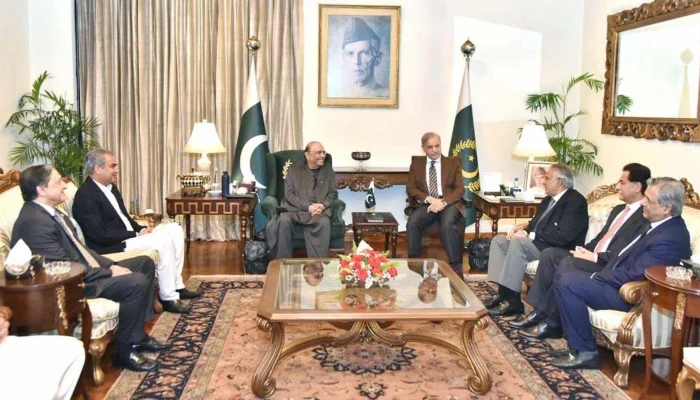

Interior Minister Mohsin Naqvi’s recent remarks on Pakistan’s governance crisis have reignited familiar debates about constitutional reform, administrative restructuring and the creation of new provinces. Yet these discussions risk obscuring a more fundamental question.
Whether Pakistan has four provinces, eight provinces or twelve provinces will not determine its future. Nor will another round of political engineering, constitutional amendments or electoral adjustments.
The real question facing Pakistan’s ruling elites, including the establishment, is whether they wish to preserve an extractive state that serves competing elite interests or build a developmental state that invests in its people, strengthens institutions and creates broad-based prosperity. Everything else is secondary.
For decades, Pakistan’s political discourse has been trapped between two competing orthodoxies. One insists democracy is the only path to development. The other assumes stronger central control can compensate for weak institutions. Pakistan’s experience suggests both explanations are incomplete.
Since 1988, Pakistan has held repeated elections, witnessed transfers of power and experimented with different political coalitions. Yet state capacity has steadily deteriorated. The state struggles to educate its children, provide quality healthcare, maintain public safety, manage urbanisation, regulate markets, attract investment and generate sustained growth.
This is not an argument against democracy or free and fair elections. They are essential for legitimacy, accountability and protection against arbitrary power. But after nearly four decades of electoral politics, intellectual honesty requires asking whether elections alone are sufficient to produce capable institutions, effective governance and sustained development. Pakistan’s most severe economic crises of the past two decades, driven partly by large trade deficits, occurred under elected governments, including the 2018 crisis under the PML-N and the 2021–22 crisis under the PTI. The latter was further exacerbated by the PDM government’s policies in 2022–23. Democracies can produce both developmental states and weak, extractive ones.
The opposite conclusion – that authoritarianism is the answer – is equally unconvincing. Pakistan has already travelled that road. Ayub Khan delivered impressive growth rates but widened regional disparities and concentrated economic power in a narrow elite, contributing to tensions that culminated in the breakup of the country in 1971. And no, South Korea did not follow his model. Ziaul Haq entrenched militarisation and Islamisation while neglecting human development. Pervez Musharraf presided over rapid growth fuelled by post-9/11 inflows, yet left behind unresolved structural weaknesses and a deteriorating security environment.
All three relied on highly educated technocrats. Yet none built a developmental state. It is also worth noting that the average economic growth rates achieved under Ayub, Bhutto, Zia and Musharraf were never surpassed by subsequent elected governments led by Benazir Bhutto, the Sharifs or Imran Khan. This inability to sustain higher growth is one reason behind Pakistan’s economic stagnation over the past two decades.
The debate therefore needs to move beyond the sterile democracy-versus-authoritarianism framework that has dominated Pakistani politics for decades. The experience of East Asia offers a crucial perspective.
One of the most influential books of recent years, ‘Why Nations Fail’ by Daron Acemoglu and James Robinson, argues that inclusive institutions are the foundation of prosperity while extractive institutions ultimately undermine development. The book is persuasive in explaining why many societies stagnate. It is less persuasive in explaining how poor countries build state capacity in the first place.
The post-war experience of East Asia challenges any theory that treats democracy as the primary driver of development. Japan, South Korea, Taiwan, Singapore, China and Vietnam achieved some of the most remarkable economic transformations in modern history. Several did so under authoritarian rule for decades. South Korea and Taiwan industrialised long before democratisation. China and Vietnam remain one-party states. Singapore has been governed by the same party since independence. East Asia is not a footnote to development theory. It is one of its most important tests.
The lesson of East Asia is not that authoritarianism works. Many authoritarian states have failed spectacularly. North Korea, Myanmar and countless military regimes provide ample evidence. The real lesson is that state capacity matters. Successful states, regardless of political form, develop the ability to educate populations, implement policy, build infrastructure, support productive sectors, maintain continuity and adapt to changing economic realities. They create incentives for investment, innovation and productivity rather than dependence and rent-seeking.
That is precisely where Pakistan has struggled. Pakistan’s predicament cannot be understood simply in terms of civilian failures or military interventions. It is the product of a broader political economy that evolved into a predatory order.
Virtually every organised group seeks benefits from the state. Political elites seek patronage. Protected business interests seek privileges. Segments of the bureaucracy seek influence and status. Various groups seek exemptions, subsidies and special treatment.
The burden ultimately falls on ordinary citizens through poor services, limited opportunities, low productivity and weak growth. The state extracts resources from society but returns relatively little in human development, institutional quality or economic opportunity.
Through direct interventions, constitutional engineering, political management and successive hybrid arrangements, it has played a central role in shaping Pakistan’s political evolution. Political parties deserve criticism for corruption, incompetence and dynastic politics, but they did not develop in isolation. Institutions repeatedly manipulated for short-term objectives rarely mature into effective instruments of governance.
Acknowledging this reality is not an exercise in assigning blame but a prerequisite for serious analysis.
Yet here lies Pakistan’s central paradox. The institution most responsible for helping create the current system may also be the only institution capable of helping reform it. Many will find this conclusion uncomfortable. But public policy must operate in the world as it exists rather than the world we might prefer. For decades, political engineering was justified in the name of stability. Yet Pakistan today faces recurring economic crises, educational decline, institutional weakness, growing social frustration and a rapidly expanding youth population confronting limited opportunities. If this is stability, one is entitled to ask what instability would look like.
The debate about provinces and constitutional arrangements therefore misses the larger issue. The real challenge is not administrative geography. It is the nature of the state itself.
A developmental state is not defined by military rule, civilian rule, democracy or authoritarianism. It is defined by the commitment of the rulers to national development. A developmental state invests in human capital. It rewards competence rather than patronage. It values productivity over privilege. It thinks in decades rather than electoral cycles. It measures national strength not merely through military capability but through education, technological progress, institutional effectiveness and economic resilience. Most importantly, it understands that long-term security depends upon development.
South Korea did not become secure before it became prosperous. China did not become influential before it became productive. Singapore did not become resilient before it became capable.
Development and security are not competing objectives. In the modern world, development is increasingly a prerequisite for security. Pakistan still possesses enormous potential. But time is no longer on its side. Debt can be refinanced. IMF programmes can be negotiated. Friendly countries can provide temporary assistance. None addresses the underlying problem.
A country of nearly 250 million people cannot indefinitely postpone the consequences of educational failure, weak productivity, institutional decay and declining state capacity.
Mohsin Naqvi’s remarks are significant because they suggest that there may be institutional recognition of this reality. The real test is whether that recognition leads to major course correction.
Pakistan’s future will not be determined by the number of provinces it has or by the latest political arrangement in Islamabad. It will be determined by whether its elites are prepared to abandon an extractive model that has served powerful interests for decades in favour of a developmental model that serves society as a whole.
If the answer is no, there is little reason for optimism. If the answer is yes, Pakistan still has a chance to change course before the window closes.