
ISLAMABAD: Pakistan has taken a new step towards expanding its external financing options after the International Finance Corporation (IFC) and Bank Alfalah Limited (BAFL) signed a project agreement for the country’s first-ever Diversified Payment Rights (DPR) Programme.
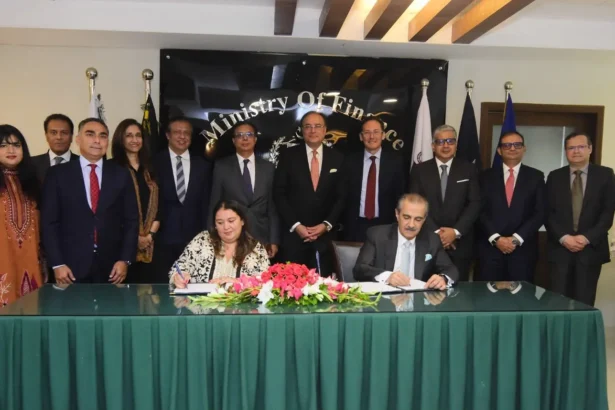
The agreement was signed on Thursday by Momina Aijazuddin, Regional Industry Director, Financial Institutions Group, Middle East & Central Asia at IFC, and Atif A. Bajwa, President and Chief Executive Officer of Bank Alfalah, according to a statement issued by the Finance Division.
The new financing structure is aimed at helping Pakistan mobilise longer-term foreign currency resources by using eligible future foreign-currency payment flows. Officials believe the mechanism could help broaden the country’s financing base and create an additional route for accessing international capital markets.
Under the initial transaction, financing of up to $100 million is envisaged through the DPR structure. The amount represents the first phase of a programme that could potentially be expanded if market conditions remain favourable and the initial transaction performs successfully.
The programme is being developed with the involvement of the Ministry of Finance, the State Bank of Pakistan, IFC and Bank Alfalah and is being pursued under the direction of the prime minister.
Focus on diversifying external financing
The initiative comes as Pakistan continues to explore alternative sources of foreign currency financing and seeks to reduce reliance on conventional borrowing channels.
Finance Minister Muhammad Aurangzeb welcomed the cooperation between the government, SBP, IFC and Bank Alfalah, saying the successful development of the transaction reflected extensive work on regulatory, policy and technical aspects.
He described the agreement as an important first step that could encourage the use of similar market-based financing arrangements in the future.
Aurangzeb also stressed the need for Pakistan to broaden its sources of foreign currency funding. According to the Finance Division, he said innovative financing structures could play a role in supporting investment and productive economic activity while helping meet the country’s foreign currency requirements.
The finance minister further called for effective utilisation of the new financing channel and emphasised the importance of developing a pipeline of projects that could qualify for foreign currency funding.
Potential for additional financing
The DPR programme could become more significant if the initial $100 million transaction performs well and market conditions support further expansion.
Officials indicated that the structure could eventually attract participation from international institutional investors as well as private-sector investors. This could provide Pakistani financial institutions with another potential mechanism for raising longer-term foreign currency funds.
Representatives of IFC welcomed the cooperation extended by the government and the State Bank of Pakistan during the development of the transaction. They also acknowledged the contribution of the institutions and stakeholders involved in bringing the programme to its current stage.
According to the Finance Division, IFC representatives expressed confidence that the DPR mechanism could create another channel for securing long-term international financing and contribute to the continued development of Pakistan’s capital markets.
Bank Alfalah becomes first Pakistani bank in DPR transaction
Bank Alfalah also welcomed the agreement and highlighted the importance of becoming the first Pakistani bank to undertake a DPR transaction.
The bank said it intended to use the financing structure to meet eligible foreign currency requirements and support productive investment.
The transaction is being viewed as a notable development for Pakistan’s debt capital market because it introduces a financing mechanism that could potentially be replicated by other Pakistani banks.
However, any expansion of the programme or participation by additional investors will depend on market conditions and the performance of the initial transaction.
The agreement therefore represents not only a potential source of up to $100 million in initial financing but also an effort to establish a new framework for raising foreign currency resources through future payment flows.