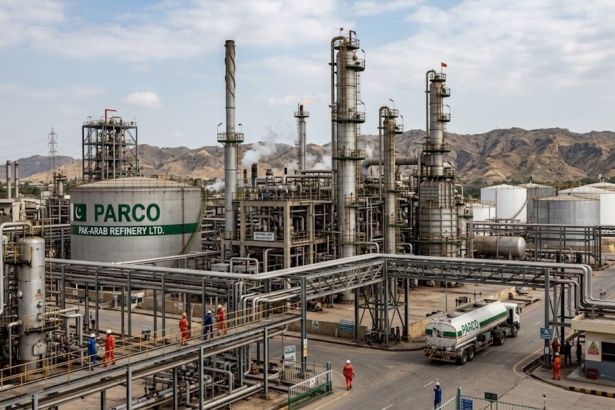

Pakistan’s oil refineries have agreed to move ahead with long-delayed agreements for upgrading their ageing plants, even as they continue to raise objections over a new financial penalty linked to the petroleum policy.
Under the revised arrangement, refineries will be required to surrender 2.5 percent of the deemed duty retained on diesel for the period of delay. Industry representatives have termed the condition unfair, arguing that the delays were largely beyond their control and should not result in a financial burden on the refineries.
Despite the disagreement over the penalty, refinery companies have indicated that they do not intend to hold up the signing of the agreements and are prepared to proceed with the modernization programme.
The government’s Brownfield Refinery Policy, originally approved in August 2023, was introduced to encourage investment in the modernization and expansion of Pakistan’s existing refining capacity. The policy has subsequently been amended twice in an effort to address implementation issues and facilitate investment in the sector.
Petroleum Minister Ali Pervaiz Malik has indicated that the long-pending agreements will be finalized shortly, while officials in the Petroleum Division are expecting the documents to be signed by the end of August.
Agreements to Be Signed With ISGS
A key change under the revised mechanism is that the upgrade agreements will now be executed with Interstate Gas Systems (ISGS), which operates under the Petroleum Division.
Previously, the agreements were expected to be concluded through the Oil and Gas Regulatory Authority (Ogra).
The change in the implementing entity is part of the government’s efforts to move the refinery-upgrade programme forward after delays in finalizing the contractual framework.
Industry representatives, however, have maintained that refinery companies had already taken substantial steps to comply with the earlier arrangements and should not be penalized for delays that occurred afterward.
Refineries Object to 2.5% Penalty
Adil Khattak, Chief Executive Officer of Attock Refinery Limited and Chairperson of the Energy Committee of the Overseas Investors Chamber of Commerce and Industry, said Attock Refinery and National Refinery had completed several important formalities ahead of the previous deadline of October 22, 2024.
According to Khattak, the companies had initialed agreements with Ogra, secured approval from their respective boards and arranged Rs1 billion bank guarantees each as part of the requirements.
He said the companies were nevertheless being asked under the revised arrangement to surrender 2.5 percent of the deemed duty retained on diesel for the period between the previous deadline and the signing of the new agreements.
The financial implications could be substantial. Khattak said Attock Refinery alone could face a penalty of around Rs7.5 million for every day of delay, increasing the industry’s concerns over the cost of the prolonged implementation process.
Refineries argue that imposing the financial charge is inappropriate because they had already completed the required formalities within the earlier timeframe and were not responsible for subsequent delays in finalizing the agreements.
Draft Agreements Circulated
The Petroleum Division has now circulated draft upgrade agreements among the refineries, marking another step towards implementation of the long-delayed modernization programme.
Officials are expected to hold further consultations with the Ministry of Finance, Controller of Accounts and ISGS before the agreements are finalized.
Although refinery companies have reservations about the penalty clause, industry representatives have indicated that the disagreement will not prevent them from signing the agreements.
The refineries are instead seeking a resolution of the financial issue separately while allowing the broader modernization programme to proceed.
Upgrade Seen as Critical for Energy Security
The modernization of Pakistan’s refining sector has gained greater importance as the country remains heavily dependent on imported petroleum products to meet domestic demand.
Khattak estimated that delays in upgrading local refineries are costing Pakistan approximately $1.5 billion annually through additional fuel imports and the resulting foreign exchange outflows.
Industry officials argue that upgrading domestic plants would allow refineries to produce a greater proportion of higher-value petroleum products while reducing dependence on imports.
The issue has also acquired greater significance amid repeated disruptions and uncertainty in international energy markets. Greater domestic refining capacity and improved processing technology could provide Pakistan with an additional buffer against external supply shocks and volatile global fuel prices.
Attock Refinery Moves Toward Financing
Attock Refinery has already made considerable progress on the technical side of its proposed modernization project.
The company has largely completed its front-end engineering and design work and has begun discussions with banks to arrange financing for the planned investment.
The next stage will depend on the finalization of the government agreement and the completion of financing arrangements.
For Pakistan, the successful implementation of the brownfield refinery upgrade programme could help improve domestic fuel production, reduce import dependence and ease pressure on foreign exchange reserves.
However, industry stakeholders say timely decisions on the remaining contractual and financial issues will be essential if the government wants to avoid further delays in a programme that was originally launched several years ago.