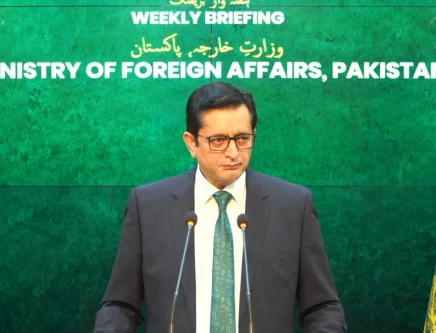

Pakistan has a “substantial” number of forces deployed in Saudi Arabia acting in a defensive capacity, a Foreign Office spokesman said on Friday.
“From Pakistan already we have substantial number of forces as well as resources in town, in Riyadh,” FO spokesman Sajjad Haider Khan told journalists in Islamabad.
He said Pakistani military personnel in the Kingdom “would not be crossing the borders of the other side for an attack on the Houthis, but of course (is acting) in the defence of the territory.”
The Foreign Office spokesperson rejected reports that its fighter jets are operating in Yemen, reaffirmed the defensive nature of its military cooperation with Saudi Arabia and raised concerns over militant groups operating from Afghan territory.
The Foreign Office spokesperson said reports about Pakistani fighter jets in Yemen were baseless and had already been denied by Pakistan. The information minister had also rejected the reports.
The spokesperson said Pakistan and Saudi Arabia reached a defence cooperation agreement last year. At a recent meeting involving three countries, the participants agreed to provide suitable personnel and resources according to their needs.
The spokesperson said the trilateral alliance was defensive in nature and aimed to protect all three countries from external aggression. Allied forces would not cross borders to attack Houthi forces in Yemen, the spokesperson added.
The purpose of any military deployment would be to defend the territories of the countries concerned and protect their sovereignty. The relevant organisation would decide the scale, timing and location of deployments, while member countries would provide personnel and resources according to requirements.
The spokesperson said Pakistani armed forces had been present in Saudi Arabia since 1982 under various arrangements. They had also provided logistical support and served in training missions in the kingdom.
Pakistan rejects Afghan allegations over Islamic State
The Foreign Office spokesperson also rejected allegations by Afghanistan’s foreign minister that Pakistan had supported Islamic State Khorasan Province (ISKP).
The spokesperson said Pakistan had clearly presented its position on terrorism at the Moscow Format meeting, raising concerns about militant activity originating from Afghan territory.
According to the spokesperson, Pakistan’s concerns had been reflected in previous joint statements issued under the Moscow Format. The spokesperson said the Afghan Taliban delegation had refused to retain the agreed wording from the previous year, preventing the participants from issuing a joint statement.
The spokesperson said Pakistan wanted friendly relations with Afghanistan but called for an end to the facilitation and recruitment of militants travelling from Afghanistan into Pakistan.
The spokesperson also said Pakistan’s military operations had targeted militant hideouts at specific locations. The stated targets included groups accused of planning further attacks in Pakistan.
The Foreign Office alleged that the Tehreek-e-Taliban Pakistan (TTP), the Balochistan Liberation Army (BLA) and other militant organisations maintained safe havens in Kabul and other parts of Afghanistan. It said the operations had targeted locations used by militants planning attacks inside Pakistan.
The spokesperson said terrorism posed a serious threat to Pakistan and other countries in the region. Pakistan had clearly raised its security concerns at the Moscow Format meeting, particularly over militant activity originating from Afghan soil.
The spokesperson said the Afghan Taliban delegation had declined to retain the language agreed upon in the previous year’s joint statement. Islamabad believed that a statement failing to reflect its legitimate security concerns would not accurately represent conditions on the ground.
For Pakistan, the spokesperson said, terrorism was not merely a matter of wording in a diplomatic document but a fundamental national security issue.
However, the spokesperson added that the failure to issue a joint statement should not reduce the importance of continued dialogue.
Pakistan objects to India’s renaming of places in Kashmir
The Foreign Office spokesperson also strongly objected to India’s attempts to change the names of places in Indian-administered Jammu and Kashmir.
The spokesperson described the unilateral renaming of locations in the disputed territory as illegal and said India’s inclusion of disputed areas on its maps amounted to geographical aggression.
The spokesperson said unilateral map-making violated United Nations Security Council resolutions and could not give legal status to India’s control over the territory.
No unilateral action by India, the spokesperson added, could change the internationally disputed status of Jammu and Kashmir or affect the Kashmiri people’s right to self-determination.
Pakistan maintains that the right of self-determination must be exercised by the Kashmiri people under United Nations supervision.