

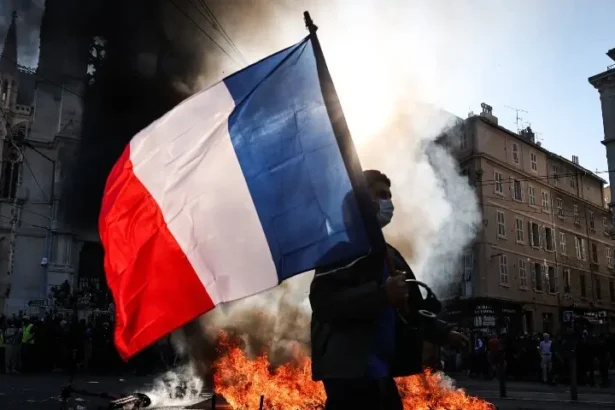

France deploys 70,000 police as fresh protests raise fears of violenceFrance is deploying around 70,000 police and security personnel nationwide as authorities prepare for another weekend of protests following violent clashes that erupted during demonstrations last week.
Interior Minister Laurent Nunez announced the security deployment at a news conference in Paris on Saturday. He warned that social media posts were encouraging violence and looting, raising fears of further unrest across the country.
The protests began with high school students demanding improvements in learning conditions. They have since spread nationwide, drawing support from people angered by the rising cost of living.
The unrest comes at a politically sensitive time for France, with presidential elections approaching in six months. Recent polling has strengthened the position of far-right leader Marine Le Pen, whose National Rally party is preparing to hold its congress in Orleans over the weekend.
Thousands of party supporters are expected to attend the gathering, while counter-protesters are also planning demonstrations. Local authorities have expressed concern that rival groups could clash.
President Emmanuel Macron met representatives of secondary school students on Friday in an attempt to address their concerns. However, the students urged their peers to continue protesting until the government presents concrete proposals to meet their demands.
The government has sought to distinguish peaceful demonstrations from the looting, arson and vandalism that accompanied protests last Saturday. Justice Minister Gerald Darmanin said courts had already sentenced 217 people to prison over the violence, around half of whom were first-time offenders.
Macron has called for severe punishment for those involved in criminal acts. He also accused far-left groups of attempting to undermine the republic during last weekend’s unrest.
Security restrictions have been tightened in several cities. In Orleans, authorities expect between 20,000 and 30,000 people to demonstrate against the National Rally congress, but protesters will be prohibited from gathering in the city centre.
Parts of central Lyon will also be closed to demonstrators. In Paris, police withdrew permission for a union-organised march between Bastille and Nation squares and proposed an alternative route on the southeastern outskirts of the capital. Unions have vowed to proceed along the original route, citing safety concerns over the proposed alternative.
Authorities in Marseille also reversed an earlier protest ban on Friday, granting exceptional permission for a union-led demonstration. Meanwhile, major museums, including the Louvre, are set to close on Saturday, and the Art Basel fair has been shortened.
The restrictions have drawn criticism from human rights organisations. Amnesty International warned that the measures risk undermining the right to peaceful assembly. Human Rights Watch researcher Eva Cosse said police must balance public safety with the responsibility to allow peaceful protests, while expressing concern about reports of children suffering serious injuries from crowd-control weapons.
The government has increased the number of security personnel by around 20 per cent compared with the previous weekend, following questions about police preparedness and intelligence gathering before the violence.
The unrest has also intensified political uncertainty ahead of the presidential election. A Harris Interactive poll for M6 and RTL reportedly placed Le Pen at 33 to 35 per cent in the first round. The survey projected that she could face hard-left leader Jean-Luc Mélenchon in a run-off and win by a substantial margin.