
US and Israeli military strikes on Iran have reignited debate over North Korea’s nuclear ambitions and the possibility of renewed negotiations with President Donald Trump. Analysts say Kim Jong Un may view the attacks as proof that nuclear weapons remain his strongest safeguard against foreign intervention.
The strikes killed Iran’s Supreme Leader Ayatollah Ali Khamenei just weeks after Venezuelan President Nicolas Maduro was captured in a US raid. Experts believe Kim sees a clear lesson: nations without nuclear deterrence face greater risks. Song Seong-jong, a professor at Daejeon University and former South Korean defense official, explained that Kim likely concluded Iran suffered because it lacked nuclear arms.
North Korea’s foreign ministry condemned the operation, calling the United States “hegemonic and rogue.” Days earlier, Kim pledged to expand his nuclear arsenal at a party congress, while leaving open the possibility of talks if Washington changes its stance. He stated that if the US respects North Korea’s current status, relations could improve.
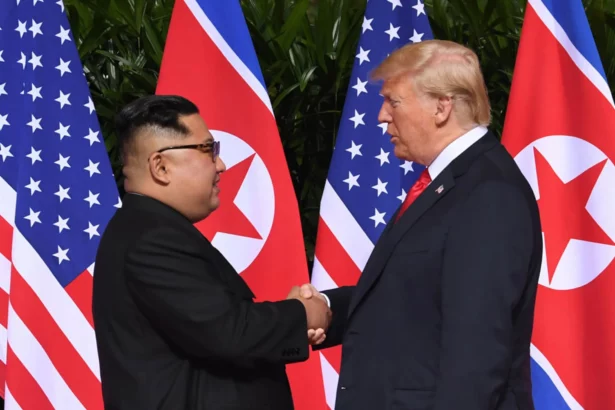
Trump has repeatedly expressed interest in fresh negotiations, fueling speculation about a potential meeting during his upcoming trip to China. Leif-Eric Easley, professor at Ewha Womans University, noted that North Korea’s nuclear program is far more advanced than Iran’s, with intercontinental ballistic missiles already in place.
North Korea enshrined the right to preemptive nuclear strikes in 2022, making its nuclear status “irreversible.” Sydney Seiler of the Center for Strategic and International Studies argued that Trump’s use of military force as leverage may make Kim cautious. Yet some analysts believe heightened threat perception could push him back to the table.
Cho Han-bum of the Korea Institute for National Unification stressed that denuclearization is impossible due to the dispersal of nuclear sites. The Stockholm International Peace Research Institute estimated North Korea holds about 50 warheads and enough material for up to 40 more.
Yang Moo-jin of the University of North Korean Studies suggested Kim may seek talks to gauge Washington’s position while advancing nuclear capabilities. Nam Sung-wook of Sookmyung Women’s University added that Kim’s ties with China and Russia provide him confidence, though he may still want to reassure Trump of restraint.
Ko Young-hwan, a former North Korean diplomat, said the Iran incident likely convinced Kim to manage relations with the US more carefully. The coming months may reveal whether Kim chooses confrontation or negotiation.