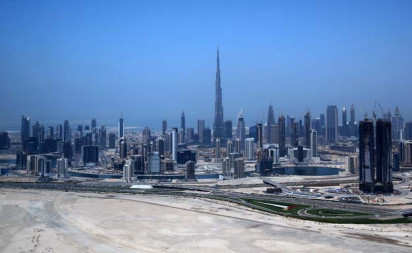

UAE stock markets tumbled on Monday as fresh threats from Iran and escalations by U.S. President Donald Trump stoked investor fears over Gulf energy security. The downturn comes amid a week of heightened geopolitical tensions, with Trump warning he could “obliterate” Iran’s power plants if Tehran does not fully reopen the Strait of Hormuz within 48 hours.
The Strait of Hormuz, a crucial artery for global oil shipments, has been at the center of the ongoing conflict between Iran and the United States, now in its fourth week. While Iran appeared to retract earlier threats to desalination plants—vital for providing drinking water across Gulf nations—it reaffirmed its ability to retaliate against energy infrastructure, prompting jitters across regional markets.
“The lying … US President has claimed that the Revolutionary Guards intend to attack the water desalination plants and cause hardship to the people of the countries in the region,” Tehran’s military command said in a statement carried by state media. The message underscored the delicate balance in the region, where even minor escalations can ripple across global energy and financial markets.
Investors reacted immediately. Dubai’s main share index (.DMFGI) dropped 2.7% in early trade, dragged down by a 4.6% fall in blue-chip developer Emaar Properties (EMAR.DU) and a 2.9% decline in Emirates NBD Bank (ENBD.DU). Abu Dhabi’s benchmark index (.FTFADGI) slipped 1.6%, with real estate giant Aldar Properties (ALDAR.AD) down 5% and Abu Dhabi Commercial Bank falling 4.9%.
Energy stocks were also hit. Abu Dhabi National Energy Company (TAQA.AD) declined 3.6%, while Dubai Electricity and Water Authority (DEWAA.DU) fell 0.8%. ADNOC Gas (ADNOCGAS.AD) dropped 2.7% after temporarily adjusting liquefied natural gas production and export-traded liquids due to shipping disruptions in the Strait of Hormuz. The company confirmed that operations remain safe and core facilities were unaffected by debris from nearby incidents.
The market slump highlights the vulnerability of Gulf economies to geopolitical shocks. Dubai’s year-to-date index losses climbed to 10.7%, while Abu Dhabi’s fell 5.9%, according to LSEG data. Analysts warned that even short-term disruptions in the Strait of Hormuz could have lasting effects on regional trade, energy prices, and investor sentiment.
With energy infrastructure under threat and military rhetoric intensifying, traders and companies alike are bracing for continued volatility. For now, the message is clear: any misstep in the Gulf could ripple far beyond the region, affecting global energy supply and markets that remain on edge amid the escalating conflict.