
In the early 1990s, stock markets were seen as part of the economy; today, they are often treated as its measure. Despite reforms, the Pakistan Stock Exchange (PSX) stands at a critical juncture – not for failing to rise, but for failing to endure.
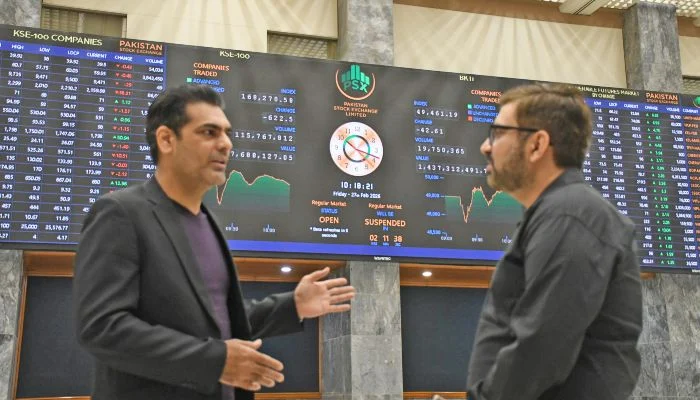
While KSE-100 rallies over the past decade have impressed investors, the market remains driven more by speculation than sustained capital formation.
The index’s jump from around 40,000 in 2022 to over 188,000 suggests a strong recovery, but masks deeper weaknesses. In 2017, PSX market capitalisation was $100 billion; today it is about $60-65 billion, despite currency depreciation and more listings. In real terms, it remains well below its peak and is under 1.5% of India’s roughly $5 trillion equity market.
If we analyse the trend between January and March 2026, open interest in Single Stock Futures dropped by approximately 60%, diminishing from around Rs70 billion to Rs28 billion. This is simple evidence and a reflection of the broader structural imbalance of how leveraged thrust can disappear at a staggering pace. Of course, it was not merely technical; rather, it exposed the instability of a market not driven by deep institutional commitment but by short-term positioning.
This divergence further explained the fragility, where one observes strong nominal returns alongside weak foreign participation. According to the State Bank of Pakistan data, in 2017, the foreign ownership of free float was nearly 27%, whereas in 2026 it is roughly 3-4%. This is very serious, as it is not just a cyclical retreat but a structural withdrawal – due to currency volatility, repatriation risks, and market depth. And it has forced several multinational companies (MNCs) and funds that once considered Pakistan a capital allocation base to scale down or exit equity exposure altogether.
Many commentators have lauded the retail participation in PSX as it has reached 200,000 active investors. It has expanded significantly, certainly a notable milestone in financial inclusion, but participation alone does not reflect the true picture. The majority of these retail investors are concentrated and engaged in short-term trading rather than long-term capital allocation. The proliferation of accounts has definitely increased turnover, but not necessarily investment. As the comparative analysis shows, the true strength of any capital market lies not in how aggressively it trades but in how successfully it raises new capital.
The PSX also has sectoral concentration, which in turn compounds the problem. There is an imbalance in market capitalisation across the PSX’s banking and energy sectors, leaving many important sectors underrepresented, such as manufacturing, technology, and export-oriented sectors. This narrow base is one of the principal reasons that limit diversification and diminish the market’s capability to reflect the economy at large. PSX (P/E) price-to-earnings multiples remain flattened, signalling persistent risk discounting by foreign investors even after periodic rallies.
We can further understand this phenomenon through the ‘V’ and ‘U’ shape curves, as the character of recent rallies emphasises this concern. Pakistan’s equity cycles have gradually acquired a sharp ‘V’ shape – quick inclines fuelled by leverage and sentiment, followed by equally swift corrections triggered by margin calls and forced deleveraging. This is because markets largely respond to perception rather than performance. By contrast, asset classes such as real estate usually follow a more gradual ‘U’ trajectory, where valuations are reinforced by cash flows, collateral and time. There is a critical distinction here: one is driven by momentum, while the other is driven by structure. Generally, across the globe, markets dominated by ‘V’ dynamics cannot sustain the institutional capital of MNCs.
According to these benchmarks, the PSX’s performance will be considered modest. Although in recent years we have witnessed sporadic IPO activity at PSX, the annual proceeds are still measured in billions of rupees rather than billions of dollars and, above all, with less foreign participation. Initial Public Offerings (IPOs) are considered vital for transforming an economy’s industrial capacity, as emerging markets such as India and Indonesia regularly utilise equity markets as primary instruments of capital formation, raising tens of billions annually to finance growth.
Although oversight by the Securities and Exchange Commission of Pakistan (SECP) has improved transparency and market infrastructure, gaps remain in monitoring leveraged positions, enforcing disclosure standards and deterring insider-driven trading and speculation. Regulatory progress has been meaningful, but incomplete. Generally, the Pakistan stock market is overly regulated, and the problem lies in the enforcement and meaningful implementation of these regulations.
The SECP can certainly learn from global regulatory benchmarks, as institutions such as the US Securities and Exchange Commission, the UK Financial Conduct Authority, and the European Central Bank coordinate and facilitate market stability through stringent disclosure regimes, capital requirements and systemic risk controls. These practices certainly do not eliminate volatility, but they instil confidence in the market, which is a key factor in any financial market amongst its stakeholders.
In periods of regional instability, the PSX has demonstrated piercing intraday corrections, highlighting its sensitivity to global risk sentiment. Moreover, external shocks, such as oil price volatility, inflation, currency depreciation and geopolitical tensions, further intensify instability and rapidly spread into equity stress. This is in contrast with deeper and mature markets, where institutional buffers absorb shocks, whereas Pakistan’s stock market remains more exposed to speculation and sentiment-driven swings.
The government’s macroeconomic stabilisation agenda, predominantly through engagement with the IMF, has played a supportive role in restoring short-term confidence, easing external pressures and stabilising currency expectations. But we need to realise that stabilisation is not transformation, and without parallel structural reforms, we cannot make the Pakistani capital market attractive.
Regulatory tightening must move beyond incremental adjustments as the future pathway is clear and interlinked with decisive, meaningful regulatory execution.
Large derivative exposures should be transparently reported and capped relative to free float. Together with a prudent regulatory regime, we also need sensible tax policies for capital markets that reward long-term equity holding and discourage short-term turnover. Corporate governance is the most important factor in empowering capital markets. It must evolve from compliance to credibility, with stronger boards, independent oversight, and enforceable minority protections.
More importantly, if we need to strengthen our capital markets, we need to institutionalise our domestic capital markets. Pension funds, insurance pools, and mutual funds must play a larger and constructive role in equity allocation, as this practice will provide stability and long-term orientation. Exchange-traded funds (ETFs) and diversified vehicles can channel retail savings away from speculative trading toward structured investments, thereby creating a reliable and predictable retail distribution network.
The market volatility and severity of deleveraging cycles can further be reduced and addressed through market stabilisation mechanisms, such as liquidity backstops or coordinated institutional. These measures can certainly shift market behaviour from knee-jerk volatility toward restrained resilience. In Pakistan, although the index has delivered strong percentage gains in certain periods, the nexus between equity markets and real economic growth remains weak, largely due to dollar-denominated market capitalisation, as the PSX remains below past peaks and far behind regional peers.
Developed and mature equity markets are defined by their capacity to allocate capital efficiently, attract stable foreign direct investment, and survive external shocks without systemic disorder. A stable equity market is measured by how sustainable the value they create, not by how high their indices rise. Pakistan’s equity market has demonstrated on many occasions that it can create momentum.
The challenge we are facing is structural and governance-related. Until we initiate that change, the PSX will remain a market capable of impressive rallies, yet constrained by recurring fragility. Perhaps a dysfunctional capital market where capital circulates but rarely compounds. Therefore, the future of Pakistan’s PSX will not be determined by how high its index rises, but by how well it withstands the external shocks and challenges.