
KARACHI: Human rights and minority rights activists on Tuesday stressed the urgent need for effective legislation to curb forced conversions and protect vulnerable communities, particularly minors, during a high-level consultation on the issue.
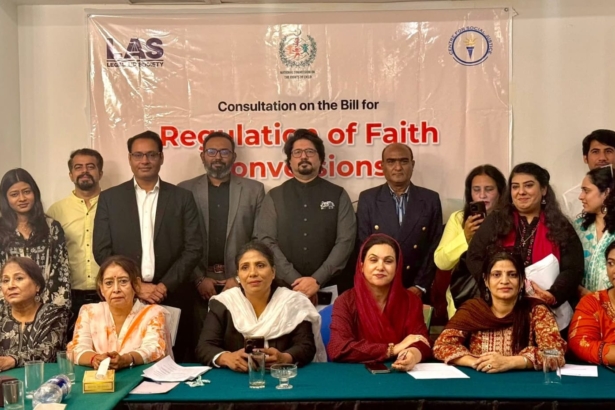
The consultation, focusing on forced conversions and child marriages, was organised by the National Commission on the Rights of the Child (NCRC) in collaboration with the Centre for Social Justice (CSJ) and the Legal Aid Society (LAS). The event centred on the proposed “Regulation of Faith Conversion Act 2025,” a draft bill aimed at introducing legal safeguards against coercion in religious conversions.
Members of Sindh Assembly Dr. Fouzia Hameed and Mahesh Kumar Hasija also attended the meeting. In his video message, Peter Jacob, Executive Director of CSJ, highlighted the importance of regulatory measures in addressing wrongful conversions. He said the proposed framework would play a crucial role in preventing abuse and ensuring that conversions take place lawfully and voluntarily. He described the draft legislation as a significant step toward safeguarding the rights of religious minorities in Pakistan.
Speaking at the consultation, Maliha Zia Lari, Director of Gender, Inclusion and Diversity at LAS, termed the draft bill a “comprehensive and far-reaching” initiative. She noted that the document would be disseminated across all provinces and presented before the respective provincial assemblies for deliberation and adoption.
According to her, the proposed legislation incorporates constitutional guarantees as well as international obligations, particularly United Nations conventions relating to minority protection and child rights. She emphasised that harmonising domestic laws with global human rights standards is essential for building a more inclusive legal framework. Earlier, Pirbhu Satyani, Member of the NCRC He pointed out that Pakistan currently lacks a standardised legal procedure to determine whether a religious conversion is voluntary or coerced.
“Many conversions take place informally before clerics or through handwritten affidavits,” he said, adding that such practices often bypass proper verification of consent, age, and surrounding circumstances. This, he noted, creates space for exploitation and misuse, particularly in cases involving minors. Satyani explained that the proposed bill seeks to introduce a clear and regulated mechanism to ensure that all conversions are voluntary and free from coercion.
Highlighting the child protection dimension, Satyani stressed that the proposed framework is particularly critical for safeguarding minors from forced conversions and early marriages.
“The best interests of the child must remain central to any legal framework,” he said, warning that minors are often exposed to risks such as abduction, coercion, trafficking, and exploitation under the guise of religious conversion. He further stated that the proposed legislation aims to strike a balance between protecting freedom of religion and ensuring that any change of faith is based on informed and voluntary consent.
This approach, he noted, is consistent with Pakistan’s constitutional guarantees as well as its commitments under international human rights law. Participants at the consultation broadly agreed that without a codified legal mechanism, cases of forced conversion will continue to be handled inconsistently, often leaving victims without adequate protection or recourse.
They called on lawmakers to prioritise the proposed bill and initiate a broad-based consultative process involving stakeholders from all provinces, civil society, and minority communities.
The consultation concluded with a consensus that timely legislation, coupled with effective enforcement, is essential to address the longstanding issue of forced conversions in Pakistan and to uphold the rights and dignity of all citizens, particularly women and children belonging to minority groups.