
KARACHI: The Sindh government is all set to devise multiple plans to bring the maximum number of Out of the School Children (OOSC) back to schools through Non-Formal Education (NFE) centers following a very disturbing report issued by the officials of UNESCO on the steep rise in drop-outs of students in the entire country.

To cope with alarming emerging situations, the high-ups of Sindh Education and Literacy Department under the dynamic leadership of Sindh Education Minister Syed Sardar Ali Shah have taken a number of the significant steps to stem the rot in the entire province with the active intervention and concerted efforts of his Education and Literacy Department together with Directorate of Literacy and Non-Formal Education and some other organizations.

The findings from recent United Nations Educational, Scientific and Cultural Organization (UNESCO) and supplementary educational reports on Pakistan are widely considered disturbing by experts, as they highlight a deepening educational crisis characterized by massive exclusion and regional inequality. As of 2026, Pakistan is grappling with one of the highest numbers of out-of-school children (OOSC) globally, with figures reaching approximately 26.21 million children—nearly 39% of the school-aged population. This concerning report issued by the authorities of an international organization on the very alarming state of drop-outs of the students from schools in the entire country is supposed to be an eye opener for the concerned authorities with a clear wake up call for them to come up with comprehensive policies and plans to tackle the alarming situations. The report states that Pakistan is facing a serious challenge to ensure all children, particularly the most disadvantaged, attend, stay and learn in school. “While enrollment and retention rates are improving, progress has been slow to improve education indicators in Pakistan. ” An estimated 26.21 million children aged 5-16 are out of school” the report revealed and warning that currently, Pakistan has the world’s second-highest number of out-of-school children (OOSC) with an estimated 26.21 million children aged 5-16 not attending school, representing 35 per cent of the total population in this age group. At the provincial level, Punjab accounts for the largest absolute number of out-of-school children, with 9.7 million children aged 5–16 (representing 27 per cent of the provincial age cohort) not attending school. This is followed by Sindh, where 7.4 million children, equivalent to 44 per cent of the 5–16 population are out of school. In Khyber Pakhtunkhwa, an estimated 4.5 million children (34 per cent) are out of school, while Balochistan faces the most severe exclusion in proportional terms, with 3.5 million children, nearly 69 per cent of the provincial school-age population are out of schools’ the report added with deep concerns. It was revealed in the report that In the Islamabad Capital Territory, approximately 0.09 million children (15 percent) were out of school. The report added that the gender disparities further exacerbated those patterns, particularly in Sindh and Khyber Pakhtunkhwa, where the number of out-of-school girls exceeded that of boys, underscoring enduring structural and socio-cultural barriers to girls’ education.

“These challenges are compounded by chronically low and declining public investment in education. ‘Pakistan has historically allocated around 1.5 percent of GDP to education, already well below the UNESCO and SDG-4 benchmark of 4–6 percent and the situation worsened further, with the Pakistan Economic Survey 2024–25 reporting education spending at approximately 0.8 percent of GDP, a record low that fell far short of national policy goals and international commitments. The report further stated that nearly 90 percent of education expenditure was absorbed by recurrent costs, mainly teacher salaries, leaving limited fiscal space for infrastructure, teacher development, learning materials, and system strengthening. “This imbalance restricts progress on access, learning outcomes, and equity, particularly for marginalised groups and adolescent girls. Without increased and more strategic education financing, Pakistan will continue to struggle to address the out-of-school children crisis and broader learning challenges” the report added.

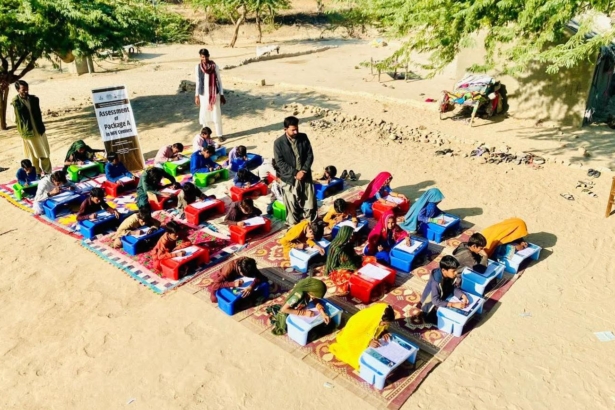
According to available details the ultimate target is 3,000 NFE centers under a Directorate of Literacy and Non-Formal Education designed to provide accelerated learning and vocational training to children aged 9 to 16, facilitating their return to formal education. The project is being rolled out in phases. Following an initial phase of 500 centers, the Sindh government, in partnership with as many as 30 NGOs and private sectors, has officially launched the second phase, aiming to establish 1,420 new NFE centers in districts including Jamshoro, Jacobabad, Kashmore-Kandhkot , Mirpurkhas, Tharparkar, and Umerkot. This initiative particularly focuses on areas with low literacy rates and high numbers of out-of-school children, aiming to enroll a significant number of girls . These centers offer an Accelerated Learning Program (ALP), allowing children to complete primary education within 24–30 months, alongside vocational training. The centers are being digitally monitored, with 500 devices recently distributed to support this. This initiative is said to be the part of the Sindh government’s broader strategy to reduce the number of out-of-school children in the province, which is estimated to be over 4 million.
The Sindh government is also implementing a five-year, multi-sectoral roadmap (2026-2030) aiming to enroll 50% of out-of-school children, supported by a Rs 4 billion budget allocation (2025–26) to address 6 5-7.8 million out-of-school children. The key initiatives include establishing digital, micro-schools, and 500 new enrollment centers through partnerships, targeting rural girls and providing financial incentives to them.
Syed Sardar Ali Shah and Sindh Minister for Works and Services, Jam Khan Shoro along with representatives of UNESCO addressing the joint press few days back, announced this five -year-plan to bring revolutionary changes in the education sector as per the required national and international standards. It was also agreed that the roadmap would be implemented through coordinated efforts across departments, with the Planning & Development Department playing a central coordination role. A dedicated delivery unit and a digital dashboard would be established to ensure monitoring and data-driven decision-making.
Additionally, partnerships with international donors, development partners, and the private sector would be strengthened to mobilize resources. Financial incentives such as scholarships, cash transfers, and attendance-linked benefits for low-income families would also be introduced. Special focus will be given to improving infrastructure, facilities, and safe transportation for girls. The roadmap also includes non-formal education, second-chance programs, vocational training, and targeted interventions for flood-affected and climate-vulnerable areas. The meeting reaffirmed the Government of Sindh’s commitment to ensuring that every child is enrolled, retained, and provided with quality education. The initiative is expected to increase literacy, reduce poverty, develop a skilled workforce, and contribute to overall economic and social stability in the province. It was further decided that the finalized proposals and progress on the roadmap would be submitted to the Chief Minister Sindh, Syed Murad Ali Shah for final approval.
According to available information, Sindh government has heavily prioritized Non-Formal Education (NFE) as a key strategy to address the high number of out-of-school children (OOSC), though specific total expenditure figures for Non-Formal Education with a sole purpose to impart the non-formal education among adults who either dropped out from their respective schools or never attended the schools. The official reports say that for the 2025–26 fiscal year, Rs 4 billion was allocated specifically for programs targeting out-of-school children.
Under Public-Private Partnership (SEF), the Sindh Education Foundation (SEF), which often manages non-formal and alternative education, was allocated Rs.13.5 billion in the 2025-26 budget, a significant increase to support Foundation-Assisted Schools. The Education Foundation has so far set up 145 such centers where 12,320 students are getting non-formal education and such initiatives are also supported and financed by UNESCO and Japan International Cooperation Agency (JICA).
As many as 30 NGOs in Thar Education Alliance, Muslim Hands and others are playing their active role to help the Sindh government achieve its goals. The Education Minister Syed Sardar Ali Shah believes that non-formal education is the only effective way to help the 1.6 million children born in Sindh annually who could not all be accommodated in conventional schools.
The high-ups of NFE are trying to tackle its multiple issues together with different organizations, and have been devising various initiatives to address the core issues of its three districts of Mirpurkhas region, with special focus on ameliorating the education standard. In three districts of the region including Mirpurkhas, Umerkot and Tharparkar. As many as 120 centers have been established where several hundred students, who were either among the drop-outs or never enrolled to acquire education, have been given an opportunity to get education. In these 120 centres as many as 3,662 children including 1,960 girls, aged 9 to 16, have been admitted and are being given quality education by trained teachers for 30 months so that they could complete their different academic grades. The local people told this reporter that their children were getting education after they had previously missed the opportunity to get education due to a number of factors.
Thar Education Alliance, which has emerged as one of the leading organizations to work for the noble cause of education in various districts of Sindh, was given the responsibility to run these centers to impart non-formal education (NFE) among adults.
Success Stories:
“For the first time, I can imagine a future where my child can read, write, and stand on his own feet,” says Lachhman, a daily wage laborer and father of a child with special needs, his voice filled with quiet hope. The opening of a Non-Formal Education (NFE) Center in village Chaudhary Ghulam Shabir in Mirpurkhas district of Sindh, by the Government of Sindh, has transformed what once felt like an impossible dream into a living reality for Lachhman and many families like his. Implemented by Thar Education Alliance (TEA) with the support of the Directorate of Literacy and Non-Formal Education (DL &NFE), Government of Sindh, the center is more than just a classroom. It is a safe and inclusive learning space where children from diverse communities, including persons with disabilities, are welcomed, encouraged, and supported to learn at their own pace. For Lachhman, the center means dignity, inclusion, and hope. “My child was always left behind. Today, he goes to class with confidence, and that changes everything for us,” he pointed out while sharing his views with this reporter.
Nawaz is yet another learner at a Non-Formal Education Center being run by Thar Education Alliance (TEA) with the support of the Directorate of Literacy and Non-Formal Education (DL NFE), Government of Sindh. Recalling his journey towards educating himself , Nawaz shared, “My father used to tell me, ‘Don’t go to school. Stay at the hotel and help me.’ But I always replied, ‘Baba, I’ll help you too, but please let me study’.” His father, burdened by the weight of feeding a family of ten amid rising inflation, hesitated. “He often said that one income isn’t enough to support us all, and my help could make a small difference,” Nawaz continued. “But I kept insisting I only wanted three hours a day to learn. I told him that education would help me make a bigger difference in the future.” Eventually, his father agreed. That small window of time changed Nawaz’s life. With gratitude shining in his eyes, Nawaz said, “I am deeply thankful to the Government of Sindh for creating this opportunity for children like me, those who dream of learning despite life’s struggles.” His teacher and facilitator, Abdul Mateen Halepoto, proudly spoke About Nawaz’s dedication towards the cause to adorn himself with the ornaments of education “Nawaz is one of the most committed learners at our center. “He attends regularly, never late, and always eager to learn. Through non-formal education, we are not just teaching, we are transforming lives by bringing out-of-school children like Nawaz back into the world of learning and ultimately towards becoming a powerful man with the pen in his hands, ” he added.