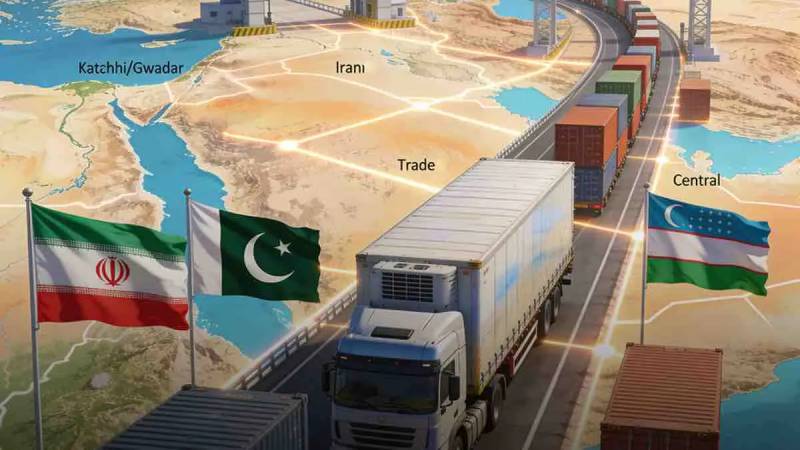

The recent operationalization of a new trade corridor linking Pakistan’s Gwadar Port with Iran and onward to Central Asia marks a significant geopolitical and economic development in the region. The dispatch of the first export consignment from Pakistan to Uzbekistan via Iran has transformed what was once a strategic concept into a functioning trade route. This development is not merely a logistical adjustment but a broader shift in regional connectivity that has the potential to reshape trade flows across Eurasia.
At its core, the corridor connects the Arabian Sea to landlocked Central Asia through Iranian territory, offering an alternative to traditional and often disrupted trade routes that rely on Afghanistan or longer maritime pathways. By doing so, Pakistan has effectively opened a new commercial gateway that shortens distance, reduces dependency on unstable routes, and enhances regional accessibility. This structural change carries implications far beyond simple trade facilitation.
The primary beneficiaries of this corridor are Pakistan, Iran, and the Central Asian republics, particularly Uzbekistan, Turkmenistan, and Tajikistan. For Pakistan, the corridor provides direct access to resource-rich and underserved Central Asian markets. These countries have long sought efficient access to warm-water ports, and Gwadar offers a viable solution. In addition, the route diversifies Pakistan’s trade options at a time when geopolitical tensions and border uncertainties have repeatedly disrupted traditional transit pathways.
For Central Asian states, the benefits are equally significant. The corridor offers a shorter and potentially more cost-effective route to global markets, reducing both transit time and logistical expenses. This enhanced connectivity strengthens their export competitiveness and integrates them more closely with global supply chains. For landlocked economies, such access is not just beneficial but strategically essential for long-term economic growth.
Iran also stands to gain substantially from this development. Serving as a transit bridge between South and Central Asia, Iran can generate revenue through transit fees, logistics services, and expanded bilateral trade. At a time when international sanctions have limited its external economic engagement, regional connectivity projects such as this provide Tehran with an opportunity to strengthen its economic resilience and maintain strategic relevance in Eurasian trade networks.
From an economic perspective, the corridor has the potential to significantly expand trade volumes among participating countries. By reducing transportation costs and improving transit efficiency, it can enhance the competitiveness of exports and encourage new investment in logistics, warehousing, and infrastructure development. If effectively implemented, it could generate billions of dollars in annual trade and stimulate broader economic activity across the region.
For Pakistan, the most visible impact is expected in Balochistan, particularly Gwadar. Increased port activity, infrastructure expansion, and logistics development can create employment opportunities and stimulate local economic growth. Historically underdeveloped, the region could benefit from improved connectivity, foreign investment, and integration into regional trade networks. This could gradually transform the socioeconomic landscape of the province if development remains consistent and inclusive.
The question of whether this corridor will become a game changer for Pakistan depends largely on implementation. Geographic advantage alone is not sufficient. Sustained success requires security, political stability, and efficient infrastructure. Any disruption in border management, customs procedures, or regional stability could undermine the corridor’s effectiveness.
Equally important is long-term policy continuity, ensuring that economic priorities are not altered by short-term political shifts.
Iran’s gains from this corridor are also strategically important. Beyond immediate transit revenues, Iran strengthens its position as a key regional connector linking South Asia, Central Asia, and the Middle East. This enhances its geopolitical leverage and provides an alternative economic channel in the face of ongoing international pressure. In the long term, such connectivity may help Iran integrate more deeply into regional economic systems, even under constrained global conditions.
The corridor does not exist in a geopolitical vacuum. Competing regional interests are likely to shape its trajectory. India, which has invested heavily in Iran’s Chabahar Port to gain access to Central Asia while bypassing Pakistan, may view this development as a strategic challenge. The existence of parallel corridors could intensify economic competition in the region, even if not leading to direct confrontation.
The United States, given its sanctions regime on Iran, may indirectly influence the corridor’s expansion, particularly if international financing or large-scale investment becomes involved. While Washington may not oppose regional connectivity in principle, its broader Iran policy could limit the corridor’s integration into global financial systems. Israel, closely aligned with U.S. regional strategies and cautious about Iran’s economic strengthening, may also view such developments through a geopolitical lens, although its influence would remain indirect.
Despite these external dynamics, the most significant challenges are internal. Infrastructure gaps, bureaucratic inefficiencies, and security concerns remain key obstacles. In addition, Central Asian states are likely to maintain multi-vector foreign policies, meaning they will continue using multiple trade routes rather than relying exclusively on one corridor. This will naturally limit the corridor’s dominance but not necessarily its usefulness.
The Gwadar–Iran–Central Asia corridor represents a major opportunity for regional economic integration. It has the potential to transform Pakistan into a significant transit hub, strengthen Iran’s regional economic role, and provide Central Asian countries with improved access to global markets. However, its success is not guaranteed. It depends on sustained political will, regional stability, and efficient execution. If these conditions are met, the corridor could indeed become a game changer for Pakistan and a meaningful driver of regional connectivity. If not, it risks becoming another underutilized initiative in a region where geography offers immense potential but politics often slows its realization.