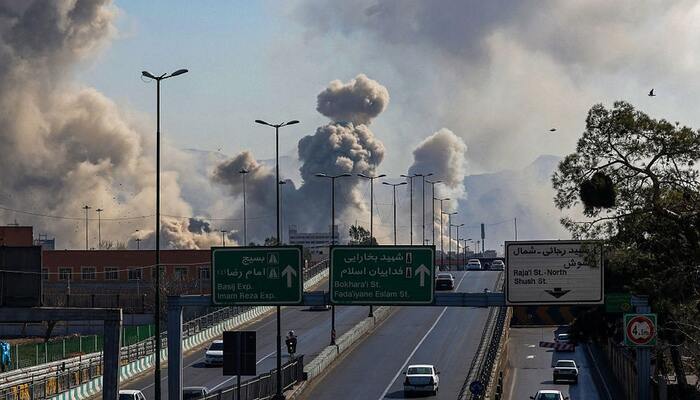

The emerging picture of the 2026 Iran war now sharpened by detailed reporting, is less about battlefield dynamics and more about the anatomy of a strategic miscalculation.
What stands out is not merely that the US entered another Middle Eastern conflict, but how quickly the underlying assumptions unravelled and how decisively non-military variables, such as energy markets, domestic politics and alliance pressures, came to dictate the trajectory of the war.
At the centre of this episode is US President Donald Trump, a leader who had long signalled aversion to prolonged entanglements in the Middle East, dismissing the region in stark terms as “blood and sand”.
Yet, as the reporting suggests, that instinct was overridden in a compressed decision-making cycle shaped heavily by external persuasion, most notably from Israeli PM Benjamin Netanyahu and reinforced by voices within Washington such as Lindsey Graham. The resulting policy shift was not grounded in a recalibrated doctrine, but rather in a belief arguably superficial that Iran could be coerced into rapid compliance.
That belief proved to be the war’s original flaw. Iran is not a peripheral actor susceptible to quick economic strangulation or political isolation. It is a structurally resilient state with layered deterrence capabilities, including a well-developed doctrine of asymmetric warfare.
Crucially, it understands the strategic leverage embedded in geography, specifically the Strait of Hormuz, through which roughly 20% of globally traded oil transits under normal conditions. Any assumption that such a chokepoint could remain functionally open during escalation was not merely optimistic; it was strategically negligent.
What followed was a rapid demonstration of how modern disruption works. Iran did not need to ‘close’ the strait in the classical sense. It only needed to inject enough uncertainty through drones, mines, and intermittent threats to render commercial shipping economically unviable. Within days, tanker traffic contracted dramatically, with industry estimates indicating that flows dropped by as much as 80% to 90% at the peak of the disruption. The effect was immediate: millions of barrels per day were effectively stranded, insurance premiums spiked and energy markets entered a phase of acute volatility.
This is the new grammar of conflict. Control is no longer binary; it is probabilistic. A state does not need to dominate a maritime corridor; it only needs to make its use unpredictable. In that sense, Trump’s reported remark that “a guy with a drone can shut it down” is less a casual observation and more an inadvertent acknowledgement of a transformed battlespace, where low-cost technologies can impose disproportionate systemic costs.
The economic consequences of that disruption quickly eclipsed the military narrative. Oil prices surged sharply in the early phases of the conflict, with benchmarks breaching the $110–$120 per barrel range before moderating amid partial de-escalation.
Liquefied natural gas (LNG) shipments from Qatar faced similar constraints, compounding supply concerns in already tight global markets. The shock was transmitted directly into inflationary pressures, particularly in energy-importing economies across Asia and Europe. For fragile economies, Pakistan included, the implications were immediate: higher import bills, currency stress, and renewed fiscal strain at a time when macroeconomic stabilisation remains incomplete.
What is striking, however, is how rapidly the political calculus in Washington appears to have shifted in response to these pressures. Trump moved from confidence in a swift victory to private concern about escalation within weeks. By late March, well before the conflict reached its most visible flashpoints, there were already instructions to explore diplomatic off-ramps. This suggests that the war’s decisive arena was never the battlefield; it was the intersection of markets and domestic opinion.
Polling data reportedly showed the conflict eroding support for Republican candidates ahead of the midterm elections. That is a familiar inflexion point in American strategic behaviour: when external engagements begin to carry measurable domestic political costs, the tolerance for risk contracts sharply. The war, initially framed as a demonstration of resolve, was reinterpreted as a liability requiring containment.
Compounding the problem was a breakdown in strategic communication. Effective wartime leadership depends not only on decisions but also on internal and external coherence. The White House is struggling on this front, with the president engaging in unscripted media interactions that often contradict official positions.
For allies, this created uncertainty about US intent; for adversaries, it opened space for recalibration; and for markets, it amplified volatility.
The confusion surrounding the operational status of the Strait of Hormuz became emblematic of this problem. Official statements suggesting normalisation often diverged from observable shipping behaviour, with vessels rerouting or pausing despite assurances of safety. In modern conflict environments, perception is operational reality.
If insurers, shipowners and traders believe a route is unsafe, it is effectively closed regardless of formal declarations.
Beneath these dynamics lies a deeper structural issue: the divergence of strategic objectives between allies. For Netanyahu, the imperative was likely centred on degrading Iran’s military and nuclear capabilities, a long-standing Israeli priority.
For the US, the calculus was more complex, encompassing regional stability, alliance credibility and global economic continuity. These objectives overlap but are not congruent. When alignment is imperfect, the initiating logic of a conflict can reflect one actor’s priorities, while the sustaining costs fall disproportionately on another.
This asymmetry becomes especially consequential in a globalised economic system. The Strait of Hormuz is a systemic node. Its disruption reverberates across continents, affecting supply chains from East Asia to Europe. During the conflict, there were indications that the limited flows that continued through the strait were increasingly tied to specific geopolitical alignments, particularly involving China, highlighting how conflict can reconfigure trade patterns in real time.
For Pakistan, the lessons are both immediate and strategic. As an energy-importing country with limited fiscal space, Pakistan is acutely exposed to external price shocks. The 2026 Iran war shows the urgency of diversifying energy sources, strengthening strategic reserves, and accelerating regional connectivity projects that reduce reliance on single chokepoints. At the same time, Islamabad’s emerging role as a potential diplomatic interlocutor, given its geographic and political positioning, illustrates how middle powers can leverage crises into opportunities for constructive engagement.
Yet, the broader takeaway extends beyond any single country. This conflict illustrates a fundamental shift in the nature of power. Military superiority, while still decisive in conventional terms, does not guarantee strategic control in a networked world. Economic interdependence, technological diffusion and domestic political constraints all act as force multipliers and, in some cases, force limiters.
The portrait that emerges of Trump in this episode is therefore less about individual temperament and more about systemic vulnerability. A decision influenced heavily by allies, premised on optimistic assumptions, confronted by complex realities, and ultimately constrained by domestic and economic pressures, this is not an anomaly. It is increasingly characteristic of decision-making in an era where the margin for strategic error is narrowing.
By the time the April 1 address to the nation was conceived, reportedly as an effort to project control, the underlying uncertainty was already apparent. A leader reluctant to declare victory because the end-state was unclear is, in itself, a signal. It reflects a recognition that the original objectives had become misaligned with achievable outcomes.
The 2026 Iran war may be remembered not for its duration or its destruction, but for its exposure of a critical gap between intent and execution. It demonstrated how quickly a conflict can outgrow its initial rationale, how decisively economic systems can shape strategic choices, and how difficult it is for political leadership to recalibrate once committed.
The cost of that gap is not measured solely in military terms. It is reflected in disrupted markets, strained alliances, and diminished credibility. And perhaps most importantly, it is reflected in the enduring lesson that in a world defined by interconnected risks, the decision to go to war is no longer just a question of power, it is a question of systems, signals and consequences that extend far beyond the battlefield.