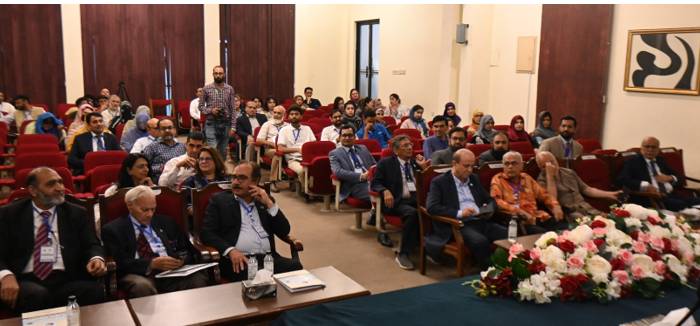

The Pakistan Academy of Sciences (PAS) Islamabad and The Aga Khan University (AKU) Karachi jointly organized a Hybrid Seminar on “Emerging Health Technologies” on Monday at the A.Q. Khan Auditorium of the Academy in Islamabad.
The main objective of the event was to promote health sciences education and research, and contribute to developing a regulatory framework for National Health Plan.
Over 85 scientists, academicians, medical practitioners, and scholars from various Universities (Quaid-i-Azam University, Aga Khan University, NUST, Ripha International University, City University, Islamabad Medical and Dental College, Virtual University, NUTECH); Healthcare Institutions (Helping Hand Institute of Rehabilitation Sciences, GAK HealthCare International); International Organizations (OIC-COMSTECH, ECOSF), Government Organizations (PSF); R&D Institutions/Organizations (NILOP, PINSTECH, PNRA), Hospitals-Health Institutions & clinical laboratories (Health Science Academy), and NGOS (NAYS) attended the event physically; while over 40 researchers attended the event online.
In his opening address, Dr Muhammad Wasay (Prof. AKU & Fellow, Pakistan Academy of Sciences) highlighted the distinctive challenges confronting Pakistani population in the domain of health and life sciences and the urgent need to address these challenges through integrated and innovative approaches to ensure sustainable resource management.
The expert speakers related to the theme of the seminar included Major General ® Prof Muhammad Aslam (VC City University-Islamabad Medical & Dental College); Prof Noor Muhammad Butt, Fellow PAS (Chairman PINSAT-Islamabad); Dr Muhammad Saleem (NILOP/PAEC); Dr Shahid Mahmood Baig (Dean Health Science Academy-Islamabad); Dr Sajid Hamed (AKU-Karachi), Prof Dr M Aslam Baig (Secretary General, PAS-Islamabad); and Prof Dr Sakandar Rauf (University of The Punjab).
Their technical presentations highlighted the role of nano-medicine in health care; evolution of nanotechnology in Pakistan; indigenous development and applications of clinical lasers in Pakistan; genomic technologies in precision medicines; focused ultrasound in neurological diseases; drugs evaluation using laser breakdown spectroscopy; and, printed wearable ECG electrodes and wireless readout. Shields were distributed among speakers as a token of appreciation.
The event was concluded with the address by the Co-Chair of the Seminar Prof Dr Anwar-ul- Hassan Gilani (Fellow PAS) who congratulated the organizers for holding this important seminar and emphasized the need for innovative research in Pakistan in the domain of health/clinical sciences, training and as well as national and international collaboration.
The gathering recognized the need and importance to organize another serial seminar on the safety aspects of clinical practices, diagnostics and tools.