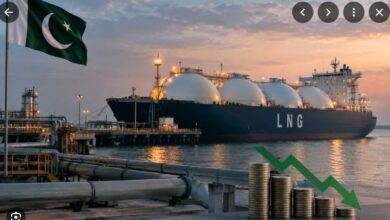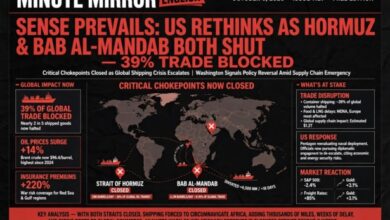

Global crude oil prices on Wednesday declined sharply after the United States reportedly lifted the blockade on Iranian ports, allowing the movement of oil tankers to resume and improving supply expectations in international markets.
The reopening of Iranian maritime routes led to renewed oil shipments, easing supply concerns and triggering a downward trend in global crude prices.
As a result, Brent crude oil fell by 0.34 percent to 79 dollars per barrel, while US West Texas Intermediate dropped by 0.29 percent to 76 dollars per barrel. The price of Emirati Murban crude remained unchanged at 72 dollars per barrel.
The development comes amid broader international market reactions to easing geopolitical tensions and improved shipping activity through key oil routes.
Earlier, international news agency Agence France-Presse reported that oil prices had fallen below 80 dollars per barrel, with Brent crude settling at 78.96 dollars after a 5.1 percent decline, while West Texas Intermediate dropped 5.8 percent to 76.05 dollars per barrel.
Oil prices dropped below $80 a barrel Tuesday on optimism over the promised reopening of the Strait of Hormuz, easing inflation pressures on global economies.
The slide accelerated to more than five percent after The Wall Street Journal reported that Washington could ease sanctions on Iranian crude as part of the deal to end the Middle East war, allowing Tehran to immediately sell crude and refined oil products.
AFP reported oil prices extended losses Wednesday and most equity markets rose, fuelled by the US-Iran deal, with attention now on peace talks and the reopening of the crucial Strait of Hormuz.
Crude has tumbled more than 10 percent this week on optimism for a lasting agreement between the two countries after more than three months of conflict that rattled energy markets and revived inflation.
The latest selling was boosted by a report in The Wall Street Journal that Washington could ease sanctions on Iranian crude as part of the deal to end the war, allowing Tehran to immediately sell crude and refined oil products.
Attention now turns to Friday’s official signing ceremony in Switzerland and the subsequent negotiations that will focus on the fate of Tehran’s nuclear programme and a plan for the lifting of international economic sanctions.
US President Donald Trump has said the Strait of Hormuz — through which a fifth of global crude usually passes — would “completely open” once the peace agreement is signed.
Both main contracts started Wednesday slightly higher after shedding more than five percent on Tuesday before turning negative, though analysts warned that with so many hurdles ahead prices were likely to be sensitive to developments.
“The risks are skewed to the upside,” said Fabien Yip, market analyst at IG.
“Any failure at the 19 June signing to produce a durable and transparent agreement — particularly on nuclear provisions — could rapidly reverse the recent decline, as each prior false start has demonstrated.
“A sustained recovery in strait traffic remains the most credible evidence that the deal is holding.”
Meanwhile, oil industry experts and shipping companies have cautioned that the restoration of normal operations after the strait’s near shutdown will take time.
Equity markets mostly advanced ahead of the Federal Reserve’s first policy announcement under new, Trump-appointed boss Kevin Warsh.
Tokyo and Seoul enjoyed their best finishes — both markets building on their breakneck tech rallies.
Shanghai, Sydney, Singapore, Mumbai and Taipei also rose, though Hong Kong, Wellington, Manila, Bangkok and Jakarta all fell.
London rose but Paris and Frankfurt edged down.
The broad gains came after a mixed day on Wall Street, where the Dow hit a fresh record high but the S&P 500 and Nasdaq retreated.
While expectations are for the Fed to stand pat on interest rates, investors will be keeping a close eye on its post-meeting statement for an idea about the policy committee’s thinking in light of surging inflation and a strong jobs market.
Data last week showed US consumer prices rose in May at their highest level for three years owing to the impact of surging oil costs caused by the war.
Some observers predict the Fed will eventually announce an increase before the end of the year, despite Trump’s previous demands for cuts.
“Warsh… inherits the most divided committee in more than three decades, with three voting members already dissenting against the easing bias in April, while outgoing governor Stephen Miran again voted in favour of a rate cut,” said Michael Krautzberger, chief investment officer for public markets at AllianzGI.
“The minutes suggested that the committee’s centre of gravity has shifted in a more hawkish direction as uncertainty about the duration and economic implications of the Middle East conflict continues to mount.”
He added that “resilient economic activity and indications that labour-market conditions are stabilising support a less accommodative policy outlook”.
“In a rapidly evolving economic and geopolitical environment, we expect the (bank) to remain on hold this year,” he said.
“But resilient growth, a stabilising labour market and increasing inflation pressures have shifted the balance of risks in a hawkish direction.”
– Key figures around 0715 GMT –
West Texas Intermediate: DOWN 1.1 percent at $75.23 a barrel
Brent North Sea Crude: DOWN 0.9 percent at $78.24 a barrel
Tokyo – Nikkei 225: UP 0.7 percent at 69,902.25 (close)
Hong Kong – Hang Seng Index: DOWN 0.9 percent at 24,285.82
Shanghai – Composite: UP 0.4 percent at 4,108.08 (close)
Seoul – Kospi: UP 1.6 percent at 8,864.24
London – FTSE 100: UP 0.1 percent at 10,501.49
Euro/dollar: UP at $1.1609 from $1.1608 on Tuesday
Pound/dollar: DOWN at $1.3415 from $1.3427
Dollar/yen: DOWN at 160.25 yen from 160.45 yen
Euro/pound: UP at 86.53 pence from 86.45 pence