
Pakistan could save more than $3.2 billion over the next 26 years by replacing imported coal with locally produced Thar coal at the Jamshoro power plant, according to a bankable feasibility study presented to Federal Minister for Energy Sardar Owais Ahmed Khan Leghari.
The study, prepared by the Dornier Group and EY Parthenon, concluded that converting the plant from imported coal to 100 percent indigenous Thar lignite is technically, economically and environmentally feasible.
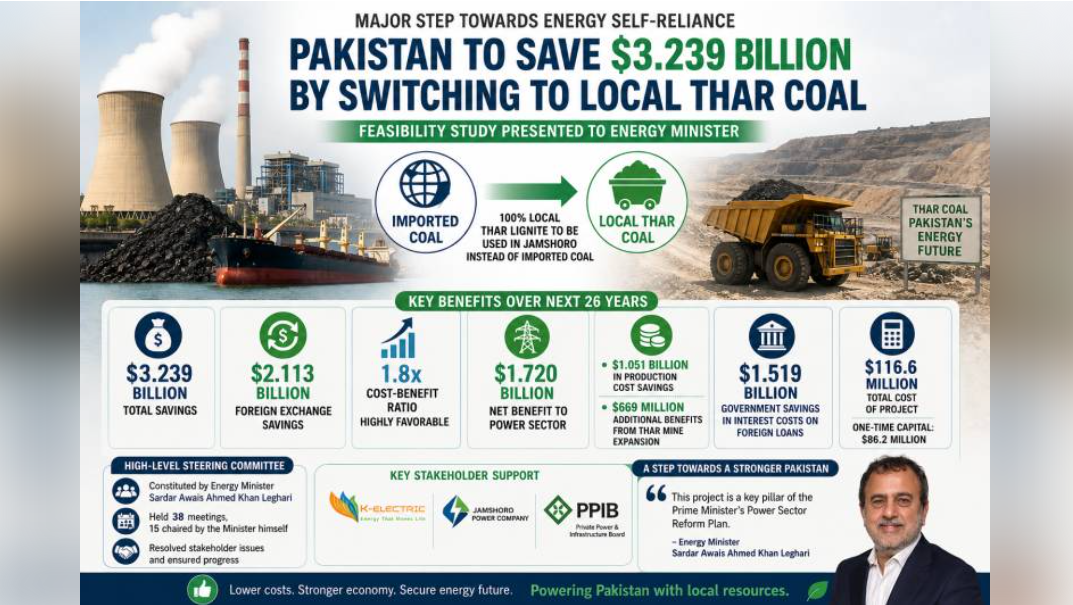
According to the feasibility report, the transition will generate total savings of $3.239 billion, including $2.113 billion in foreign exchange savings, helping strengthen Pakistan’s foreign exchange reserves and reduce dependence on imported fuel.
The study estimates a cost-benefit ratio of 1.8 times, describing the project as highly favourable. It projects a net benefit of $1.720 billion for the power sector, including $1.051 billion in production cost savings and an additional $669 million in benefits arising from the expansion of the Thar coal mine.
The report also estimates government savings of $1.519 billion in interest costs on foreign loans due to reduced import requirements.
Officials said the total cost of the conversion project is estimated at $116.6 million, including a one-time capital expenditure of $86.2 million.
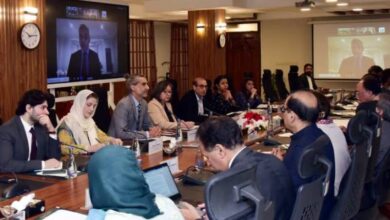
To oversee the initiative, Energy Minister Owais Leghari constituted a high-level steering committee that held 38 meetings during the course of the study. Fifteen of those meetings were chaired by the minister himself.
According to the ministry, the committee worked to address stakeholders’ concerns, remove bottlenecks and ensure timely progress on the project.
Key support for the initiative was provided by K-Electric, Jamshoro Power Company and Private Power and Infrastructure Board.
Leghari thanked all stakeholders for their contributions and said the project represents a key pillar of Prime Minister Shehbaz Sharif’s power sector reform plan aimed at lowering electricity generation costs, improving energy security and reducing pressure on the country’s external account.