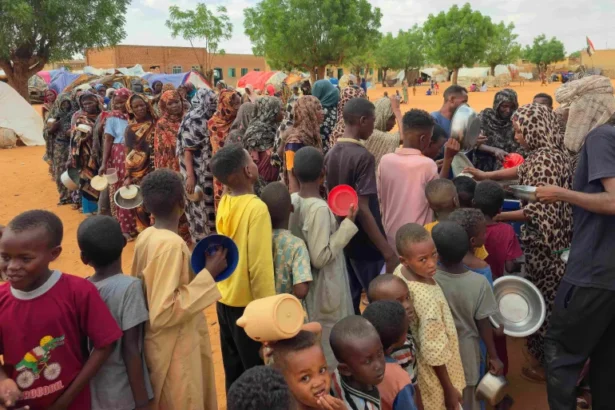

More than 11,000 people, including over 5,500 children, have fled intense fighting around the strategic city of el-Obeid over the past fortnight, triggering urgent warnings from international aid agencies. As Sudan’s three-year civil war enters a volatile new phase, the United Nations has sounded a global ‘red alert’, warning that up to 500,000 civilians could be trapped or placed at severe risk if the paramilitary Rapid Support Forces (RSF) launch a full-scale assault on the city.
El-Obeid, the capital of North Kordofan state, holds immense logistical and commercial value, positioned at a critical crossroads linking central Sudan to the Darfur region and the southern states. Whilst international attention has historically focused on Khartoum and Darfur, the conflict’s geography is shifting. Following recent territorial gains by the Sudanese Armed Forces (SAF) around the capital, the RSF has heavily consolidated military pressure around el-Obeid. For the SAF, holding this commercial hub is vital to maintaining its remaining presence in western Sudan, making the city a high-stakes prize for both warring factions.
The escalating siege has subjected local infrastructure to devastating drone warfare, causing severe disruptions to water facilities, electricity networks, and fuel depots. Consequently, food and commodity prices have spiked, and a lack of clean water has heightened the risk of waterborne diseases like cholera. The humanitarian crisis is compounded by the fact that many families currently fleeing the city are already secondary or tertiary victims of displacement, having initially sought refuge in el-Obeid after escaping violence elsewhere in the country.
UN officials and aid organisations, including Save the Children, fear that el-Obeid could replicate the tragic trajectory of el-Fasher, the capital of North Darfur. In el-Fasher, months of relentless urban warfare, shelling, and severe aid blockades completely devastated basic public services and left hundreds of thousands trapped without access to food or healthcare. Highlighting the gravity of the situation, UN Human Rights Chief Volker Turk stated that a profound human rights catastrophe is actively unfolding, urging global heads of state to intervene immediately before the current military build-up transitions into a catastrophic ground offensive.