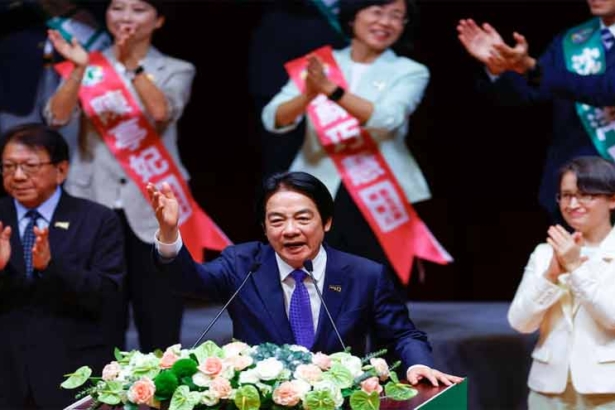

Taiwan President Lai Ching-te has called on the people of the island to stand together in defence of their democratic values and resist growing pressure from China. Speaking at the annual convention of the ruling Democratic Progressive Party, Lai said Taiwan must never allow its democratic system to be replaced by Beijing’s rule. He urged party members to remain united and confront what he described as increasing political and legal pressure from China.
Lai said Taiwan should stay alert even during peaceful times because the challenges facing the island are becoming more complex. He pointed to what he called China’s use of legal measures to expand its influence beyond its borders. One of his main concerns was a recently introduced Chinese law promoting ethnic unity, which Taiwan believes could be used by Beijing to target Taiwanese citizens it accuses of supporting independence. Taiwanese officials fear the legislation may provide China with another legal basis to investigate or prosecute people living outside its territory. Beijing has rejected such criticism and continues to insist that Taiwan falls under its jurisdiction despite having no legal authority on the island.
Addressing supporters in the Taiwanese language rather than Mandarin, Lai encouraged members of his party to take a leading role in protecting society from what he referred to as China’s “red terror.” He stressed that preserving Taiwan’s democratic system and individual freedoms should remain a national priority. According to Lai, the island’s future depends on maintaining unity in the face of political pressure from across the Taiwan Strait.
The Taiwanese president repeated his long held position that Taiwan is already an independent country under its official name, the Republic of China. He argued that the island is not governed by the People’s Republic of China and should not be considered subordinate to Beijing. Lai also said the future of Taiwan should only be determined by its 23 million residents, regardless of their ethnic background or family history. He stated that everyone who identifies with Taiwan has an equal stake in shaping the country’s future.
Relations between Taiwan and China have remained tense for decades. The split dates back to 1949 when the Republic of China government retreated to Taiwan after losing the Chinese civil war to Mao Zedong’s Communist forces, which established the People’s Republic of China on the mainland. Since then, neither side has officially recognised the other and no formal peace agreement has ever been signed.
Beijing continues to regard Taiwan as part of its territory and has repeatedly vowed to bring the island under its control if necessary. Chinese authorities have also refused Lai’s repeated offers for dialogue, describing him as a supporter of Taiwanese independence.
Reflecting on the past decade of Democratic Progressive Party rule, Lai said Taiwan had faced military pressure, diplomatic isolation campaigns and disinformation efforts from China without giving in. He argued that the island has demonstrated to the international community that democracy remains a source of strength rather than weakness. Lai concluded that protecting Taiwan’s democratic system and freedoms is essential for the country’s future as it continues to navigate growing tensions with Beijing.