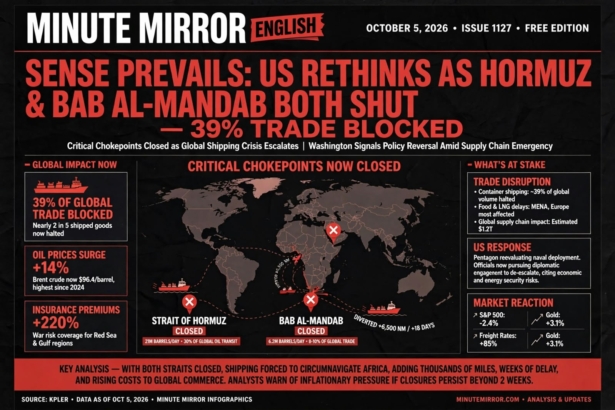

WASHINGTON/TEHRAN: The United States appears to be reassessing its approach to the prolonged conflict as disruptions in the Strait of Hormuz and the Bab al-Mandab Strait continue to threaten global trade, energy supplies and regional stability.
The simultaneous closure or severe disruption of the two key maritime chokepoints has created mounting economic and military pressure, with officials and analysts warning of wider consequences for international shipping and energy markets.
The Strait of Hormuz has remained at the centre of the latest escalation. Reports indicated several attacks on shipping since September 28, while the UK Maritime Trade Operations (UKMTO) continued to issue warnings to vessels operating in the area.
Iran’s Islamic Revolutionary Guard Corps Navy also warned commercial vessels against using routes it considers unsafe. Iranian Parliament Speaker Mohammad Bagher Ghalibaf said on Monday that the strait would remain closed until the United States met Tehran’s stated conditions.
The situation has also affected shipping through the Bab al-Mandab Strait. Houthi forces have maintained pressure around key maritime routes in the Red Sea, prompting shipping companies to reduce or reroute operations.
Recent attacks on Saudi Arabian targets have further heightened concerns. Missile strikes near Riyadh and attacks around Yanbu have added to pressure on Saudi energy infrastructure, particularly after the kingdom redirected part of its crude exports following disruption in the Gulf.
Oil prices have consequently remained elevated, with Brent crude trading above $100 a barrel and Murban crude also recording significant gains.
Meanwhile, the Pentagon confirmed that 12 B-1B Lancer bombers had departed RAF Fairford in Britain on October 4 following a security incident involving an alleged bomb plot. British authorities arrested several suspects over the reported plot, while British officials indicated possible Iranian links. Tehran rejected the allegation as fabricated.
The Pentagon said the aircraft remained available for deployment from the continental United States if required.
Diplomatic efforts have continued despite the military tensions. US special envoy Steve Witkoff and Jared Kushner held discussions with Iranian Foreign Minister Abbas Araghchi through Qatari mediation. The two sides reportedly remain divided over sanctions, Iran’s nuclear programme and the sequence for reopening the Strait of Hormuz.
Qatar has proposed a compromise aimed at keeping negotiations alive, but no final agreement has emerged. US President Donald Trump has also said Washington has not offered sanctions relief to Tehran.
US Senator Chris Murphy’s visit to Doha has added another political dimension to the diplomatic effort, as regional states continue to push for an arrangement that could halt further escalation.
At the same time, UN Secretary-General António Guterres is scheduled to travel to Pakistan for a four-day visit at the invitation of Deputy Prime Minister and Foreign Minister Ishaq Dar. He is expected to meet Prime Minister Shehbaz Sharif, Dar and President Asif Ali Zardari.
The visit is expected to include discussions on regional stability and Pakistan’s diplomatic role in efforts to reduce tensions between Washington and Tehran.
With maritime trade under growing pressure, rising energy prices and diplomatic channels still open, the United States and its regional partners face increasing pressure to find a negotiated path toward de-escalation.