


ISLAMABAD: Senate Chairman Yousaf Raza Gilani on Monday pledged parliamentary support through legislation, oversight and budgetary allocations to strengthen water security, urging policymakers to translate commitments into practical measures to protect farmers and communities from floods and water shortages.
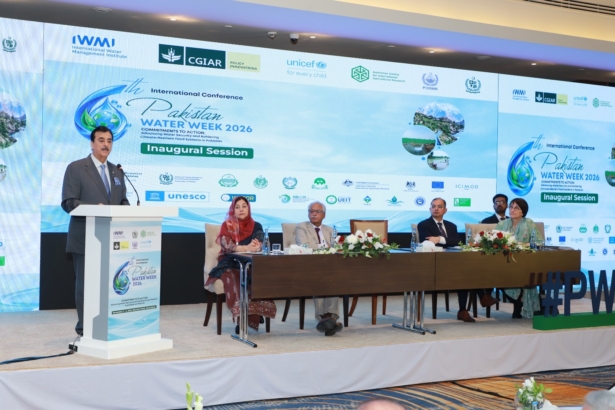
Addressing the inauguration of the sixth Pakistan Water Week 2026 in Islamabad, Gilani said water security was a national priority requiring coordinated efforts by Parliament, provincial governments and relevant institutions.
The five-day conference, being held from November 2 to 6, has brought together more than 200 participants to discuss strategies for strengthening water security and developing climate-resilient food systems.
Gilani identified enforceable legislation, effective parliamentary oversight and sustained financial resources as three key areas requiring immediate attention. He stressed the need for full implementation of provincial water laws and stronger mechanisms to regulate groundwater extraction.
He said Parliament must ensure that water policies deliver tangible benefits to farming communities, particularly those located at the tail end of irrigation networks. Similarly, flood early-warning systems must reach vulnerable villages in time to prevent loss of life and property.
Emphasising the importance of preventive measures, the Senate chairman said public spending should prioritise disaster-risk reduction alongside relief and rehabilitation efforts.
He acknowledged that solar-powered tube wells had provided relief to farmers but cautioned that their expansion must be accompanied by effective groundwater regulations to prevent excessive extraction. He also called for planned aquifer recharge and greater use of floodwater to replenish underground water reserves.
Gilani underscored the importance of reliable water data-sharing to strengthen trust among provinces, adding that women, young people and farming communities should be actively involved in water governance.
Recalling his tenure as prime minister during the devastating 2010 floods, he said Pakistan was confronting the dual challenge of increasingly destructive floods and declining water availability.
He noted that the 2022 floods affected around 33 million people and caused more than $30 billion in economic losses and damages, while nearly seven million people were affected by floods last year.
At the same time, per capita water availability had declined from more than 5,000 cubic metres to approximately 1,000 cubic metres, reflecting the growing pressure on the country’s water resources.
“Too much water and too little, sometimes in the same districts within the same year,” Gilani remarked, highlighting the country’s vulnerability to climate-related water extremes.
He questioned whether post-disaster reconstruction was adequately reducing future risks or merely rebuilding existing vulnerabilities, stressing that “response is not resilience”.
Reiterating Pakistan’s position on the Indus Waters Treaty, Gilani maintained that the agreement remained valid and binding, emphasising that water should never be used as an instrument of political pressure.
He called for collective efforts to achieve a water-secure and flood-resilient Pakistan by 2047, when the country will mark its centenary.
Speaking on the occasion, International Water Management Institute (IWMI) Pakistan Country Representative Dr Muhammad Ashraf said water security was intrinsically linked to food security, climate resilience and economic stability.
He emphasised that each conference session should result in clear commitments, designated responsibilities and specific timelines to ensure practical outcomes.
In his keynote address, IWMI Strategic Programme Director for Water, Food and Ecosystems Dr Mohsin Hafeez said Pakistan had accumulated substantial research, evidence and policy recommendations but needed a shared commitment to translate them into action.
He stressed that decisions made during the conference in Islamabad must result in tangible improvements in the lives of farmers.
The conference is being organised by IWMI and the CGIAR Policy Innovations Science Program in collaboration with the Pakistan Council of Research in Water Resources and the Ministry of Water Resources.
Its programme features two thematic tracks comprising 13 sessions each, alongside plenary discussions on development partners’ water and climate priorities and water governance in the Indus Basin. The closing ceremony is scheduled for November 5, while the conference will conclude on November 6.
Concluding his address, Gilani urged participants to assess the real impact of their commitments on ordinary citizens, particularly farmers in Thar, families living along the Ravi and children in Quetta struggling to access clean drinking water.