

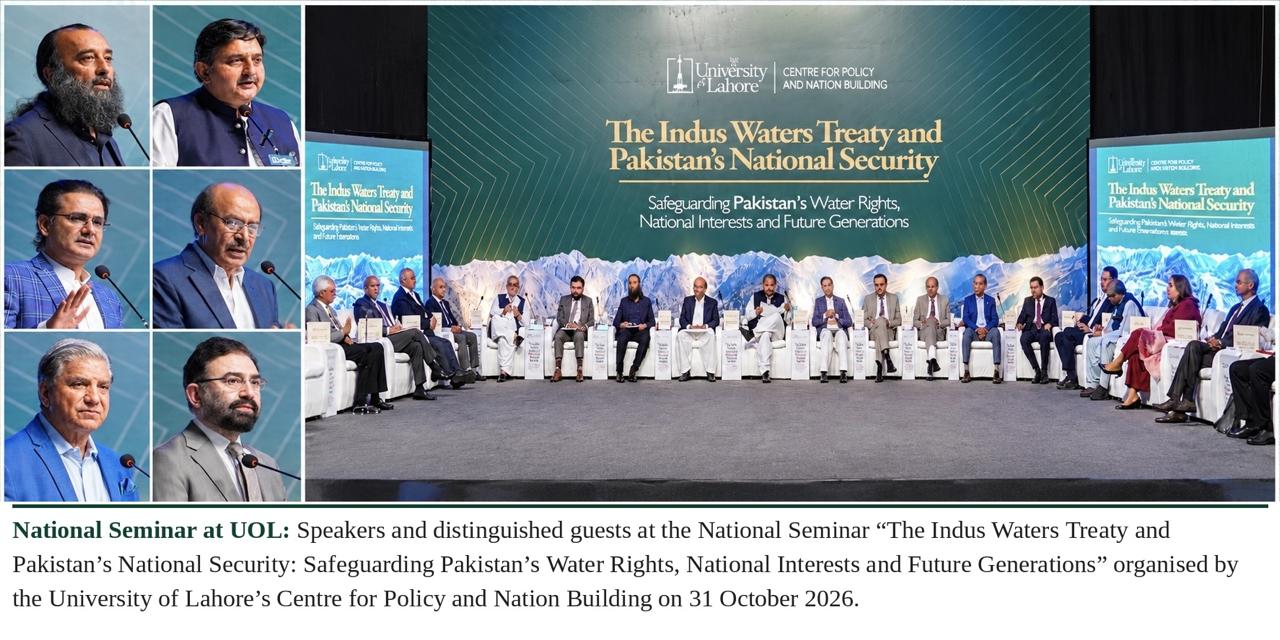

LAHORE: The University of Lahore convened a landmark national dialogue on “The Indus Waters Treaty and Pakistan’s National Security.” The event brought together the country’s most distinguished political, parliamentary, journalistic and academic voices who examined the treaty’s historical foundations, legal standing, diplomatic dimensions, the mounting pressures of climate change and Pakistan’s water requirements, an issue now inseparable from national survival. Thanking all the participants of the seminar, Chairman (BoG), The University of Lahore Awais Raoof stated that UOL has the honor to generate the very idea that discussions on national issues at Universities level been initiated and so far, UOL has the pride to host seventh back-to-back seminar on national issue since last one and a half month which was made possible by the University’s Centre of Policy and Nation Building (CPNB) under the presidentship of Mr. Munir A. Khan.
The national seminar participants include Speaker Punjab Assembly, Malik Muhammad Ahmad Khan; Senator and PPP Sindh President Nisar Ahmed Khoro; Attorney General for Pakistan Mansoor Usman Awan; former WAPDA Chairman Lt. Gen. (R) Muzammil Hussain; Indus Waters Commissioner Syed Mehar Ali Shah; Senator Mohsin Leghari; IRSA Member Punjab Amjad Saeed; senior journalist Suhail Warraich; Sindh Provincial Minister for Universities Muhammad Ismail Rahoo; former Federal Secretary for Water and Power Irfan Ali; WAPDA Adviser Shahid Hameed; Hasan Abbas; Sikandar Shah; and international expert Ross Masood.
Speaker Malik Muhammad Ahmad Khan commended The University of Lahore for providing a platform for dialogue on matters of vital national importance. He said such debates properly belong in Parliament and the provincial assemblies, but that universities are now stepping in to fill the vacuum left at the parliamentary level. He described India’s unilateral action against the Indus Waters Treaty as a fundamental change of circumstances. He acknowledged that both provinces harbour genuine fears over water. Sindh dreads obstruction and the denial of flows to the lower riparian regions. Punjab grapples with acute problems of availability. He urged legislators of both provinces to dispel misunderstandings through sustained dialogue and to forge a joint strategy on water. The Speaker said the water question demands serious reflection and consultation with all stakeholders. He affirmed the nation’s commitment to peace and the peaceful settlement of disputes, then added an unmistakable warning: there will be no compromise on Pakistan’s integrity, sovereignty and defence.
Senator Nisar Ahmed Khoro of the Pakistan Peoples Party praised the university’s efforts to promote dialogue on pressing national questions. He described Pakistan as the lower riparian country of the region and Sindh as the lower riparian province of Pakistan. He insisted that in any distribution of water resources, the interests and apprehensions of the downstream regions must never be brushed aside. He noted that the water problem has persisted for nearly a century. When Sindh once argued for using rainwater to hold back the advancing sea, the proposal was met with ridicule, though its purpose was to push the sea back. He said Sindh was never given even a fixed quantity of the water it was promised. In his view, however, nothing stands in the way of resolving the issue, and Pakistan’s leadership has adopted a firm and resolute position.
Attorney General Mansoor Usman Awan explained the Indus Waters Treaty and set out a forward-looking strategy for the present situation. He underlined the urgent need for effective, decisive measures.
Amjad Saeed, IRSA Member Punjab, briefed participants on Pakistan’s river system and the architecture of the Indus Basin. He explained how water is apportioned across the country and underscored the importance of equitable distribution of water resources.
The dialogue closed with a firm call for a coordinated national strategy to meet Pakistan’s water challenges. Its pillars are effective diplomacy, legal action, inter-provincial harmony, the construction of water reservoirs, environmental protection and better water management. The speakers stressed that Pakistan’s agricultural economy, food security and future economic and national interests depend on the prudent use and equitable distribution of its water resources.