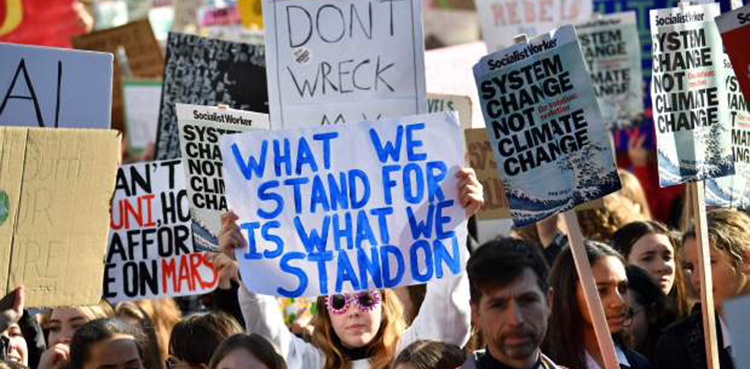

ROME: Blocking a road to protest inaction against climate change could soon be punishable with prison in Italy as Prime Minister Giorgia Meloni’s hard-right government cracks down on demonstrations, even peaceful ones.
A new security law passed by MPs and facing final scrutiny in the Senate has been dubbed the “anti-Gandhi” law — after pacifist Indian independence hero Mahatma Gandhi — by critics for taking aim at demonstrations by people ranging from prisoners to climate activists.
It is specifically aimed at protests against two major infrastructure projects — a high-speed, cross-border Turin-Lyon railway to France and a mooted bridge over the Strait of Messina to Sicily — both championed by Deputy Prime Minister Matteo Salvini.
Salvini, who also has responsibility for transport and infrastructure, is a defender of the combustion engine and crusades against “climate terrorism”, particularly the young members of the Last Generation, a climate group known for headline-grabbing protests.
Under the new law, blocking a road outside the authorised route of a demonstration could be punishable by up to two years in prison, up from the current penalty of a fine between 1,000 and 4,000 euros.
Critics see it as a deliberate attempt to silence dissent by Italy’s most right-wing government since the end of World War II.
But Salvini, head of the far-right League party, rejected accusations of a “police state”, insisting: “Good people have nothing to fear.”
‘Ideological madness’
Meloni’s post-fascist Brothers of Italy party took office in October 2022 after an election victory fuelled by anti-immigration, nationalist and populist rhetoric, forming a coalition with the League and the right-wing Forza Italia party.
The government has since passed numerous laws and measures designed to please their right-wing base, from legislation limiting the activities of charities that rescue migrants at sea to reinforcing an existing ban on surrogacy and clamping down on juvenile crime.
With the security law, “the government wants to charm the part of society that continues to vote mainly for far-right parties”, many of them older people “who are much less sensitive to issues of civil rights, the labour crisis and climate change”, said Anna Bonalume, a journalist who closely follows Salvini.