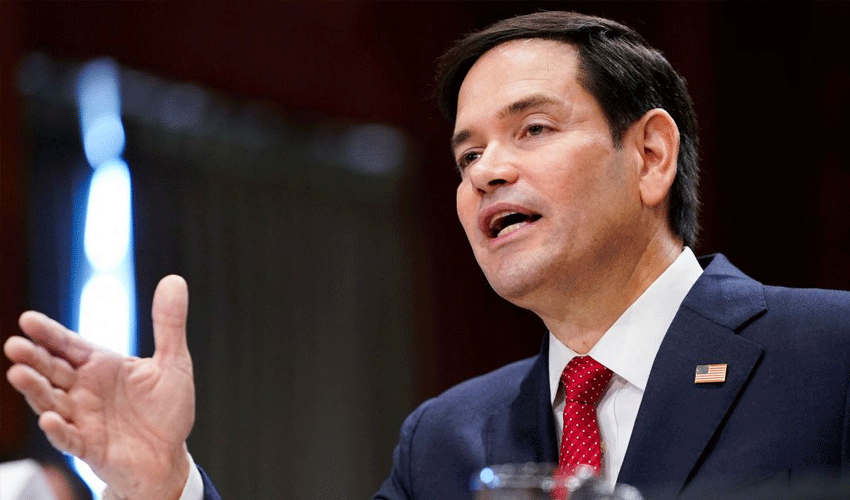

United States Secretary of State Marco Rubio has announced he will not attend the upcoming Group of 20 (G20) foreign ministers’ meeting in South Africa, citing a deepening dispute between the US and Pretoria over South Africa’s controversial land expropriation law.
Rubio’s decision, made public on Wednesday, follows threats from US President Donald Trump to cut aid to South Africa in response to the legislation allowing the government to seize land without compensation in certain cases.
The meeting, which is scheduled for February 20-21 in Johannesburg, marks South Africa’s turn as G20 president until November 2025.
Rubio, a key diplomat in the Trump administration, took to social media to express his discontent, criticizing the law and accusing South Africa of promoting anti-Americanism under the guise of international cooperation.
“South Africa is doing very bad things. Expropriating private property. Using G20 to promote ‘solidarity, equality, [and] sustainability.’ In other words: DEI and climate change,” Rubio wrote on X, formerly Twitter.
“My job is to advance America’s national interests, not waste taxpayer money or coddle anti-Americanism,” he added, confirming his absence from the G20 talks.
The law in question, passed last month by South African President Cyril Ramaphosa’s administration, permits the seizure of land without compensation if deemed “just and equitable” and in the public interest, such as in cases where property is unused.
The legislation aims to address the racial disparities in land ownership, a legacy of apartheid, where Black South Africans, who make up over 80% of the population, hold less than 5% of privately owned farmland. White South Africans, by contrast, own the majority of farmland despite representing just 7% of the population.
The Trump administration has strongly criticized the law, with President Trump accusing Ramaphosa’s government of “confiscating land” and mistreating specific demographic groups. However, Ramaphosa has defended the law, explaining that it is a necessary step to address the inequalities left by apartheid and is part of a legally mandated process under South Africa’s constitution.
Despite these defenses, the law has sparked division within the country. The main opposition party, the Democratic Alliance (DA), which largely represents South Africa’s white, Indian, and Coloured communities, has expressed concerns that the law undermines property rights and could deter foreign investment.
While the DA disputes Trump’s claims of arbitrary land seizure, it acknowledges the controversial nature of the law.
Critics of Rubio’s decision argue that his absence from the G20 meeting undermines US foreign policy and strengthens rival powers like China.
Andrew Bates, former White House senior deputy press secretary under President Joe Biden, decried the move as a “show of weakness” that would harm US national security and economy. Bates posted on social media, stating, “If you’re not at the table, you’re on the menu.”