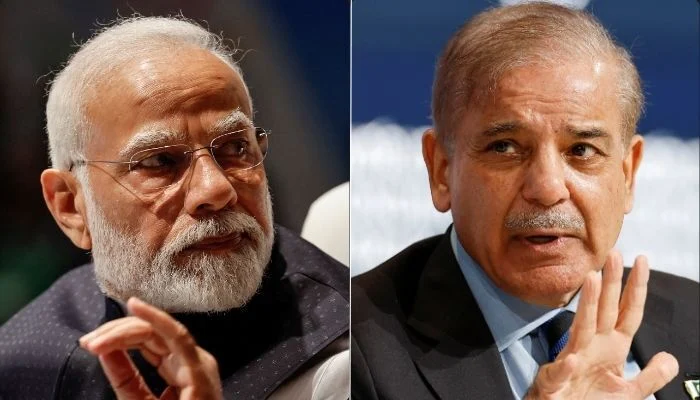

ISLAMABAD: The Foreign Office on Friday dismissed speculation about a possible meeting between Prime Minister Shehbaz Sharif and his Indian counterpart Narendra Modi on the sidelines of the upcoming SCO Summit in China.
At the weekly media briefing, Foreign Office spokesperson Shafqat Ali Khan reaffirmed Pakistan’s willingness to engage in composite dialogue with India, despite what he described as recent unprovoked missile attacks by New Delhi.
“India says they would talk on terrorism only; however, we want to talk on all matters, including terrorism, not just on terrorism. We will not hesitate from discussion on terrorism. We have complete and detailed evidence about India’s acts of terrorism against Pakistan, but this would just be one item during the composite dialogue,” said the spokesperson.
He was asked to comment on the remarks made by Deputy Prime Minister and Foreign Minister Ishaq Dar while interacting with the media earlier in the day, in which Dar said that Pakistan was ready for collective dialogue with India — a position that was also expressed at the time when the ceasefire was brokered between the two countries.
Asked if any friendly country was working behind the scene for rapprochement, the spokesperson said: “Regarding efforts of our friendly countries, we welcome all the efforts because the direction of our policy is very clear, and we are ready for composite dialogue. We welcome any effort which helps us achieve our objectives”.
In the background are efforts by China, which wants to see peace and stability in the region and this was evident by remarks made by Chinese Foreign Minister Wang Yi at the press stakeout at the Foreign Office on Thursday.
“My visit to India, Afghanistan and Pakistan, I have to say that South Asia’s development enjoys strong potential. Peaceful and prosperous South Asia serves in the interest of all 3 countries and the region”, he had remarked.
In New Delhi too, China supported the sacrifices that Pakistan had made in the ongoing terrorist attacks.
“Pakistan is a victim of terrorism”, Chinese Ambassador to India Xu Feihong remarked at the Delhi conference on SCO Summit 2025.
To a query about China warming up to India which saw the latter in the bad books of the Trump administration, he pointed out: “Pakistan-China relationship stands on its own. There is decades of history, trust, and all-encompassing cooperation between the two countries.
“The most important point is that the relationship lives in the hearts of the people of two countries. And we do not think our initiatives for regional cooperation involving China; our bilateral relationship with China, our growing economic relations, and our strategic cooperation with China can be affected by anything. Pakistan-China relationship is a very sustainable, long standing, and robust relationship”.
In this regard, he added, counterterrorism cooperation was an important element of Pakistan-China multifaceted cooperation and it was ongoing partnership and cooperation.
“There is nothing new in this. China has been our friend and a reliable partner as we have endured all the challenges centered on terrorism. It has been a close friend and a partner of Pakistan”.
As reports come in about the continued harassment of Pakistani diplomats posted in India, Pakistan reiterated that it firmly believed in dignified treatment of diplomats and honoring of the relevant international treaties. Pakistan and India also have a mutually agreed code of conduct on this subject.
“The provisions of all these documents should be fully respected and implemented”, he said at a time when Indian High Commission too has taken up issues about difficulties it faces in Islamabad.
As Pakistan this week once again faced terrorist attacks from the TTP based inside Afghanistan, Pakistan, publicly at least practices patience and repeats the standard policy saying: “Terrorist elements enjoying sanctuaries in Afghanistan has been a constant issue bedeviling the full potential of Pakistan Afghanistan relations. It continues to be an important topic of our conversation with the Afghans, and similarly, in the trilateral format (with China).
“We hope Afghan authorities would respond to our legitimate concerns, and the three countries would be able to attain the full potential of economic cooperation, connectivity, people to people exchanges, and trade,” he expressed.
He also expressed that Pakistan finds the Indian arms buildup, an alarming trend, saying: “We notice the arms accumulation or the procurement. It becomes more sinister when you look at their declaratory policy, and the domestic developments in India, which are so hostile towards Pakistan, and increasingly Islamophobic. It is dangerous not only for Pakistan’s security but also for regional stability.” ”
He further said: “We have been raising this issue with our partners. The international community turning a blind eye to India’s mad rush to develop the military capabilities is a very dangerous trend. This remains a source of peril for the regional security and stability.”