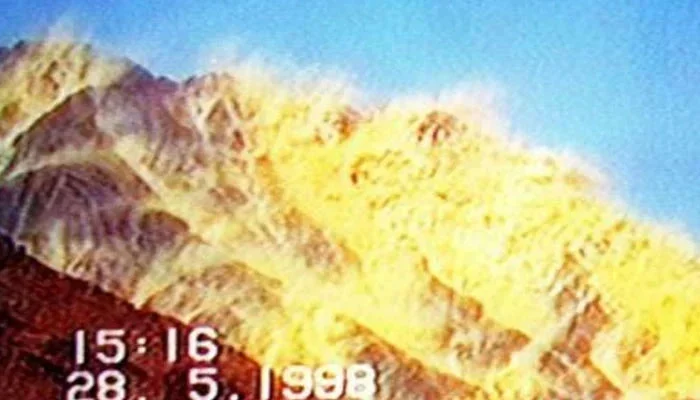

On the morning of 28 May 1998, five nuclear devices were detonated in the granite hills of Chagai, and a country that had lived for two decades under the threat of being denied a deterrent moved formally into the small club of states that stand by one.
The decision had been preceded by weeks of intense pressure, with urgent calls from Washington offering aid packages in exchange for restraint and warning of the sanctions that would follow if Islamabad went ahead. Pakistan tested anyway and absorbed the punitive measures that came.
Twenty-eight years later, the implications of that morning are still being calculated, and the most recent entry in the ledger is being written in Islamabad now, in proposals moving back and forth between Tehran and Washington through Pakistani channels.
It is tempting to treat Chagai as a moment of national assertion completed in itself, a one-day commemoration of capability acquired and adversaries deterred. The more difficult reading, and probably the more accurate one, is that May 28 did not end anything; it began a long and uncertain negotiation between what Pakistan had become technically and what it could become diplomatically.
Most of the intervening years have been spent paying down the cost of that decision; some, more recently, have been spent collecting the return.
The cost was considerable and stretched across decades. Sanctions imposed under the Glenn Amendment and the Pressler regime cut off military and economic assistance, and the country’s nuclear establishment lived under international suspicion that hardened, after the AQ Khan incident of 2004, into a sustained set of doubts about command-and-control that Western capitals were content to keep alive.
The doctrinal evolution towards full-spectrum deterrence, including tactical systems developed in response to India’s Cold Start posture, drew further criticism and complicated Pakistan’s standing in non-proliferation conversations it could not avoid.
Throughout this period, the dominant question abroad about Pakistan’s nuclear status was not whether it had achieved strategic autonomy, but whether it could be trusted with what it possessed.
The return on that investment has emerged slowly and unevenly, through indirect channels rather than formal recognition. A nuclear state cannot be casually coerced – and that single fact, more than any individual diplomatic skill or relationship, has shaped how Pakistan is now treated in capitals that once treated it as expendable.
The mediating role Islamabad is currently playing between Tehran and Washington is the clearest illustration in a generation of what deterrence quietly underwrites. It is not that Pakistan is a uniquely gifted diplomatic actor; many smaller states are at least as capable.
It is that very few states can credibly stand between two adversaries when one of them has just bombed the other, without being assumed to be acting under duress from the more powerful side.
The April ceasefire was brokered by Prime Minister Shehbaz Sharif and COAS-CDF Field Marshal Asim Munir; the Islamabad Talks brought an American delegation led by US Vice President JD Vance into direct contact with an Iranian team led by parliamentary speaker Mohammad Bagher Qalibaf; the most recent Iranian proposal was conveyed through Pakistani intermediaries last week. None of this would have happened in a Pakistan that had accepted the package on offer in May 1998.
None of this is to suggest that the nuclear option was the only path to strategic autonomy, or that the costs of pursuing it (the sanctions, the AQ Khan affair, the years of international suspicion, the opportunity costs of decades without concessional finance) were trivial.
They were not. But to argue that those costs cancel the dividend now visible in Islamabad’s diplomatic standing is to misread how states accumulate and eventually exercise credibility. The cost was paid early and concretely, while the return has come late and diffusely, in the form of room to manoeuvre Pakistan would otherwise not have.
What follows from this is less a list of next steps than a single recognition: the dividend is not a sum to be drawn down but a foundation to be built on.
The mediation between Tehran and Washington has demonstrated what Islamabad can do at the right scale; the work now is to convert that demonstration into durable institutional architecture, the depth of foreign-service expertise and the track-II capacity that turn a moment of opportunity into a sustained position.
The credibility earned through deterrence is most powerfully exercised when paired with the internal strength that lets a state engage from confidence rather than necessity, which is why the economic and institutional consolidation already underway is not separate from Pakistan’s strategic position but a precondition of its continued exercise.
Few states get a moment like this, and fewer still get a second one if the first is treated as an end in itself. On May 28, 1998, the question facing Islamabad was whether the cost of testing would be worth what testing would buy. The answer at the time was not obvious, and it has taken most of the intervening years to make itself visible.
What Chagai bought, in the end, was not victory in any dispute or a permanent advantage over any adversary, but the room to be in the conversation, and to be trusted within it, when the moment came. The moment has now come, and what is done with it will be the more honest commemoration.