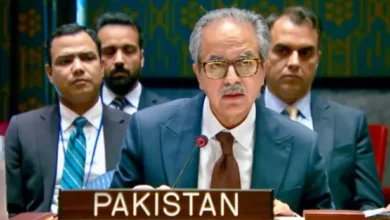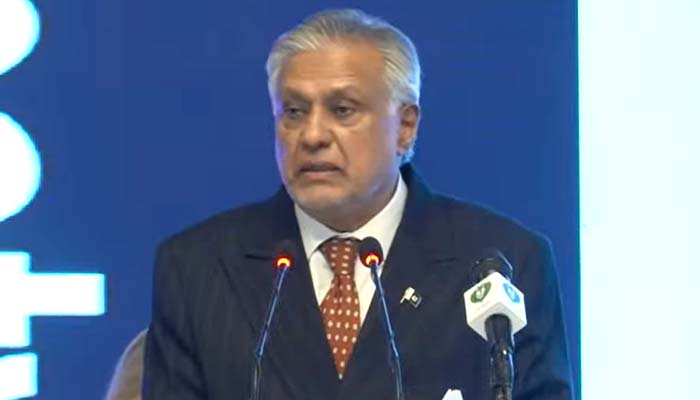

Deputy Prime Minister and Foreign Minister Ishaq Dar has urged India to “live like good neighbours” and resolve all issues via dialogue and diplomacy, stating that “it takes two to tango”.
Addressing an international seminar on the Indus Waters Treaty (IWT) in Islamabad on Tuesday, DPM Dar warned India against violating the IWT, saying that the cost of sabotaging an international agreement on rivers can be very high.
He said the consequences of violating international law and agreements are not limited to just two countries.
“Such actions set a dangerous precedent in international relations,” Dar said, adding that the violation of agreements spoils the reputation of states.
Addressing the seminar, Dar said India held the Indus Waters Treaty with Pakistan in abeyance, following the killing of 26 people in Indian Illegally Occupied Jammu and Kashmir in April 2025. New Delhi accused Islamabad of orchestrating the deadly militant attack, an allegation that Pakistan denied.
He said long-term peace was possible only through mutual respect and state sovereignty. “If Pakistan is deprived of its water rights, it will have serious consequences”, DPM Dar warned.
Recalling the past attempts to resolve issues with India through dialogue, the DPM said: “We in all sincerity are ready to talk on all issues, but we call for composite dialogue, but it takes two to tango.”
Dar lamented that India had become so “narrow-minded that even the sports are now subjected to this Hindutva philosophy”.
“See the recent elections in Bihar; what happened there [that] 40 million people were disenfranchised and they were deprived of voting that is their internal matter, but I think the world community must take notice of it,” he added.
Earlier, Information Minister Attaullah Tarar warned that Pakistan’s leadership is ready and to give an effective response if any attempt is made to stop the country’s water, reaffirming that Islamabad would safeguard the sanctity of the Indus Waters Treaty under all circumstances.
Addressing the seminar on IWT, Tarar said Pakistan remained committed to ensuring that the treaty remained intact, stressing that using water as a weapon is tantamount to undermining regional and global peace and stability.
The minister said the 1960 Indus Waters Treaty holds a unique place in international relations and remains one of the world’s most enduring water-sharing agreements.
“We are not merely discussing a treaty, but the lifeline of 240 million people,” Tarar said, adding that water is not just a natural resource for Pakistan but a matter of national survival.
He said Pakistan has consistently maintained that its people have a legitimate and complete right over the waters of the Indus River, warning that any attempt to stop or divert Pakistan’s water would receive an effective response from the country’s leadership.
He added that Pakistan’s history is intrinsically linked to the Indus River and that agriculture, the backbone of the national economy, depends on its waters.
The minister said Pakistan has always demonstrated its commitment to peaceful relations, constructive dialogue and the sincere implementation of international agreements. He noted that the Indus Waters Treaty was established more than six decades ago through mutual consent between two countries.
He stressed that any changes to the treaty could only be made through mutual agreement, adding that the unilateral suspension of the treaty had embarrassed India at international forums.
India diverting Chenab water
Pakistan’s Commissioner for the Indus Waters Treaty, Syed Mehr Ali Shah, said India has not been complying with the treaty since August 2023, adding that a letter was sent to India just a day earlier requesting data sharing under the agreement.
Addressing a seminar on the Indus Waters Treaty, the commissioner said India’s unilateral suspension of the treaty was completely illegal and a clear violation of the agreement. He said India was diverting the waters of the Chenab river, a move that would affect the flow of 1.9 million gallons of water.
He said that under the Indus Waters Treaty, India cannot divert Chenab waters into the Beas river, and that the construction of the Chenab-Beas link by India was completely illegal. He added that under the treaty, India was obligated to allow Pakistan to inspect the link.
‘India’s bid to stop Pakistan’s water violates int’l law’
A Russian expert, Dr Roxolana Zigon, said that India’s statement on denying Pakistan water violates international law in the coming years violates international law, adding that the treaty forms the basis of equitable water sharing in the region and is regarded globally as one of the most successful water-sharing agreements.
She said the treaty had ensured water cooperation between Pakistan and India for more than six decades despite tensions between the two countries, adding that it contains no provision for unilateral withdrawal.
The expert said more than 90% of Pakistan’s agriculture depends on river water, while 21 major hydropower projects are linked to the Indus river system. She added that almost the entire population of Pakistan is connected to the Indus basin in one way or another.
Dr Zigon said India’s construction of dams in upstream areas could increase instability in the region, accusing New Delhi of attempting to use water as a weapon and warning that its unilateral policies were eroding international trust.
The Russian expert described the Permanent Indus Commission as an important and effective mechanism for resolving disputes and stressed that preserving the Indus Waters Treaty was essential for peace and stability in South Asia.
It is to be noted here that based on baseless allegations, India started the war against Pakistan in May 2025, which was the heaviest fighting to have occurred between the two neighbouring nations in decades, before a ceasefire was reached and brokered by the US.
Pakistan, during the 87-hour conflict, downed eight Indian fighter jets, including French-made Rafale, and dozens of drones.