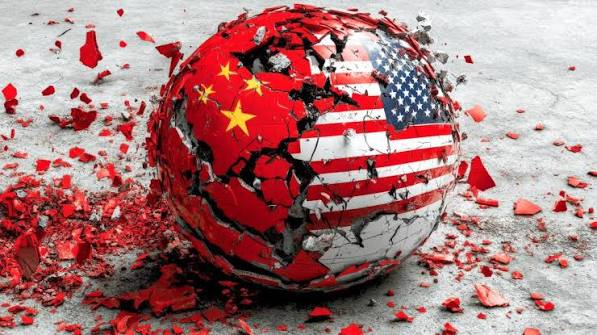

For three decades, the prevailing narrative of the global economy was one of seamless integration. From the design studios of California to the high-tech assembly lines of Shenzhen, the world operated on the assumption that technology was a bridge, not a barrier. However, that era of “borderless innovation” is rapidly giving way to a more fragmented reality. As the United States and China engage in an intensifying rivalry over the foundational technologies of the 21st century artificial intelligence (AI), semiconductors, and 5G a “Silicon Curtain” is descending, reshaping global supply chains and forcing a difficult reckoning for developing nations.
The shift marks a transition from a world defined by economic efficiency to one governed by national security. In Washington, the consensus has hardened around the idea that “de-risking” from China is essential to protect intellectual
property and maintain a military edge. In Beijing, the drive for “technological
self-reliance” has become a central pillar of national survival. What began as a
series of trade disputes in 2018 has evolved into a comprehensive decoupling
that threatens to bifurcate the global digital ecosystem.
The Semiconductor Siege and the AI Arms Race
At the heart of this decoupling is the semiconductor the “oil” of the digital age. Advanced microchips are the brains behind everything from smartphones to hypersonic missiles. In 2022, the U.S. Department of Commerce introduced sweeping export controls designed to prevent China from acquiring the high end chips necessary for training generative AI models. The “CHIPS and Science Act” further signaled Washington’s intent to reshore manufacturing, offering billions in subsidies to bring fabrication back to American soil.
China has responded with its own set of defensive and offensive measures. Beijing has invested hundreds of billions of dollars into its domestic chip industry via the “Big Fund” and has imposed export restrictions on critical minerals like gallium and germanium materials essential for high-tech manufacturing.
This tit-for-tat dynamic has profound implications for AI development. While the U.S. currently leads in algorithmic innovation and hardware design, China possesses a vast reservoir of data and a highly integrated industrial base. As the two powers diverge, the world faces the prospect of two distinct AI “stacks” each with its own standards, ethical frameworks, and hardware requirements. For global corporations, the cost of maintaining two separate supply chains is staggering, with some estimates suggesting a permanent 1 to 5 percent drag on global GDP.
The 5G Dilemma: Infrastructure as an Ideology
The rivalry is equally visible in the rollout of 5G telecommunications. As the backbone of the “Internet of Things,” 5G infrastructure is more than just a faster cellular network; it is the nervous system of modern cities. The U.S. campaign to exclude Chinese providers like Huawei and ZTE from Western networks, citing security vulnerabilities, has effectively split the world into two camps.
Many European and “Five Eyes” nations have aligned with Washington, citing the risks of state-sponsored espionage. Conversely, many nations across Southeast Asia, Africa, and the Middle East have continued to embrace Chinese infrastructure, which is often more affordable and comes with flexible financing. This infrastructure divide creates a “path dependency”: once a country adopts a specific 5G standard, the subsequent software, security protocols, and hardware upgrades are likely to follow the same technical lineage.
The “Digital Non-Aligned Movement”
Perhaps the most complex fallout of this decoupling is felt in the Global South. Developing nations, many of which are in the midst of their own digital transformations, now find themselves in an uncomfortable position. They are being pressured to choose between the two technological poles, a choice that carries significant economic and diplomatic risks.
For a developing economy in Africa or Latin America, U.S. technology offers high security and integration with Western financial markets. However, Chinese technology often provides a lower barrier to entry and a focus on state-led development goals. The danger, according to many economists, is that this “tech-polarization” will lead to a lack of interoperability. If a startup in Nairobi develops an app on a Chinese cloud platform, will it function seamlessly for a user in a market dominated by American standards?
Furthermore, the “friend-shoring” of supply chains where production is moved to politically allied nations is creating new winners and losers. Countries like Vietnam, India, and Mexico have seen an influx of investment as manufacturers seek to diversify away from China. However, other developing nations that lack the infrastructure or political alignment to join these new “trusted” supply chains risk being further marginalized.
A World of Redundancy and Risk
Critics of decoupling argue that the process is not only expensive but potentially futile. The global tech industry is so deeply intertwined that total separation may be impossible without catastrophic economic damage. Apple, for instance, still relies heavily on Chinese assembly, while Chinese tech firms
still utilize American software architectures.
Moreover, the environmental cost of decoupling is often overlooked. As both superpowers race to build redundant factories and secure mineral supplies, the efficiency gains of globalized production are lost, leading to increased carbon footprints and resource competition. The “Green Transition” itself is at risk, as solar panels and electric vehicle batteries are caught in the crosshairs of trade restrictions.
The US-China tech rivalry is no longer a peripheral trade dispute; it is the defining feature of modern geopolitics. The shift from a globalized market to a fractured one represents a fundamental change in how the world innovates and communicates. While “strategic autonomy” may offer a sense of security for the superpowers, it introduces a new layer of volatility for the rest of the world.
As we move forward, the challenge for the international community will be to establish a “digital floor” a set of minimum standards and protocols that allow the world to remain connected even as political systems diverge. Without such a framework, the “Fractured Circuit” may not only slow the pace of global innovation but also deepen the divide between the connected and the disconnected, leaving the most vulnerable nations to navigate a world of incompatible systems and dwindling choices. The Silicon Curtain is being drawn; the question is whether anyone can still see across the line.
*Lawyer, is a seasoned legal expert in constitutional and corporate law, advising public and private sectors and contributing to legal and policy thought.