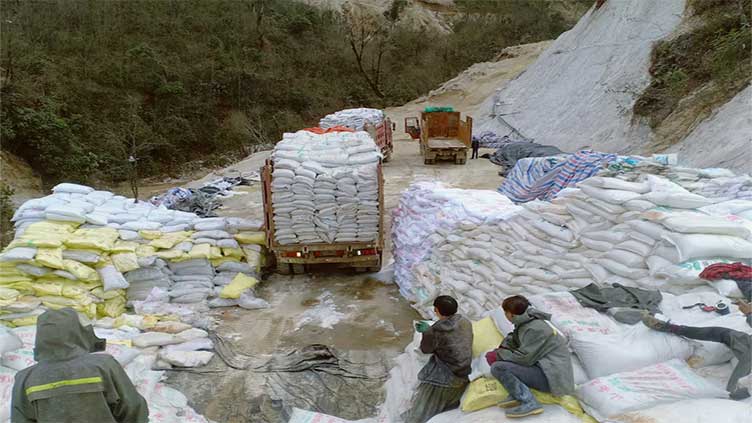

BANGKOK: When armed rebels seized northern Myanmar’s rare-earths mining belt in October, they dealt a blow to the country’s embattled military junta – and wrested control of a key global resource.
By capturing sites that produce roughly half of the world’s heavy rare earths, the Kachin Independence Army (KIA) rebels have been able to throttle the supply of minerals used in wind turbines and electric vehicles, sending prices of one key element skyward.
The KIA is seeking leverage against neighbouring China, which supports the junta and has invested heavily in rare earths mining in Myanmar’s Kachin state, according to two people familiar with the matter.
Chinese imports of rare earth oxides and compounds from Myanmar dropped to 311 metric tons in February, down 89% compared to the year-ago period, according to Chinese customs data that hasn’t been previously reported. Most of the fall came after October.
Reuters spoke to nine people with knowledge of Myanmar’s rare earths industry and its four-year civil war about turmoil in the mining belt.
One of them described the move by the KIA, which is part of a patchwork of armed groups fighting military rule, as an attempt to drive a wedge between the junta and China.
“They want to use rare earth reserves as a leverage in their negotiation with China,” said Dan Seng Lawn, executive director of the non-profit Kachinland Research Centre, which studies Kachin socio-political issues.
Three of the people also detailed previously unreported interest in the sector by India, China’s regional rival, which they said in late 2024 sent officials from a state-owned rare earths mining and refining firm to Kachin.
The KIA is one of the largest and oldest ethnic militias in Myanmar. It fights for the autonomy of the Kachin minority, a mostly Christian group who have long held grievances against the Bamar Buddhist majority.
The group has imposed a hefty tax on the mostly Chinese-operated rare-earth miners working around Panwa and Chipwe towns in Kachin, according Dan Seng Lawn, whose institute is based in the state, and a Chinese mining analyst.
China has been one of the staunchest international backers of Myanmar’s military since it deposed a civilian-led government in 2021 and ignited a bloody civil war. Beijing continues to see the junta as a guarantor of stability along its frontier, though the military has been ejected from most of the borderlands since a major rebel offensive in 2023.
A spokesperson for China’s Foreign Ministry said the department was not aware of the specifics of the situation in the mining belt but it continues to “actively promote peace talks and provide all possible support and assistance for the peace process in northern Myanmar.”
India’s external affairs ministry, the KIA and a junta spokesperson did not return requests for comment. Bawn Myang Co Ltd, which the US government previously identified as an operator of mines in the area, couldn’t be reached.
PRICE SPIKE
Chinese spot prices of terbium oxide, whose supply is concentrated in Kachin, jumped 21.9% to 6,550 yuan per kg between late September and March 24, data from Shanghai Metals Market show.
Prices of dysprosium oxide, which is also largely mined in Kachin but was in lower demand over the last six months, eased 3.2% to 1,665 yuan per kg during the same period.
Most rare earths from Kachin are processed in China, so a protracted stalemate would have global implications.
“A prolonged shutdown would likely lead to higher, potentially more volatile rare earth prices in China, and a reshaping of market dynamics in the near term,” research firm Adamas Intelligence said in a February note.

EXPORT PLUNGE
Chinese miners started building up major operations in Kachin in the 2010s, after Beijing tightened regulations on domestic mines.
Kachin’s often unregulated mines steadily expanded after the 2021 coup with the tacit approval of the junta, according to the UK-based Global Witness non-profit.
But the growth came at a heavy cost, ravaging the environment and leaving Kachin’s hills pock-marked with leeching pools, according to witness accounts and satellite imagery.
Since the KIA’s takeover, a 20% tax imposed by the rebels has made it effectively impossible for local operators to run profitable mines.
The KIA wants China to stop pushing it to set down arms against the junta and to recognise the rebels’ de facto control of the border, said Dan Seng Lawn, adding that the parties had met at least twice in recent months.
The KIA has full control of the border in areas where it operates and anti-junta groups rule most of the rest of Myanmar’s frontier with China.
Beijing appeared reluctant to accept the KIA’s demands, though it risked its monopoly on Myanmar’s rare earth reserves if it doesn’t position itself pragmatically, Dan Seng Lawn said.
Reopening the minerals sector would be a major financial lifeline to the rebels: Myanmar’s heavy rare earths trade stood at around $1.4 billion in 2023, according to Global Witness.
The KIA has told miners in Kachin it will now allow shipments of existing rare earth inventories to China, Reuters reported Thursday.
But to resume operations at full capacity, the KIA needs an agreement with China, home to thousands of workers with the know-how, said Singapore-based rare-earths expert Thomas Kruemmer.
“Without them, this won’t work, full stop,” he said.