
PARIS/BERLIN: More than three years after Russia’s invasion of Ukraine, Europe’s energy security is fragile.
US liquefied natural gas helped to plug the Russian supply gap in Europe during the 2022-2023 energy crisis.
But now that President Donald Trump has rocked relationships with Europe established after World War Two, and turned to energy as a bargaining chip in trade negotiations, businesses are wary that reliance on the United States has become another vulnerability.
Against this backdrop, executives at major EU firms have begun to say what would have been unthinkable a year ago: that importing some Russian gas, including from Russian state giant Gazprom, could be a good idea.
That would require another major policy shift given that Russia’s invasion of Ukraine in 2022 made the European Union pledge to end Russian energy imports by 2027.
Europe has limited options. Talks with LNG giant Qatar for more gas have stalled, and while the deployment of renewables has accelerated, the rate is not fast enough to allow the EU to feel secure.
“If there is a reasonable peace in Ukraine, we could go back to flows of 60 billion cubic metres, maybe 70, annually, including LNG,” Didier Holleaux, executive vice-president at France’s Engie, told Reuters in an interview.
The French state partly owns Engie, which used to be among the biggest buyers of Gazprom’s gas. Holleaux said Russia could supply around 20-25% of EU needs, down from 40% before the war.
The head of French oil major TotalEnergies, Patrick Pouyanne, has warned Europe against over-relying on US gas.
“We need to diversify, many routes, not over-rely on one or two,” Pouyanne told Reuters. Total is a large exporter of US LNG and also sells Russian LNG from private firm Novatek.
“Europe will never go back to importing 150 billion cubic meters from Russia like before the war … but I would bet maybe 70 bcm,” Pouyanne added.
GERMAN PIVOT
France, which produces large amounts of nuclear power, already has one of the most diversified energy supplies in Europe.
Germany relied heavily on cheap Russian gas to help drive its manufacturing sector until the Ukraine war and has fewer options.

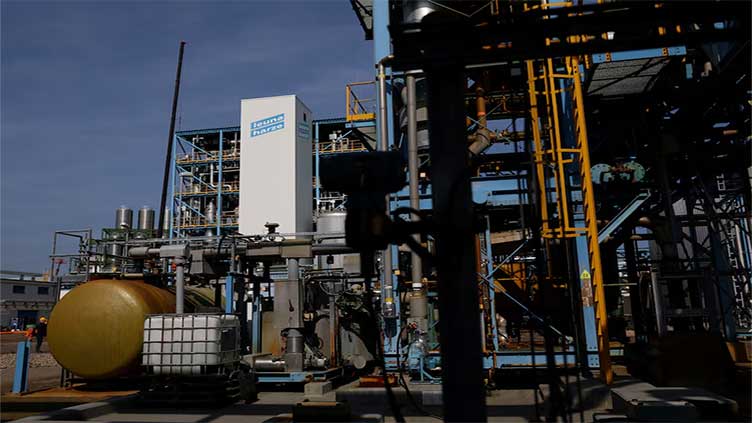
In Leuna Chemical Park, one of Germany’s biggest chemical clusters hosting plants of Dow Chemical and Shell among others, some makers say Russian gas should return quickly.
Russia used to cover 60% of local needs, mainly through the Nord Stream pipeline, which was blown up in 2022.
“We are in a severe crisis and can’t wait,” said Christof Guenther, managing director of InfraLeuna, the operator of the park.
He said the German chemical industry has cut jobs for five quarters in a row, something not seen for decades.
“Reopening pipelines would reduce prices more than any current subsidy programmes,” he said.
“It’s a taboo topic,” Guenther added, saying many colleagues agreed on the need to go back to Russian gas.
Almost a third of Germans voted for Russia-friendly parties in the February federal election.
In the state of Mecklenburg-Vorpommern, the east German region where the Nord Stream pipeline comes ashore after running from Russia under the Baltic Sea, 49% of Germans want a return to Russian gas supplies, a poll carried out by the Forsa institute found.
“We need Russian gas, we need cheap energy – no matter where it comes from,” said Klaus Paur, managing director of Leuna-Harze, a mid-sized petrochemical maker at the Leuna Park. “We need Nord Stream 2 because we have to keep energy costs in check.”
The industry wants the federal government to find cheap energy, said Daniel Keller, economy minister for the state of Brandenburg – home to the Schwedt refinery, co-owned by Russian oil firm Rosneft but held in German government trusteeship.
“We can imagine resuming the intake or transport of Russian oil after peace is established in Ukraine,” Keller said.