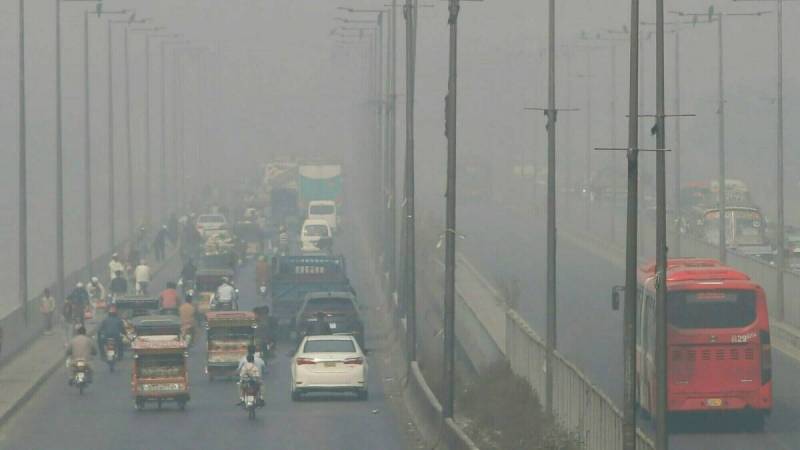

The haze hanging over Lahore is no longer just a seasonal issue; it has become a reflection of our priorities, policies, and weak implementation. During a recent hearing, remarks by Lahore High Court judge Justice Shahid Karim once again highlighted the harsh reality that despite understanding the problems, we still lack seriousness in solving them.
The court’s expression of displeasure over traffic police unnecessarily stopping citizens may appear to be a routine administrative matter, but in reality, it raises critical questions about civil liberties, environmental pollution, and governance. Justice Shahid Karim rightly pointed out that stopping citizens without any violation is not only illegal but also amounts to curtailing fundamental rights.
This is an issue often ignored. Anyone who uses the roads knows that traffic police frequently stop citizens without clear legal justification or meaningful outcome. Instead, such actions lead to traffic congestion, fuel wastage, and most importantly, an increase in smog.
The key question is: is traffic management meant to enforce the law or merely to create roadblocks under the guise of checking? If traffic police are failing to stop actual violators—as observed by the court—then a serious review of current strategies becomes inevitable.
On the other hand, by extending the stay order on the Shiranwala Gate and Taxali Gate projects, the court sent a clear message that development projects cannot proceed while ignoring environmental and historical considerations. Lahore is a historic city, and its gates are not just structures of brick and mortar but symbols of our identity.
During the smog mitigation case hearing, the issue of declining groundwater levels also surfaced. According to WASA’s report, the rate of decline has slowed due to court orders, but this progress is minimal. A reduction of only about one centimeter in a year does not mean the problem is solved; rather, it indicates how much more needs to be done.
The court rightly emphasized the need for more effective measures to improve groundwater levels. If we fail to address this issue today, it may turn into an irreversible crisis tomorrow.
The Environmental Commission’s report that a road project in Noorpur Khushab was redesigned to save 8,000 out of 11,000 trees is a positive step. However, the question remains: are such actions part of a consistent policy or merely a result of judicial pressure? If every project requires court intervention to prevent environmental damage, then institutional performance is clearly questionable.
Similarly, while reports regarding brick kilns in Sheikhupura claim no violations, the court’s observation that the Environment Department must act proactively before smog season is both realistic and necessary. In our system, actions are often taken after the problem emerges, whereas proactive planning is what truly matters.
The court’s remarks regarding the Parks and Horticulture Authority (PHA) are equally significant. Scientific policies for tree transplantation and protection of green belts are the need of the hour. If environmental bodies remain focused solely on revenue generation, environmental protection inevitably becomes secondary.
All these points highlight a deeper issue: our institutions operate on reaction rather than proactive planning. Unless this mindset changes, problems like smog, water scarcity, and urban mismanagement will only worsen.
In conclusion, the court is playing the role of a guiding force, repeatedly reminding institutions of their responsibilities. However, in a functional society, the real responsibility lies with the institutions themselves to ensure accountability and provide better services to the public.
If traffic police focus on genuine law enforcement instead of unnecessary stops, if environmental bodies adopt sustainable policies rather than temporary measures, and if development projects respect both environment and heritage—then perhaps Lahore can once again become a livable city.
Otherwise, judicial remarks will remain buried in files, while citizens remain stuck on roads, breathing polluted air.