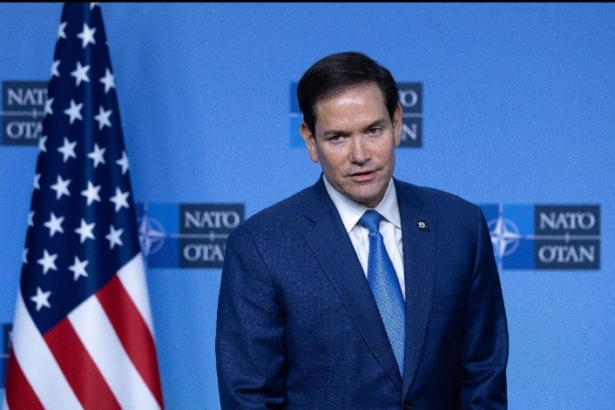

United States Secretary of State Marco Rubio said on Friday that “slight progress” had been made in ongoing diplomatic efforts surrounding rising tensions with Iran, particularly over the increasingly volatile situation in the Strait of Hormuz, one of the world’s most critical energy corridors.
Speaking to reporters ahead of a NATO foreign ministers’ meeting in Sweden, Rubio struck a cautiously optimistic tone but warned that core disputes remain unresolved, especially Iran’s nuclear ambitions and maritime strategy in the Gulf.
“There’s been some slight progress, I don’t want to exaggerate it, but there’s been a little bit of movement, and that’s good,” Rubio said, while standing alongside NATO Secretary General Mark Rutte.
Nuclear concerns remain central
Despite the diplomatic movement, Rubio stressed that Washington’s position had not shifted on what it considers a red line.
“The fundamentals remain the same: Iran can never have nuclear weapons,” he said.
US officials say ongoing negotiations are focused on limiting uranium enrichment levels and addressing concerns over Iran’s stockpile of highly enriched material. Washington and its allies have long accused Tehran of using civilian nuclear energy programs as cover for potential weapons development — an allegation Iran has consistently denied.
Rubio emphasized that discussions were continuing through international channels, including United Nations-backed mechanisms, though he expressed frustration over potential veto threats within the Security Council.
“Let’s see if the United Nations still works,” he said, hinting at resistance from unnamed member states.
Dispute over the Strait of Hormuz
The most contentious issue remains Iran’s alleged proposal to establish a “tolling system” for ships passing through the Strait of Hormuz, a narrow but strategically vital waterway linking the Persian Gulf to global markets.
Rubio accused Tehran of attempting to pressure neighboring Oman into supporting the system, which would effectively allow Iran to regulate or tax maritime traffic through one of the busiest oil transit chokepoints in the world.
“There is not a country in the world that should accept that,” Rubio said, warning that such a move could set a dangerous global precedent.
“If that were to happen in the Straits of Hormuz, it will happen in five other places around the world,” he added, suggesting broader risks to international shipping security.
Roughly one-fifth of global oil and liquefied natural gas passes through the Strait of Hormuz, making any disruption a major concern for global markets already sensitive to geopolitical instability.
NATO signals concern over navigation freedom
NATO Secretary General Mark Rutte echoed concerns about maritime security, saying alliance members were increasingly alarmed by threats to freedom of navigation.
“I hear from many colleagues here that it is not acceptable that freedom of navigation is being trampled upon,” Rutte said.
He also thanked the United States for continued military support to Ukraine, highlighting coordinated defense efforts funded by European and Canadian allies.
The meeting in Helsingborg also focused on defense spending, burden-sharing among NATO members, and wider global security risks — including instability in the Middle East.
Regional diplomacy intensifies
Diplomatic efforts have also been intensifying outside NATO channels.
Anwar Gargash, a senior advisor in the United Arab Emirates, said there is a “50-50 chance” of a breakthrough between Washington and Tehran, but warned that repeated failures in past negotiations stem from mistrust and miscalculation on both sides.
“This is not something new. They have missed many opportunities,” Gargash said at a conference in Prague, urging both countries to avoid another cycle of escalation.
He also warned that turning the Strait of Hormuz into a politically controlled zone would have “serious global repercussions,” particularly for Europe’s energy security.
Washington pushes UN resolution
The United States is also pursuing a Bahrain-backed resolution at the United Nations aimed at reinforcing maritime freedom in the region. Rubio claimed the measure has received wide international support, though he acknowledged resistance from some Security Council members.
“We’re working through the UN,” he said, adding that opposition to the resolution would test the credibility of international institutions.
Domestic pressure builds on US leadership
In Washington, President Donald Trump faces increasing domestic pressure as rising fuel prices and prolonged instability in the Middle East weigh on public sentiment.
Lawmakers in the US House of Representatives recently scrapped a vote on a resolution aimed at limiting presidential war powers in Iran, amid internal Republican divisions and concerns over political fallout.
Democrats accused Republican leaders of blocking debate to avoid constraining the administration’s military flexibility.
Iran rejects accusations, defends sovereignty
Tehran has strongly rejected US accusations, including claims that it is attempting to militarize or control the Strait of Hormuz through tolls.

Iranian officials insist that all maritime proposals are aimed at “regulating security” in line with regional sovereignty and international law. They also argue that Western sanctions and military pressure are the root causes of instability.

Iran’s foreign ministry has also condemned new US sanctions targeting Lebanese officials and figures linked to Hezbollah, calling them “incitement to sedition.”

Energy markets on edge
Global markets have reacted sharply to uncertainty surrounding the negotiations. Oil prices have climbed amid fears that any disruption in the Strait of Hormuz could trigger supply shocks, inflation spikes, and broader economic instability.
Analysts warn that with summer demand rising and regional supply constraints tightening, the global energy system could face heightened stress in the coming months.
The International Energy Agency has already cautioned that the market may enter a “red zone” if tensions persist into peak consumption season.
Outlook remains uncertain
While diplomats describe incremental progress, major disagreements persist over nuclear restrictions, sanctions relief, and maritime control in the Gulf.
Rubio acknowledged that while some movement exists, a comprehensive agreement remains distant.
“We’re not there yet,” he said, signaling that negotiations will likely continue in the coming weeks under intense international scrutiny.
For now, the Strait of Hormuz remains both a lifeline for global energy and a flashpoint for one of the world’s most sensitive geopolitical confrontations.