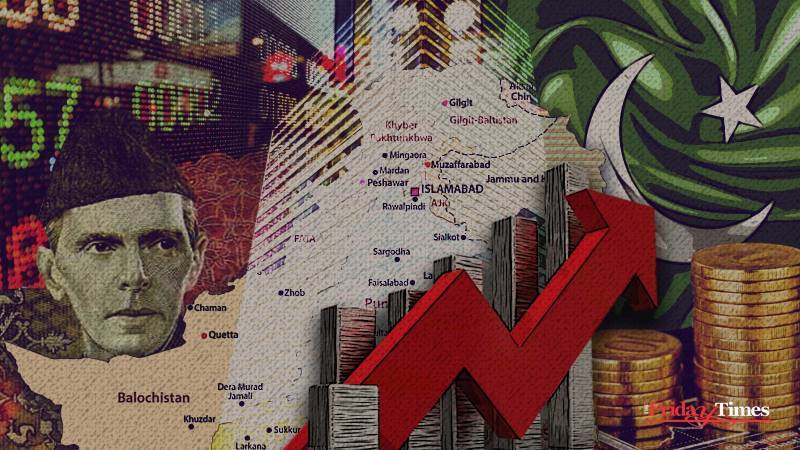

The economic survey is out with the latest revealing that Pakistan’s economy expanded by 3.7 per cent during FY2025-26. Even though it is below the target of 4.2 percent, its fastest pace in four years. Likewise, the rate of Inflation has plunged, and foreign exchange tensions had eased significantly, and Government is extolling it as a turning point in its economic affairs. However, history has a dark note in its history as Pakistan had some brief recovery periods in the past but has been plunged into crisis a few years later. The more relevant question is, then, whether there is economic security or not.
Overall, there are some signs of a substantive improvement in the economy in the Economic Survey 2025-26. Growth picked up to 3.7% and inflation eased significantly from its very high levels during the recent crisis. Furthermore, the current account was slightly improved due to the ongoing fiscal consolidation under the stabilisation programme supported by the IMF.
These developments deserve an adequate acknowledgment. Two years ago, Pakistan was in a severe balance of payment crisis with its foreign exchange reserves rapidly being exhausted, inflation levels going sky high and the possibility of the country going into sovereign default. Nowadays, the economy is faring better than back then.
However, stability is not economic security, it is only temporary. Stability is about what’s happening now, and economic security is about resilience. It is a measure of an economy’s resilience, its capacity to create sustainable growth and opportunities for businesses and consumers. The survey shows that there are considerable weaknesses under the surface of the positive headline figures.
The first is a fiscal vulnerability in Pakistan. Although the situation in fiscal management has improved, the debts servicing is still absorbing a large proportion of Government revenues. Consequently, there continues to be limited resources for public investment in development, infrastructure, education, health care and investments in productivity.
This leaves a structural problem. With a strong emphasis on fulfilling fiscal goals, government may continually under-invest in the basis for long-term growth. While fiscal stabilisation is required, it is not sufficient to ensure fiscal security. Financial security when a government can have policy space to adjust to economic shocks without compromising its development objectives. Pakistan is yet to reach that level.
The second is about external resilience. Although the balance of payments has improved, the economy continues to be highly reliance on remittances and external financing arrangements and has a comparatively low export base.
This dependency leaves Pakistan exposed to the changing economic climate, geopolitical shifts, commodity price changes and fluctuating financial conditions. If the external stability of a country depends heavily on factors outside its control, then it cannot be considered to be economically secure.
The survey’s figures indicate that the immediate burdens have been lifted, but that the bigger task of diversifying the economy, and making it export-oriented, remains unresolved. Economic security is fundamentally about providing regular foreign exchange earnings, not on an ad hoc basis.
The most significant take-out of the survey, perhaps, or the most obvious fact to reinforce is that Pakistan is still plagued with a productivity gap. Continued strong growth in services, but weak performance in agriculture and manufacturing compared to potential.
Growth is not sustainable if it’s only about consumption. It comes from productivity, technology upgrading, industrial diversification, and innovation. The countries that managed to break free of the middle-income status like South Korea, Vietnam, and Malaysia did so by continually raising the productivity of labour and capital.
The growth rate of 3.7 percent can be regarded as a recovery in Pakistan, but it has not been enough to catch up with a rapidly growing population that every year adds a large number of young people looking to enter the labour market. Growth needs to be faster and more productive to ensure economic security.
The survey also points to a lesser talked about but still very important issue that is the on-going underinvestment in human capital. Education, skills development, research and productivity of work force are still one of the weakest areas of the growth model in Pakistan.
There is no country that has become economically sustainable without paying attention to its human resources. The best economies dedicate a significant portion of their budgets to the people, since the knowledge, skills and innovation capacities are the key to future competitiveness rather than the natural resources.
Demographics are huge assets in Pakistan, but they become assets if we have focus on education and employable skills. Otherwise, they represent an economic burden instead of an economic opportunity.
It’s obvious the policy problem. Pakistan’s focus needs to shift from crisis management to creating economic resilience.
First, our government should change the focus from stabilisations goals to productivity goals. Secondly, industrial policy should focus on diversification of exports and value added production. Third, investments in infrastructure, logistics, energy reliability and digital connectivity should focus on the public sector. Fourth, education and workforce development must be viewed as essential economic investments and not as ‘social costs’ after the fact. Lastly, policy continuity should be guaranteed to give investors long-term predictable and credible signals.
These steps may not be news in the short term, but they are vital to creating real economic security.
The Economic Survey for 2025-26, as per my view, is a two-story tale. The first is that Pakistan has made it out of a near economic crisis and has regained a level of macroeconomic stability. The second is more cautionary than many of the structural vulnerabilities which made it possible for previous crises to take place have not been erased.
Stability versus security is a difference. Stability can be achieved may be within a year or two through corrective policies. The key components to economic security require continued institutional transformation, productive investment, investment in human capital, and economic structures that are resistant to shocks. Pakistan has been successful on the first challenge. Second challenge is not yet complete. Economic security will not be achieved until stability is converted to resilience, prosperity and competitiveness.