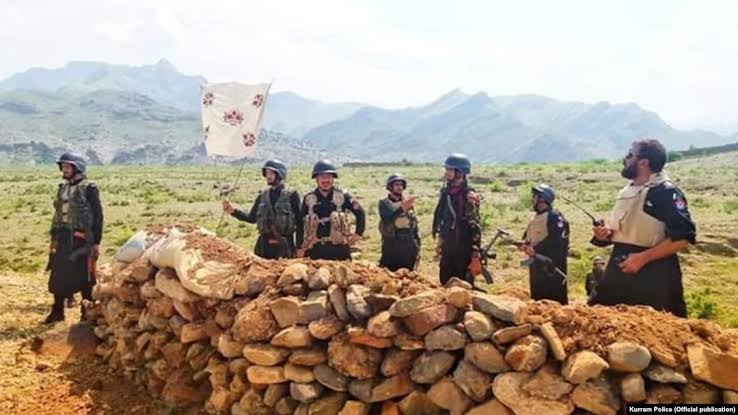

The deadly clash in Dadu’s Katcha area is not simply another incident of tribal rivalry. It is a disturbing reminder of how land disputes, personal enmities, illegal weapons, political influence and weak governance can combine to turn local disagreements into prolonged armed conflicts. According to media reports, eight people were killed and several others injured when rival groups clashed over a longstanding dispute concerning land and access to a passage. The exchange of gunfire was reportedly intense enough to force residents to remain indoors, while police were deployed to bring the situation under control.
The incident deserves to be examined beyond the immediate question of who fired the first shot. The larger issue is why disputes that could potentially be settled through administrative mechanisms, mediation or courts are repeatedly allowed to develop into armed confrontations. When rival groups possess sophisticated weapons and can maintain fortified positions for hours, it raises serious questions about the availability of illegal arms, the effectiveness of law enforcement and the influence of powerful political and tribal actors in conflict-prone areas.
Tribal conflict in rural Sindh is rarely about one issue alone. Land, irrigation, access routes, family disputes and questions of honour can all become triggers. But these factors become dangerous when institutions fail to provide timely and credible justice. When people lose confidence in courts, police and administration, they begin to look elsewhere for protection. That is when tribal and feudal structures become stronger, and private weapons begin to replace public authority.
A land dispute, in itself, should not be capable of producing a battlefield. If land records are accurate, boundaries are properly demarcated and disputes are settled promptly, there is little reason for two communities to mobilise armed men against each other. The escalation of such disputes suggests that the problem is not only tribal hostility but also institutional weakness.
The most disturbing question concerns the heavy weapons increasingly seen in tribal confrontations. Ordinary citizens do not normally have access to sophisticated firearms, ammunition and fortified positions. Whenever such weapons appear in prolonged rural clashes, authorities should investigate their source and the networks through which they entered the area.
There have also been allegations in different conflict-affected areas that politically connected individuals or elements within state institutions have facilitated access to weapons or provided protection to armed groups. Such allegations must not be treated as established facts without credible evidence. However, they cannot simply be ignored either. If there is evidence that any law-enforcement official has supplied weapons, facilitated their movement, protected illegal arms depots or deliberately allowed armed groups to operate, the matter should be investigated independently and those responsible should be held accountable.
The police have a responsibility to prevent violence, not merely to respond after blood has already been spilled. If heavily armed groups are known to be operating in an area, intelligence-based policing should identify them before a confrontation occurs. Illegal weapons should be traced and seized, and those financing or protecting armed groups should face investigation regardless of their political or social standing.
This becomes particularly important in areas where feudal and tribal influence remains powerful. The traditional Sardar or landlord can play an important role in resolving disputes, but that influence can also become problematic when communities become dependent upon individual patrons rather than state institutions. A population that depends on a powerful figure for protection is less likely to demand justice directly from the state.
This is where the political dimension of tribal conflict becomes difficult to ignore. A divided community is often easier to control than an organised and politically conscious one. When two groups remain locked in rivalry, each side seeks the protection of influential individuals. The patron consequently becomes more powerful because people begin to depend on him for security, political access and assistance in disputes.
This does not mean that every Sardar or feudal landlord deliberately creates conflict. Such a sweeping accusation would be unfair and unsupported. But wherever powerful individuals repeatedly emerge as patrons of rival armed groups, their role deserves serious scrutiny. The question should be whether their influence is being used to establish peace or to maintain political and social dominance.
The interests of entrenched local elites can extend beyond the immediate dispute. Political influence, control over land, access to state resources and the loyalty of local communities can all be strengthened through patronage. In an environment where ordinary people fear their neighbours and rival groups, the powerful intermediary can present himself as the only person capable of providing protection.
This creates a dangerous cycle. Insecurity produces fear; fear creates dependence; dependence strengthens patronage; and strengthened patronage can weaken institutions further. As institutions become weaker, communities become more dependent on local power brokers, allowing the cycle to continue.
The greatest victims of this system are often young men from poor families. They are recruited into conflicts over land, honour or inherited rivalries in which they have little influence over the underlying political and economic interests. They carry weapons, face the danger and ultimately lose their lives, while those with greater political and financial power may remain away from the battlefield.
Every tribal killing therefore has consequences far beyond the death toll. Families lose breadwinners, children lose parents, agricultural activity is disrupted and communities become increasingly suspicious of one another. Schools may close, farmers may be unable to reach their fields and ordinary residents may avoid travelling through areas where armed groups operate.
Persistent tribal violence also deepens poverty. Investment and economic activity decline in insecure areas, while government officials may find it difficult to perform their duties effectively. A community already deprived of education, healthcare, roads and employment is pushed further into deprivation when violence becomes part of everyday life.
The state must therefore recognise that tribal conflict is not merely a law-and-order problem. It is also a governance problem, a development problem and, in many cases, a problem of political accountability.
The response to the Dadu incident, including the deployment of police and orders for investigation and arrests, is necessary. But temporary action after a massacre is not enough. Authorities need a long-term strategy for areas where tribal violence has become entrenched.
Land disputes must be resolved through transparent revenue mechanisms. Land records should be properly maintained, boundaries clearly demarcated and cases handled without political interference. Where access roads, irrigation channels or other common resources are disputed, the administration should intervene before disagreements become violent.
At the same time, the state must pursue illegal weapons without discrimination. It is not enough to arrest a few gunmen after a clash. Investigators must determine where the weapons came from, who financed them and whether anyone provided political or institutional protection to the armed groups.
This is particularly important when allegations involve members of law-enforcement agencies. The credibility of the state depends upon its willingness to investigate its own institutions. A police officer who facilitates criminal activity should not receive protection simply because he belongs to the state apparatus. Accountability must apply to everyone.
There is also a need to rethink the role of traditional dispute-resolution mechanisms. Tribal elders and Sardars can contribute to reconciliation, particularly when they have the confidence of both sides. But reconciliation cannot become a substitute for criminal justice. A jirga may help persuade two families to stop fighting, but it cannot lawfully replace the courts in cases involving murder and serious violence.
The distinction is fundamental: reconciliation can restore social relations, but accountability prevents future crime.
A sustainable peace strategy must therefore combine law enforcement with social and political reform. Communities need access to justice, education, healthcare, roads, employment and basic services. Young people need alternatives to becoming armed followers of tribal groups. Women and children, who often bear the indirect consequences of violence, need particular protection.
Most importantly, citizens must begin to see the state—not the Sardar, landlord or tribal patron—as the ultimate source of security and justice.
The real challenge is to dismantle the system of dependency that allows private power to flourish where public institutions should prevail. A farmer should not require the protection of a powerful landlord simply to cultivate his land. A family should not need a tribal patron to obtain justice. A young person should not have to join an armed group to protect his community.
The state must also resist the temptation to treat every tribal conflict as a temporary disturbance that can be settled through a political compromise. A ceasefire may stop the firing, but it does not necessarily resolve the causes of conflict. If the weapons remain, land disputes remain unresolved and political patrons continue to exercise influence over armed groups, another confrontation is only a matter of time.
The Dadu incident should therefore become an opportunity for a broader policy rethink. The government should map conflict-prone areas, identify illegal arms networks, strengthen local policing, improve land administration and establish mechanisms for early intervention. Intelligence agencies and law-enforcement institutions should work together to prevent armed groups from accumulating weapons before violence begins.
At the same time, political leaders must demonstrate that their commitment is to the rule of law rather than to individual patrons. No influential person should be allowed to use tribal identity as a shield against accountability.
Ultimately, tribal conflict is not an inevitable part of rural society. It persists when institutions fail, when weapons circulate unchecked and when political and economic interests find advantage in division.
The people of Dadu and other conflict-affected areas do not need another generation of young men inheriting their fathers’ rivalries. They need schools instead of checkpoints, courts instead of revenge, employment instead of armed patronage and an impartial police force instead of dependence on powerful individuals.
The question after every tribal massacre should therefore go beyond who pulled the trigger. Authorities must also ask who supplied the weapons, who financed the armed groups, who protected them, who benefited from the conflict and why the state failed to intervene before lives were lost.
Until these questions are seriously investigated, tribal violence will remain more than a criminal problem. It will remain a symptom of a deeper crisis of governance and power.
The ultimate solution lies in replacing tribal hegemony with the rule of law, private patronage with accountable institutions, revenge with justice and fear with citizenship. Only then can communities trapped in cycles of bloodshed begin to imagine a future in which disputes are settled through law rather than through the gun.