


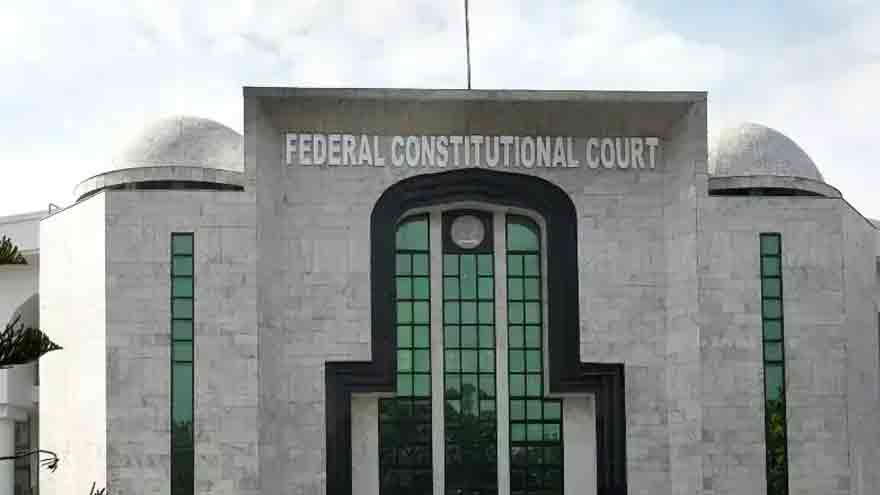

ISLAMABAD: The Federal Constitutional Court of Pakistan (FCCP) has ruled that departmental action against a government employee requires credible evidence, a fair inquiry, and compliance with legal requirements, holding that a High Court cannot assume the executive’s role in matters relating to an officer’s posting and disciplinary proceedings.
A bench comprising Justice Rozi Khan and Justice Syed Arshad Hussain Shah issued the judgment on an appeal filed by police officer Munir Samo, examining an order passed by the Sindh High Court’s Circuit Court at Larkana on June 30, 2026.
Justice Rozi Khan authored the written judgment.
The FCCP observed that the inquiry report had not established Inspector Munir Ahmed Samo’s involvement in the alleged raid.
According to the report, his role was limited to that of a group officer issuing intelligence reports, and no further action against him had been recommended.
The judgment stated that the Sindh High Court had ordered an inquiry into the matter on April 16, 2026. Subsequently, expressing dissatisfaction with the initial inquiry, it directed the Senior Superintendent of Police (SSP), Larkana, to conduct a fair and comprehensive investigation.
On June 19, 2026, the High Court had also directed that the officers concerned should not be assigned field postings for at least one year until the inquiry report was submitted.
The FCCP held that the High Court had failed to adequately consider the significant findings and recommendations contained in the subsequent inquiry report. Any adverse administrative or departmental action against a government employee must be supported by reasons consistent with the inquiry findings and must comply with the prescribed legal procedure, it added.
The written judgment referred to Article 4 of the Constitution, which guarantees the right to be dealt with in accordance with law, and Article 10-A, which ensures the right to a fair trial and due process.
It emphasised that an officer must be given a reasonable opportunity to present his position and respond to the allegations before an adverse decision is taken against him.
The court further observed that the posting of civil servants, allocation of duties and departmental discipline fell within the executive’s domain. Courts could examine the legality of administrative actions but could not substitute their own decisions for those of the competent authorities.
Judicial review, the judgment concluded, was intended to bring unlawful actions into conformity with the law, not to transfer administrative powers to the judiciary.