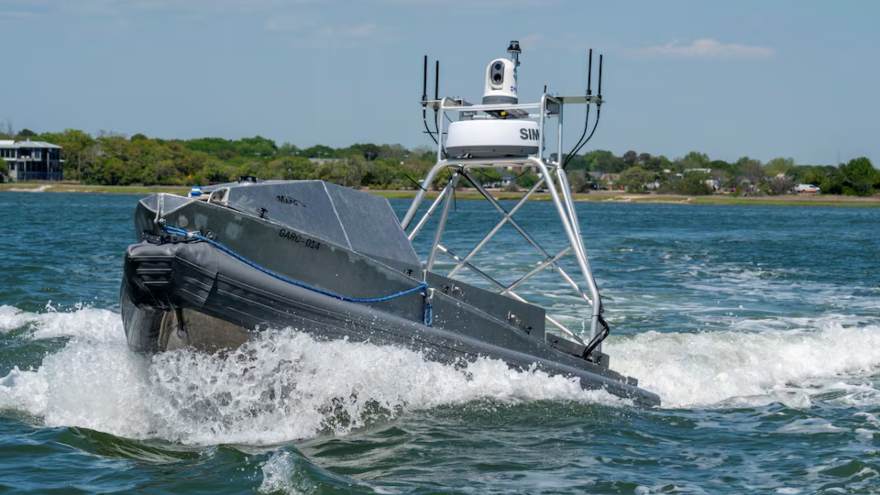

NEW YORK: During a US naval test off the California coast last month, which was designed to showcase the Pentagon’s top autonomous drone boats, one vessel stalled unexpectedly.
As officials scrambled to fix a software glitch, another drone vessel smashed into the idling boat’s starboard side, vaulted over the deck, and crashed back into the water – an incident captured in videos obtained by Reuters.
The previously unreported episode, which involved two vessels built by US defense tech rivals Saronic and BlackSea Technologies, is one of a series of recent setbacks in the Pentagon’s push to build a fleet of autonomous vessels, according to a dozen people familiar with the program.
Weeks earlier, during a separate Navy test, the captain of a support boat was thrown into the water after another autonomous BlackSea vessel it was towing suddenly accelerated, capsizing the support boat, according to four people familiar with the matter. The captain was rescued and declined medical attention. The incident was first reported by Defense Scoop, opens new tab.
Both incidents stemmed from a combination of software failures and human error, including breakdowns in communication between onboard systems and external autonomous software, according to a person with direct knowledge of the matter, who requested anonymity to share sensitive information.
The Navy, Saronic and BlackSea declined to comment on the incidents.
US military leaders, seeing the outsized impact of maritime drones in the Ukraine war, have repeatedly said they need autonomous swarms of aerial and maritime drones to hinder a potential advance by China across the Taiwan Strait. Taiwan itself has begun acquiring its own maritime drones.
The drones being developed in Ukraine, which often look like speedboats without seats, and are capable of carrying weapons, explosives and surveillance equipment, are primarily remote-controlled and cost close to $250,000 – making them optimal for kamikaze missions that have effectively neutralized Russia’s Black Sea Fleet.
The US, meanwhile, is aiming to build an autonomous naval fleet that can move in swarms and without human command – a more ambitious task at a higher price point; as much as a few million dollars per speedboat.
The recent test failures highlight the challenges facing the Navy’s effort to deploy the nascent technologies, said Bryan Clark, an autonomous warfare expert at the Hudson Institute. It will need to adapt its “tactics as it better understands what the systems can do and what they can’t do.”
But the Navy’s problems go beyond getting the boats to work: its autonomous maritime drone acquisition unit has also been rocked by the firing of its top admiral, and a top
Pentagon official voiced concerns about the program in a candid meeting with Navy brass last month, Reuters found.
Since the most recent incident, the Pentagon’s Defense Innovation Unit (DIU), which had acquired technology for the tests, has indefinitely paused a contract – valued close to $20 million – with L3Harris, one of the companies providing autonomous software used to control some of the vessels, according to two people familiar with the matter.
The Pentagon did not respond to questions about the cause of the accidents or the L3Harris contract being paused, which has not been previously reported.
A Pentagon spokesperson said it conducted drone tests as part of a “competitive and iterative approach, between operators and industry.”
L3Harris declined to comment on the contract and directed questions to the DIU. The DIU declined to comment.
“L3Harris stands behind the safety, integrity and capability of our autonomy command-and-control product,” said Toby Magsig, who oversees L3Harris’ autonomous software products.
RISE OF SEA DRONES
To accelerate its drone effort, the Pentagon in 2023 launched the $1 billion Replicator program, through which branches like the US Navy and the DIU planned to acquire thousands of aerial and maritime drones, along with the software to control them. The first systems from this program are due to be announced this month.
The Navy has committed at least $160 million to BlackSea, which is producing dozens of its Global Autonomous Reconnaissance Craft boats a month, according to procurement records.
Saronic, which was recently valued at $4 billion in a funding round backed by Andreessen Horowitz and 8VC, makes the competitive sea drone Corsair, but is yet to announce a major contract. Federal procurement records show the company has generated at least $20 million from prototype agreements.
“These systems will play a critical role in the future of naval warfare by extending fleet reach, improving situational awareness, and increasing combat effectiveness,” acting chief of naval operations Jim Kilby said during a visit to BlackSea’s facility in June.