
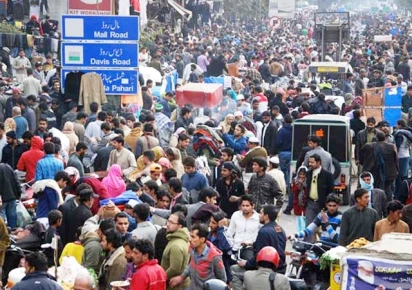

A new official demographic report has warned that Pakistan’s population could surge to around 390 million by 2050, raising serious concerns over jobs, resources, and long-term economic stability.
The projection is based on Pakistan’s 2023 census, which recorded a population of 241.9 million. According to the report launched by Planning Minister Ahsan Iqbal in collaboration with the United Nations Population Fund (UNFPA), the country could see an increase of nearly 148 million people within the next 25 years under a slow fertility decline scenario.
Even under alternative assumptions, the population is expected to remain extremely high. Estimates suggest it could reach around 371.9 million in a rapid fertility decline case, and about 383.2 million if contraceptive use expands significantly across provinces.
The report highlights that the most critical challenge will be employment generation. Out of the projected population, nearly 255 million people could be part of the working-age group by 2050, far exceeding Pakistan’s current total population.
It warns that unless economic growth accelerates significantly, the country may struggle to absorb the growing labour force. Current growth trends of around 3.5% are seen as insufficient, with experts suggesting that 6% to 8% sustained growth would be required to generate adequate employment opportunities.
The demographic breakdown shows major shifts across age groups. The population under 18 is expected to rise modestly, while the youth segment aged 15–29 could expand to around 100 million. The elderly population is also projected to nearly triple, increasing pressure on healthcare and social protection systems.
Provincially, all regions are expected to see significant growth. Punjab may rise to about 200 million, Sindh to over 91 million, Khyber Pakhtunkhwa to 68 million, and Balochistan to around 25 million. The Islamabad Capital Territory is projected to experience the fastest proportional growth.
Officials have described the trend as both an opportunity and a risk. While a larger working-age population could create a “demographic dividend,” the report stresses that this potential will only be realised through strong investment in education, healthcare, and job creation.
At the same time, policymakers warn that without urgent reforms, rapid population growth could intensify pressure on infrastructure, public services, and natural resources, making long-term development more difficult to sustain.