
Canada is rapidly strengthening its Arctic defense partnerships with Nordic countries as geopolitical tensions rise in the far north, driven in part by recent statements from U.S. President Donald Trump and growing strategic competition involving Russia and China.
According to officials and defense experts, the move reflects a broader shift in Canada’s security strategy as it seeks to reduce over-reliance on the United States while expanding cooperation with trusted “middle power” allies in the Arctic region.
The initiative comes amid increasing concern over Arctic sovereignty and security. The region, once largely frozen and inaccessible, is now opening due to climate change, creating new shipping routes and access to vast natural resources. This has intensified military and political interest from global powers.
Canadian Prime Minister Mark Carney has prioritized deeper Arctic collaboration with Nordic nations, including Denmark, Finland, Iceland, Norway, and Sweden. In March, Canada and these five countries agreed to expand cooperation in defense procurement, military readiness, and cybersecurity resilience.
A key driver behind the accelerated partnership has been heightened rhetoric from Washington, including Trump’s previous remarks suggesting the United States could take control of Greenland or even integrate Canada as a U.S. state—comments that sparked strong reactions among allies and Arctic policymakers.
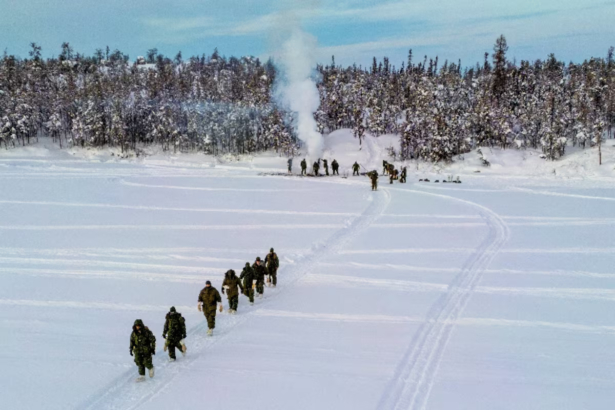
In response, Canada and Denmark have intensified discussions on developing a Canadian-style Arctic Ranger model for Greenland. The Canadian Rangers, a reserve force embedded in remote northern communities, have long provided surveillance, local knowledge, and rapid response capability in harsh Arctic environments.
Experts say this model is now being considered as a blueprint for strengthening indigenous and local defense structures across the wider Arctic region.
“The rhetoric coming out of the White House has sped up efforts to show that Arctic communities can defend themselves and rely on northern partnerships,” said Arctic security expert Whitney Lackenbauer, an honorary lieutenant-colonel with the Canadian Rangers.
Meanwhile, Canada has expanded its diplomatic footprint in the Arctic, opening a consulate in Nuuk, Greenland, and increasing high-level exchanges with Nordic defense officials. Canadian Foreign Affairs Minister Anita Anand has also held regular consultations with Nordic counterparts on collective Arctic security.
The cooperation is not purely military. Canada and Nordic nations are also working on joint responses to cyber threats, infrastructure vulnerabilities, and maritime safety challenges in increasingly busy Arctic waters.
Despite the growing partnership, experts caution that Canada cannot fully replace the United States’ military capabilities in the Arctic. The North American Aerospace Defense Command (NORAD) remains the cornerstone of continental defense, and U.S. technological superiority continues to play a central role in Arctic surveillance and deterrence.
“Working with the U.S. remains essential for high-end military capability,” said Arctic analyst Rob Huebert, noting that Canada’s evolving strategy is about complementing—not replacing—its traditional alliances.
Still, the shift is significant. Canada’s increased participation in Nordic-led NATO exercises, including Arctic drills in Norway, signals a more active and independent posture than in previous decades.
Russia’s expanding Arctic military footprint and China’s growing interest in the region’s strategic and resource potential have further underscored the urgency of cooperation among Western Arctic nations.
Officials argue that the emerging Canada–Nordic partnership is designed not only to strengthen defense but also to send a political message: the Arctic is no longer a low-tension frontier where major powers can act without coordination or consequences.
As Canada deepens its Arctic engagement, policymakers say the goal is clear—build resilient northern alliances capable of protecting sovereignty, ensuring stability, and shaping the future of one of the world’s most strategically important regions.