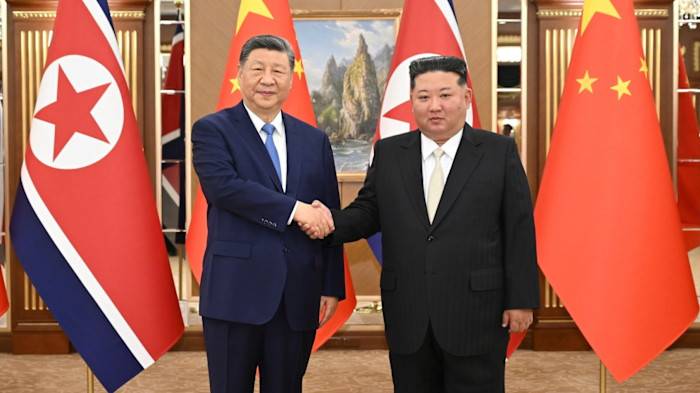

Chinese President Xi Jinping’s visit to North Korea after seven years is far more than a routine diplomatic engagement. The trip represents a carefully calculated geopolitical move that reflects changing power dynamics in East Asia and beyond. At a time when global rivalries are intensifying and regional security concerns are mounting, Xi’s arrival in Pyongyang signals Beijing’s determination to reassert its influence over the Korean Peninsula and shape the strategic environment in Northeast Asia.
For China, North Korea remains a critical strategic buffer separating Chinese territory from the United States-allied military presence in South Korea. Beijing has long viewed stability in North Korea as essential to its national security. Xi’s visit demonstrates that China is unwilling to allow Pyongyang to drift too far into Moscow’s orbit or become an unpredictable actor capable of triggering regional instability. The visit also reaffirms the historical alliance between China and North Korea at a time when the international order is becoming increasingly polarised.
From South Korea’s perspective, the visit raises important concerns. Seoul has increasingly strengthened security cooperation with the United States and Japan in response to North Korea’s advancing nuclear and missile programs. A closer Beijing-Pyongyang relationship could complicate South Korea’s strategic calculations by reducing China’s willingness to pressure North Korea over its nuclear ambitions. Instead of acting as a mediator, Beijing may increasingly act as Pyongyang’s diplomatic protector. This development could encourage South Korea to further deepen military cooperation with Washington and Tokyo.
Japan is likely to interpret the visit through a similar security lens. Tokyo already faces growing concerns regarding North Korean missile tests and China’s expanding military capabilities. A strengthened China–North Korea partnership could reinforce Japanese arguments for higher defence spending, expanded military capabilities, and stronger coordination with the United States. The visit may therefore accelerate the emergence of competing security blocs in East Asia rather than promoting regional reconciliation.
President Xi’s global motives extend well beyond the Korean Peninsula. The Chinese leader seeks to demonstrate that Beijing remains a central actor in international affairs despite ongoing strategic competition with Washington. By visiting Pyongyang shortly after engaging with major world leaders, Xi is signalling that China possesses diplomatic influence across multiple geopolitical theatres. The message is clear: no major discussion about Northeast Asian security can take place without China’s participation.
Another important objective is to strengthen China’s leadership among countries that oppose what Beijing frequently describes as Western dominance and unilateralism. Both China and North Korea have criticised United States-led alliances and advocate a more multipolar international order. Xi’s visit therefore serves ideological as well as strategic purposes, reinforcing China’s narrative that alternative centres of power are emerging in global politics.
The Russian dimension adds another layer of complexity. Since the outbreak of the Ukraine conflict, North Korea and Russia have significantly expanded their cooperation. Pyongyang’s growing relationship with Moscow has generated concern in Beijing that China’s traditional influence over North Korea could gradually diminish. Xi’s visit can therefore be interpreted in part as an effort to remind Kim Jong Un that China remains North Korea’s most important economic partner and an indispensable strategic ally.
At the same time, China does not necessarily view Russia as a competitor in this context. Beijing, Moscow, and Pyongyang increasingly share concerns about the United States’ military alliances and sanctions policies. Xi’s visit may contribute to the gradual consolidation of a loose strategic triangle involving China, Russia, and North Korea. While not a formal alliance, such cooperation could influence regional security calculations and challenge United States influence across Eurasia.
Economically, the visit may also pave the way for expanded trade, infrastructure cooperation, and border connectivity. North Korea remains heavily dependent on China for trade and economic survival. Increased economic engagement would strengthen Beijing’s leverage while helping stabilise North Korea’s fragile economy. Such cooperation could also reduce Pyongyang’s dependence on Russia and preserve China’s long-term influence.
President Xi Jinping’s visit to North Korea is a strategic event with implications far beyond Pyongyang. It reflects China’s determination to maintain influence on the Korean Peninsula, manage North Korea’s growing ties with Russia, and counter the expanding United States-South Korea-Japan security framework. For South Korea and Japan, the visit serves as a reminder that regional security competition is entering a new phase. For Russia, it demonstrates China’s intention to remain the dominant external player in North Korean affairs. Ultimately, Xi’s trip is not merely about bilateral relations; it is a calculated move in the broader contest for influence in an increasingly multipolar world, where Northeast Asia remains one of the most strategically important regions on the planet.