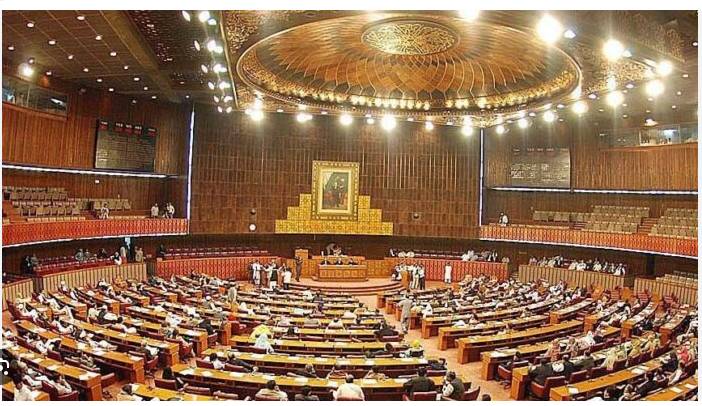

The National Assembly on Monday approved four demands for grants worth Rs74.35 billion of the Ministry of Interior, rejecting all cut motions forwarded by the Opposition.
The National Assembly continued debate on the demands for grants during its session with Speaker Sardar Ayaz Sadiq in the chair.
The House took up four demands for grants related to the Ministry of Interior for the next financial year. These were moved by Finance Minister Senator Muhammad Aurangzeb.
Opposition members participating in the discussion on the cut motions moved against these demands for grants. However, the lawmaker granted approval rejecting all 123 cut motions introduced by the Opposition.
Three demands for grants worth over Rs33.70 billion of National Food Security were also presented in the National Assembly for approval.
The Opposition members quickly submitted a motion containing 112 cuts in the National Food Security’s budget, triggering a debate on the cut motions.
Meanwhile, Federal Minister for Law and Justice Azam Nazeer Tarar urged opposition lawmakers to actively participate in parliamentary committees and the legislative process instead of merely criticizing the government.
Speaking in the National Assembly, he said representatives of the Ministry of Law and Justice had repeatedly requested members to attend meetings, but some lawmakers had chosen not to participate.
Tarar also informed the House that the government had introduced a comprehensive package of around 100 amendments to criminal laws, which is currently under consideration by the relevant standing committee.
He urged lawmakers to engage in committee deliberations and contribute to legislative reforms.
He said the government was still awaiting feedback from the Khyber Pakhtunkhwa government on the proposed amendments, which he termed non-political in nature.
He stressed that strengthening the rule of law requires practical participation in legislative work rather than speeches alone.
Referring to judicial matters, the minister said court proceedings and convictions are decided by the judiciary and not by the government, adding that anyone with objections to convictions could seek relief through the appellate process.