
There is a particular kind of defeat that wears the costume of victory. It is the defeat of a side that hit every target on its list, broke every enemy in its path, and still, when the guns fell silent, found itself standing to the side while others wrote the terms of peace. That is the story of Israel in 2026, and of a war that, on paper, it dominated from the first night to the last.
The war began on February 28, 2026, when American and Israeli forces launched a staggering opening barrage, nearly 900 strikes within twelve hours, against Iranian air defenses, missile sites, military infrastructure, and senior leadership. Among the dead, almost unthinkably, was Iran’s Supreme Leader, Ayatollah Ali Khamenei, assassinated in the campaign’s opening hours. Israeli Defense Minister Israel Katz later revealed that Prime Minister Benjamin Netanyahu had set the objective of eliminating Khamenei as far back as November, with anti government protests inside Iran in early 2026 accelerating the timeline for the strike.
The scale of the opening assault was, by any military measure, extraordinary. It decapitated Iran’s military and nuclear leadership, destroyed swaths of missile production capacity, and killed senior commanders and nuclear scientists in a matter of days. Iran responded with hundreds of missiles fired at Israel, by the tenth day roughly 300, nearly half carrying cluster munitions, and by closing the Strait of Hormuz, the chokepoint through which a fifth of the world’s oil flows, triggering fuel shortages across Asia and rattling global markets.
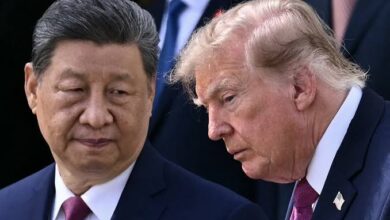
What followed was five weeks of brinkmanship, a brief ceasefire on April 7 and 8, then a renewed standoff over Hormuz and a US naval blockade, before talks brokered by Pakistan finally produced a breakthrough. On June 17, 2026, Presidents Trump and Masoud Pezeshkian signed the so called Islamabad Memorandum of Understanding, ending hostilities on all fronts including Lebanon, lifting the blockade on Iranian ports, reopening Hormuz, easing sanctions, and committing to a reconstruction plan for Iran, with a sixty day window to negotiate the unresolved question of Iran’s nuclear program. Iran reaffirmed it would not pursue a weapon. Pakistani Prime Minister Shehbaz Sharif, the deal’s mediator, called it the foundation for enduring peace.
Go back to the war’s first week, and Netanyahu’s stated objectives were unambiguous: decapitating the nuclear programme and regime change. He told ABC News at the time that targeting Khamenei “is not going to escalate the conflict, it’s going to end the conflict.” By June, with the regime still standing in Tehran, now under Khamenei’s son and successor, Mojtaba, Netanyahu had quietly rewritten the scorecard. At a June 15 press conference, asked why the campaign was ending with the regime intact, he rejected the question’s premise outright: “It did not go wrong at all. I defined the goals, and the cabinet defined the goals, differently from what you said.” He insisted Israel had “saved the State of Israel from annihilation” and maintained that regime change had never actually been a formal goal, only that “there are cracks” in Tehran’s rule.
That is not how it looked in real time. As BBC Middle East correspondent Lucy Williamson observed, Israel’s leadership is now engaged in a concerted effort to frame the achievements of the Iran war as having changed the Middle East, even without the regime change in Tehran that Israel’s prime minister had focused on. Williamson notes the uncomfortable question Netanyahu now faces: without regime change, how long before the next time, a pointed echo of the fact that this was, after all, Israel’s second war against Iran in barely a year.
The Jerusalem Post put the paradox bluntly in an analysis published as the MOU took shape. Israel, it argued, “has failed to completely defeat any of those enemies, that is a loss. Yet Israel has thoroughly bludgeoned and weakened all of those enemies in ways that cannot be restored within a year or two.” The piece framed the entire dispute as a matter of which question one asks. If the question is why Israel and the US did not already succeed at regime change, then everyone lost except Iran. If the question is why Israel is not only failing to dominate the direction of negotiations but being pushed to the side, then Israel lost badly.
That second framing is the one that should worry Jerusalem most. Israel fought the war. Pakistan brokered the peace. Washington and Tehran signed it. Israel was, by most accounts, a junior partner at its own negotiating table.
Retired IDF intelligence colonel Miri Eisen, speaking to the Christian Science Monitor earlier in the conflict, captured the gap between Netanyahu’s ambitions and Israel’s actual leverage. “For Netanyahu, the endgame in this war is to see a heavily diminished Iran,” she said, explaining that he wanted the physical threat from Iran’s nuclear program, missiles, and regional proxies “brought down to an incredibly low level.” Israeli security analyst Shlomo Brom, cited in the same piece, warned that overwhelming tactical success without “realistic, achievable goals” would mean the war would simply drag on until Trump himself grew fed up with it. That is roughly what happened. Trump, not Netanyahu, decided when the war ended and on what terms.
The International Institute for Strategic Studies framed the entire conflict’s outcome in terms that should give any victory narrative pause, noting that it is plausible all three combatants will simultaneously claim victory while ending up strategically worse off. Its analysts went further, describing the war as the logical culmination of years of failed diplomacy rather than a clean resolution to anything, and cautioned that Middle Eastern states must now contain a weakened, militarised, angry Iranian regime willing to disrupt their geo economic and geopolitical relationships, a regime still in power and now nursing a fresh grievance against both Washington and Jerusalem.
Ali Vaez, the Iran Project director at the International Crisis Group, pointed to a deeper irony in the campaign: the speed and ferocity of Iran’s retaliatory response caught planners off guard relative to expectations. Iran, battered as it was going in, proved more resilient under fire than the war’s architects had bargained for, resilient enough to shut Hormuz, batter Gulf shipping, and force Washington to the table on terms that gave Tehran sanctions relief and a reconstruction package rather than capitulation.
The Al Jazeera Centre for Studies described the campaign’s premise as having rested on the idea of an Iran weakened at home and abroad and ripe for collapse, only for that premise to collide with the reality of a forty day war that, while devastating to Iran’s senior leadership and military hardware, ended not in regime collapse but in a fragile ceasefire. The European Council on Foreign Relations was even more direct in its verdict, titling its analysis simply “a war with no winners.”
This is the trap of overwhelming tactical success unmoored from a political end state. Israel achieved things in this war that few militaries in the world could have pulled off: the killing of a sitting Supreme Leader, command and control sites flattened in hours, a nuclear and missile production apparatus set back by years. And yet none of it bought Israel a seat at the head of the table when it came time to write the peace. The MOU bears the signatures of Trump and Pezeshkian and the mediating hand of Sharif. Israel’s name appears nowhere on it as a co author, only as a party whose military operations are, per the deal’s terms, simply expected to stop.
That is the precise shape of being a victim of one’s own success. Every additional tactical win, every senior official eliminated, every missile factory destroyed, raised the cost to Washington of letting the war continue indefinitely, and it was Washington’s patience, not Jerusalem’s objectives, that ultimately decided when the war would end and how. Israel demolished the architecture of its enemy’s power so thoroughly that it convinced its own superpower patron the job was sufficiently done, even though, by Netanyahu’s original definition, the central goal of regime change was never met. In trying to win too completely, Israel may have talked itself out of the war it actually needed to finish.
The bill for that miscalculation will likely come due in increments, in exactly the form analysts have been warning about for months: a weakened but unbroken Iranian state, still in Tehran, with a fresh leader, a long memory, and sixty days on the clock to decide what comes next.