
On the tenth day of Muharram in the year 680 CE, on a sun-scorched plain in what is now southern Iraq, a small band of men, women, and children stood against one of the most powerful military forces of their time. Imam Hussain ibn Ali, grandson of the Prophet Muhammad (peace be upon him), and his companions, outnumbered, thirsty, and encircled, refused to pledge allegiance to a corrupt ruler and chose death over dishonor.
The tragedy of Karbala lasted a single day, but its reverberations have never ceased. Fourteen centuries later, the question it poses remains as sharp and urgent as ever, what are we willing to sacrifice for truth? To understand why Karbala endures, we must first understand what it was not. It was not a military miscalculation, nor a doomed revolt born of political ambition. Imam Hussain knew he was walking into a situation from which there was no worldly escape. He turned away companions who had come seeking glory, telling them clearly that death was what lay ahead. Those who remained did so with open eyes.
What unfolded at Karbala was therefore something rarer than a battle, it was a deliberate, conscious act of moral witness. Imam Hussain chose to make his death a statement, so that no Muslim in any age could claim they did not know what principled resistance to tyranny looked like. That is why Karbala speaks so directly to the modern world. We live in an era shaped by systems, political, economic, technological, that often seem too vast and entrenched to resist. Corruption wears institutional clothing. Injustice is frequently legal. The powerful not only dominate but demand legitimacy, insisting that submission is realism and protest is futile. In such a world, the figure of Imam Hussain standing alone on the plains of Iraq, refusing the pledge that would have saved his life, is not a relic of medieval Islamic history. It is a mirror held up to every generation, asking whether there are things worth standing for even when standing costs everything.
The family of the Prophet, known as the Ahl al-Bayt, occupy a singular place in Islamic consciousness. They are not merely historical figures but living symbols of what Islam, at its highest, aspires to be, knowledge, piety, compassion, and courage fused in human form. The martyrdom of Imam Hussain and his companions was therefore not just a political assassination, it was an attempt to extinguish a particular kind of moral light. That it failed, spectacularly and permanently, is one of history’s most instructive lessons. The oppressors of Karbala are remembered only as villains in a story they could not control. Imam Hussain is remembered as the conscience of an entire civilization.
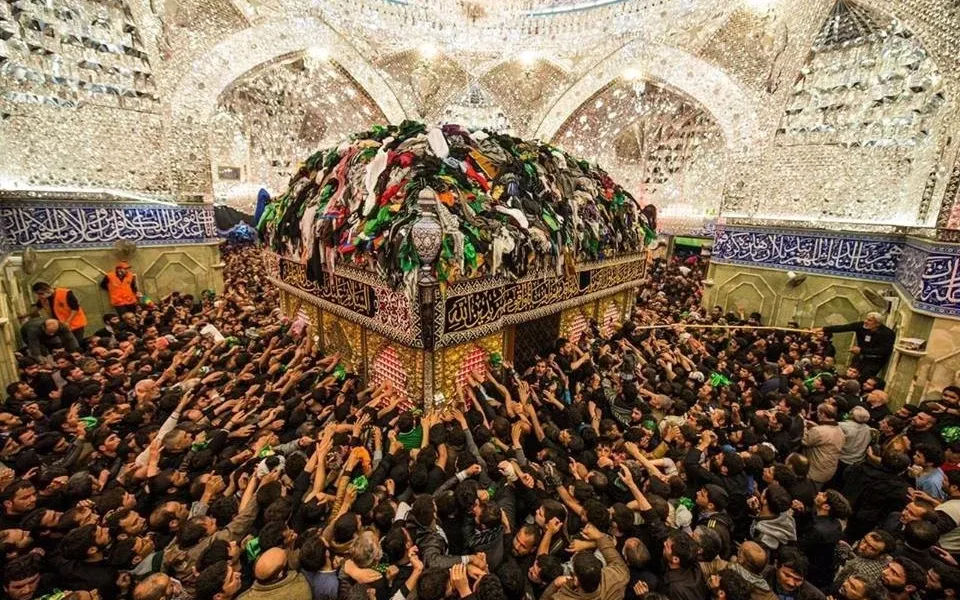
For Muslim communities around the world today, the annual commemoration of Ashura is far more than a ritual of mourning. It is a yearly reckoning, an invitation to measure the distance between the values Imam Hussain embodied and the realities of our own lives. Do we speak truth to power, or rationalize our silence? Do we stand with the oppressed, or avert our eyes for the sake of comfort? Karbala does not allow easy answers. It strips away the comfortable middle ground and asks, with quiet but devastating force, which side you would have stood on and which side you stand on now.
This is not an abstraction. Across the Muslim world and beyond, people invoke Karbala in contexts ranging from anti-colonial resistance movements to civil rights struggles to contemporary protests against authoritarian rule. The slogan “Every day is Ashura; every land is Karbala” captures the essence of this, the conflict between conscience and coercion is not confined to a single moment in history. It is the permanent human condition, renewed in every generation. What Karbala offers is not despair but a framework, a way of understanding suffering not as meaningless but as potentially redemptive, not as the end of a story but as the moment that defines it. There is another dimension to Karbala that the modern world would do well to contemplate, the role of the women who survived it.
Sayyida Zaynab bint Ali, Imam Hussain’s sister, witnessed the massacre of her brother and the men of her family, was taken captive, and was marched to the court of Yazid in Damascus. There, in chains, before a hostile ruler surrounded by his court, she delivered a speech that is still recited and studied today. She did not beg. She did not break. She condemned the tyrant in terms so precise and devastating that history has entirely vindicated her. Zaynab ensured that what happened at Karbala would not be buried or forgotten. She was, in the truest sense, the narrator of the event and without her, its meaning might have been lost.
In an age when women’s voices are still suppressed or marginalized in countless contexts, Bibi Zaynab’s example carries its own distinct power. The women of Karbala were not passive witnesses. They were active bearers of truth in circumstances of almost unimaginable grief, and it is largely because of them that the story survived and spread.
Karbala also teaches something essential about the nature of victory. By every conventional measure, Imam Hussain lost. He and most of the men with him were killed. The women and children were taken captive. Yet the moral verdict of history has been reversed so thoroughly that Yazid’s name is used as a byword for villainy, while Imam Hussain is honored by Muslims and non-Muslims alike as one of the great moral heroes of human history.
Mahatma Gandhi reportedly reflected that he derived his lessons in nonviolent resistance from Imam Hussain ibn Ali, who taught him how to be victorious while being oppressed. What Karbala ultimately offers the contemporary world is a vocabulary for a particular kind of integrity, the integrity that does not bend when bending would be easier, that does not silence itself when silence would be safer, that does not trade principle for survival when survival is openly on offer. It is a model of moral courage that transcends religion, culture, and century. In a world saturated with noise, compromise, and moral confusion, the plains of Karbala remain a place of devastating clarity. Imam Hussain and his family did not die so that their sacrifice could be confined to rituals of mourning. They died so that the question they posed, will you stand for justice even when it costs you everything? would never stop being asked. That question is as alive today as it was on the Day of Ashura. The honest answer to it is the beginning of everything that matters.