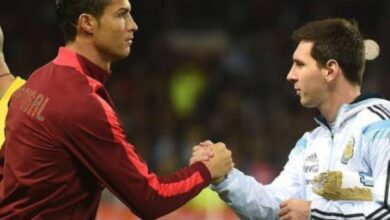
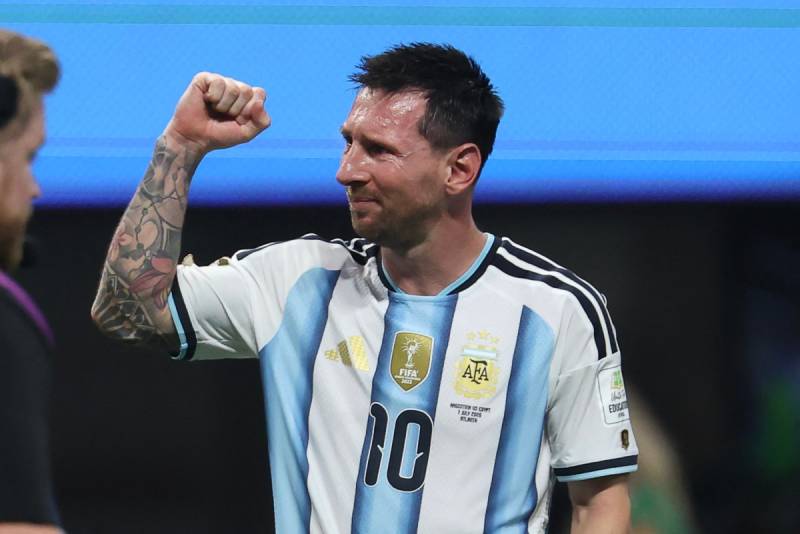

Luis de la Fuente said Spain planned to pay “special attention” to Lionel Messi in Sunday’s World Cup final but ruled out trying to man-mark the Argentina captain.
De la Fuente told reporters at a press conference that he knows from experience the challenges of using man-to-man marking against the eight-time Ballon D’Or winner.
The Spain coach recalled an experience from when he was coaching Sevilla’s youth team while Messi was playing junior football for Barcelona, underlining how it was impossible to keep him quiet for the whole match.
“I first encountered him when I was coaching the Sevilla youth team,” he said. “We went to Barcelona, and I had heard great things about a kid named Messi.
“So we assigned a player to mark him man-to-man, but in the 70th minute, I substituted the marker because he was on a yellow card. The score was 0-0, and in the span of 15 minutes, Messi scored four goals against us.”
“So we won’t use man-to-man marking this time. We have to stay alert and pay special attention, certainly,” de la Fuente added.
Messi, 39, has produced a series of vintage performances for Argentina to carry them into Sunday’s final, which will almost certainly be the veteran’s last appearance in the World Cup.
“Messi is one of a kind,” de la Fuente said. “An example for young athletes in terms of his attitude and behaviour, especially given the spectacular World Cup he is playing at his age.”
Sunday’s final will also be a personal duel between de la Fuente and has Argentina counterpart Lionel Scaloni, who formed a friendship in 2017 when de la Fuente was an instructor as Scaloni studied for his professional coaching licence.
De la Fuente strongly pushed back at suggestions that Argentina may resort to skullduggery or streetwise tactics in an attempt to disrupt Spain.
“Oh, please, no, no, no,” de la Fuente said. “I would never dare to say that. I have the utmost admiration for this national team.
“They’ve won the World Cup, two Copa Americas, the Finalissima… and they are led by a close friend of mine. I have nothing but admiration and more admiration for them.
“I believe that both Spain and Argentina will have a game plan where talent and good football will rule over everything else.”
De la Fuente said his team was prepared to adjust for the extended half-time interval for Sunday’s final. The break is expected to be nearly double the usual 15 minutes to accommodate a star-studded half-time show.
The Spain coach said he believed longer half-time breaks — and the hydration breaks introduced at this World Cup — could become football’s “normality” in coming years.
“I think that everything that we consider to be strange or odd nowadays, you know, hydration breaks, the 30-minute half-time, maybe within 30 years will become normality,” he said.
“Maybe football is developing that way. We don’t know. It is what it is. We can’t change that, so we’ll have to enjoy it.”
Spain’s defence ready to thwart Messi
If Lionel Messi and Argentina are to clinch back-to-back World Cup titles on Sunday, they will have to find a way past one of the meanest defences in tournament history.
Spain’s journey to the final in East Rutherford has been a triumph of collective spirit, with all parts of Luis de la Fuente’s well-oiled machine contributing.
But while the silky midfield control of Rodri, Dani Olmo, Pedri and Fabian Ruiz has grabbed the headlines, the cornerstone of Spanish success has been their defence.
A back four of newly signed Real Madrid left-back Marc Cucurella, centre-backs Aymeric Laporte and Pau Cubarsi, and right-back Pedro Porro have conceded just one goal in seven matches.
Another clean sheet at the MetLife Stadium on Sunday would see Spain establish a new record for the fewest goals conceded in a World Cup-winning campaign, which currently stands at two and is shared by France (1998), Italy (2006) and Spain (2010).
Cucurella, 27, who rose to prominence in the Premier League with spells at Brighton and Chelsea before his move to Madrid was completed last month, takes pride in the Spanish back four’s defensive record.
“Great teams are the ones that dominate both penalty areas,” he said earlier in the tournament.
“Obviously, the fewer goals you concede, the better your chances of winning. Hopefully, we can keep this up. If we defend well, we’ll be closer to winning.”
Cucurella’s relentless patrolling of the flank is matched by the skill of Spain’s commanding centre-half pairing of the veteran Laporte, 32, and 19-year-old Barcelona prodigy Cubarsi.
– ‘A fantastic player’ –
Laporte, who was born in France and spent five-and-a-half seasons at Pep Guardiola’s Manchester City, has been awestruck by his young partner.
“He’s a fantastic player. At 19, he’s already played a lot of matches for Barca and the national team. Time will tell, but he’s got real quality,” Laporte said.
Cubarsi, for his part, has shown no sign of youthful nerves on the biggest footballing stage of all.
The lone blemish on his World Cup so far was when he was beaten by a Charles De Ketelaere header in the 2-1 quarter-final defeat of Belgium.
“I like being imposing and aggressive,” Cubarsi said. “I like making my presence felt because it’s a position where you can’t back down against anyone.
“You can’t let yourself be taken out of the game. Above all, you need that character to be a difference-maker.”
Laporte has become one of Spain coach de la Fuente’s most trusted lieutenants during the World Cup, an assured presence at the heart of the defence who is often the starting point for attacks.
“He is one of the centre-backs who best executes the philosophy we have,” de la Fuente said.
“It’s a luxury to have him. He offers us great ball distribution, threads passes through the lines, and possesses real authority. He is a very complete player.”
The other member of Spain’s back four — Porro — has been a surprise package at the tournament.
Left out of the Spain squad that won the European Championship in 2024, Porro came into the World Cup after a harrowing season with Spurs, with the club narrowly escaping relegation from the Premier League.
But in North America, Porro has been superb in both defence and attack, scoring a beautifully worked second goal in the 2-0 defeat of France.
He is now dreaming of emulating his heroes from Spain’s victorious 2010 World Cup-winning squad.
“In 2010, when we won the title, I was splashing around in the town square,” he said.
“That World Cup… was spectacular, especially for the way it united the country. It would be great to do it all over again,” he added.