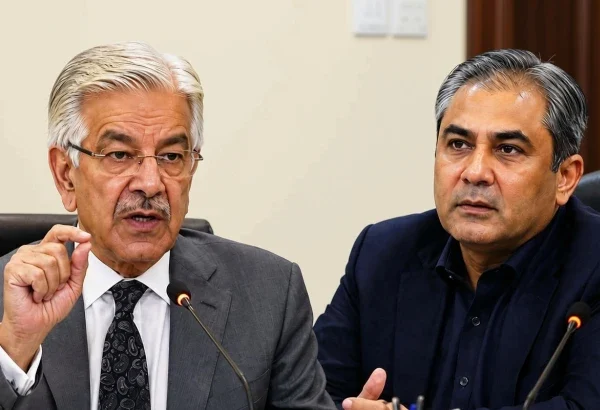

ISLAMABAD: Defence Minister Khawaja Asif has stirred fresh political debate after claiming that Interior Minister Mohsin Naqvi is the most powerful minister in the federal government and, in several matters, is not even answerable to Prime Minister Shehbaz Sharif.
Speaking during a television interview on Monday, Asif delivered unusually candid remarks about Naqvi’s role in the current administration, suggesting that the interior minister operates outside the conventional framework of the federal cabinet.
According to Asif, Naqvi has remained largely absent from the government’s routine decision-making process despite holding one of the country’s most influential portfolios. He said he had seen the interior minister attend only “two or three” cabinet meetings since the government took office.
The defence minister also questioned Naqvi’s parliamentary presence, claiming the interior minister had appeared in Parliament only seven or eight times. He suggested that if a minister with such influence was publicly expressing dissatisfaction with the existing governance structure, it reflected poorly on the entire government.
“If Mohsin Naqvi himself is complaining about the system, then perhaps we should simply go home,” Asif remarked, underscoring what he described as deep institutional weaknesses.
His comments came in response to Naqvi’s recent statement warning that Pakistan’s current administrative structure had become too weak to effectively address the country’s long-standing challenges.
The interior minister had argued that if the existing governance model continued unchanged, Pakistan could still be facing the same problems a decade from now. He maintained that creating new administrative units or provinces had become essential for improving governance, accelerating development and delivering public services more efficiently.
Naqvi said the existing system had outlived its usefulness and was no longer capable of resolving the country’s growing administrative and governance issues.
Asif’s remarks have added a new dimension to the ongoing debate over institutional reforms and the balance of power within the federal government. His observations also highlight differing perspectives within the ruling coalition on how Pakistan’s governance challenges should be addressed.
The exchange between the two senior ministers is likely to fuel further political discussion, particularly over proposals to create new provinces and reform the country’s administrative framework—an issue that has periodically resurfaced in Pakistan’s political discourse but has remained politically contentious for years.