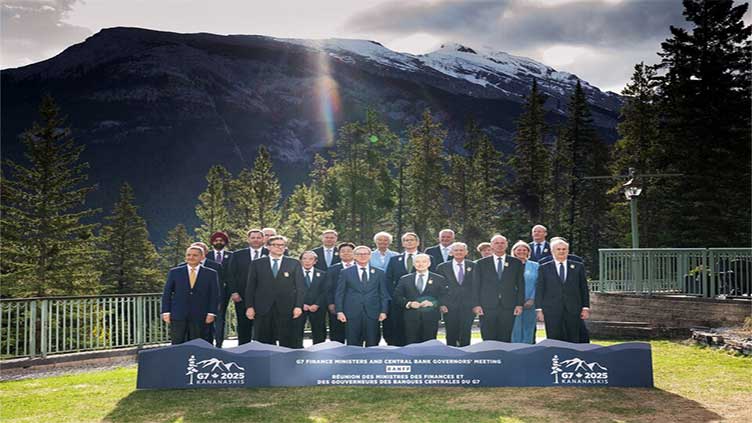

BANFF, Alberta: Finance leaders from the Group of Seven industrialized democracies sought to downplay disputes over US President Donald Trump’s tariffs and find some common ground to keep the forum viable as they met in the Canadian Rocky Mountains on Wednesday.
G7 finance ministers put a positive spin on discussions in Banff, Alberta, to try to reach an agreement on a joint communique largely covering non-tariff issues. The discussions included support for Ukraine, the threat from non-market economic policies of countries including China, and combating financial crimes and drug trafficking.
“I had a very productive day,” US Treasury Secretary Scott Bessent told reporters when asked about his bilateral meetings as he departed the venue for a mountaintop dinner with fellow G7 ministers and central bank governors.
The finance leaders were striving to avoid a repeat of a fractured G7 finance meeting hosted by Canada in 2018, when Trump’s first-term steel and aluminum tariffs made a joint statement impossible.
That meeting, described as the “G6 plus one,” ended with Canada, Japan, Germany, France, Britain and Italy expressing “unanimous concern and disappointment” over Trump’s tariffs.
Trump’s tariffs are far more extensive this time, but G7 sources said there was an effort to find compromise with Bessent.
“There’s been a marked improvement in the mood,” a spokesperson for French Finance Minister Eric Lombard said after Lombard’s bilateral meeting with Bessent. “We had sincere and honest discussion between allies.”
Earlier, Lombard said that he was willing to live without a joint statement as long as the G7 reached a better understanding on how to reduce trade imbalances, better growth policies and the war in Ukraine.
“And making progress is what matters ultimately. It’s not just a question of agreeing on a statement today for the sake of it,” Lombard said.
But Italian Economy and Finance Minister Giancarlo Giorgetti took a different tack, saying on X that reaching a communique compromise was “a step we consider crucial.”
UKRAINE DISCORD
G7 delegation sources said it remained unclear whether the leaders could agree on joint communique language. One European source said, for example, that US officials wanted to delete language describing Russia’s invasion of Ukraine as “illegal” from the draft.