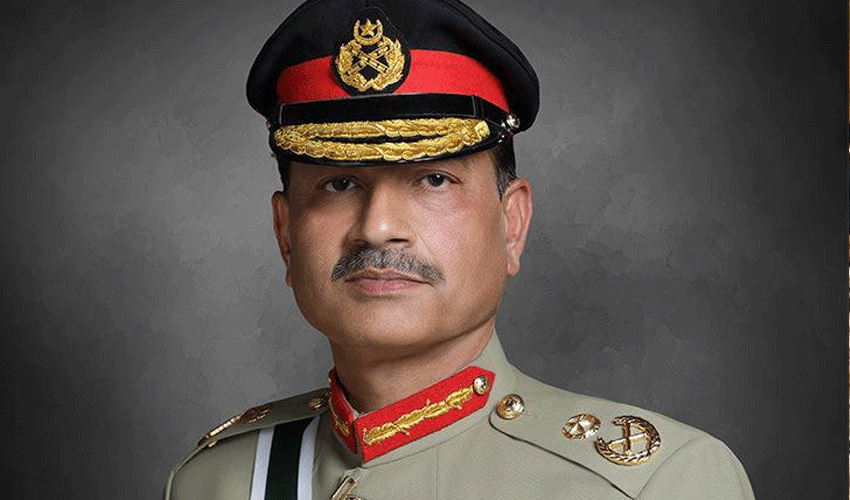

Pakistan has strongly dismissed the Indian Ministry of External Affairs’ (MEA) recent remarks about statements attributed to Field Marshal Asim Munir, accusing New Delhi of twisting facts and promoting a misleading “nuclear blackmail” narrative.
Pakistan calls remarks ‘immature’ and ‘misleading’
In a statement on Monday, the Foreign Office said the Indian stance reflects a “chronic tendency” to distort facts and take statements out of context. Islamabad described the “nuclear blackmail” allegation as a self-serving construct, stressing that Pakistan firmly opposes the use or threat of force.
“India’s sabre-rattling and warmongering whenever confronted invite unfounded allegations bereft of rationality,” the statement read.
Pakistan highlights responsible nuclear policy
Reiterating its status as a responsible nuclear-armed state, Pakistan said its command and control system is under full civilian oversight and operates with “discipline and restraint” on issues of strategic importance.
The Foreign Office also pointed to Pakistan’s “sustained and credible counterterrorism efforts,” which it said are widely recognized internationally. It dismissed Indian claims as “irresponsible” and “without evidence.”
Criticism over third-party references
Islamabad expressed concern over what it called India’s attempt to involve third countries in bilateral matters, calling it a sign of “lack of diplomatic confidence” and a “futile” move.
Warning against aggression
Pakistan vowed to respond “immediately and in kind” to any Indian aggression or violation of its sovereignty, warning that any escalation would be India’s responsibility.
“Contrary to India’s belligerent approach, Pakistan will continue acting as a responsible member of the international community,” the statement concluded.
Earlier this week, during his address to the Pakistani-American community on an official visit to the United States, Field Marshal Munir declared that Kashmir remains an unresolved international issue, not an internal matter of India, in line with the vision of Quaid-e-Azam who called it Pakistan’s “jugular vein”.
The field marshal said overseas Pakistanis remain a source of pride and dignity, sharing a deep commitment to the homeland. He warned that any Indian aggression would face a firm and immediate response. He described the diaspora as a “brain gain, not brain drain”, and urged expatriates to invest and contribute to Pakistan’s development and prosperity.
Field Marshal Munir criticised India’s ambitions of portraying itself as a “Vishwaguru” (world teacher), stating that its actions do not align with such claims.
He raised concerns over the transnational terrorist activities of India’s intelligence agency, RAW, citing the killing of a Sikh leader in Canada, the case of eight Indian naval officers in Qatar, and Kulbhushan Jadhav as examples.
The army chief said Pakistan had successfully countered India’s discriminatory and double standards through effective diplomacy.
He accused India of serious violations of Pakistan’s sovereignty, resulting in the martyrdom of innocent civilians, which, he warned, had brought the region to the brink of war.
He reaffirmed Pakistan’s full support for United Nations Security Council resolutions on Kashmir.
Field Marshal Munir thanked US President Donald Trump, crediting him for helping prevent not only the escalation of Pakistan-India tensions but also several other global conflicts.
He said Pakistan responded resolutely to Indian provocations, but India remains committed to destabilising the region.
On the humanitarian situation in Gaza, Field Marshal Munir called the ongoing conflict a “genocide” and described it as one of the worst human tragedies with serious global and regional consequences.
He said several terrorist groups operating from Afghanistan, including the Khawarij faction, are actively targeting Pakistan. He affirmed that Pakistan serves as the final frontier against terrorism and that no sympathy would be extended to terrorists.
All terrorists would be brought to justice with full force, he added.
Field Marshal Munir said Pakistan–United States relations are moving in a new and constructive direction, and this visit aims to strengthen the foundation for durable ties.
He referred to progress on the implementation of Memoranda of Understanding with the United States, Saudi Arabia, the United Arab Emirates and China, noting that a potential Pakistan–US trade agreement could attract significant investment.
He highlighted that 64% of Pakistan’s population consists of youth who hold a crucial role in shaping the country’s future.
Describing social media as a powerful tool, he warned that hostile elements exploit it to spread orchestrated unrest.
He stressed the importance of understanding the mindset and priorities of the younger generation and appreciated the loyalty and swift response of overseas Pakistanis in times of national crisis.
He emphasised that Pakistan’s future progress is closely tied to the strength of its global diaspora.
Field Marshal Asim Munir recently concluded a significant official visit to the United States, engaging with top political, military, and diaspora leaders, the military’s media wing said on Sunday.
According to ISPR, during his visit, Field Marshal Munir attended the retirement ceremony of General Michael E. Kurilla, outgoing Commander of the United States Central Command (CENTCOM), in Tampa. He praised General Kurilla’s exemplary leadership and contributions to strengthening bilateral military ties.
The ceremony also marked the transition of command to Admiral Brad Cooper, to whom COAS Munir extended best wishes for continued collaboration on shared security challenges.
In a key meeting, the Field Marshal met with General Dan Caine, Chairman of the Joint Chiefs of Staff.
The two discussed matters of mutual professional interest, focusing on enhancing military cooperation. Munir extended a warm invitation to General Caine to visit Pakistan, signaling a commitment to ongoing dialogue.