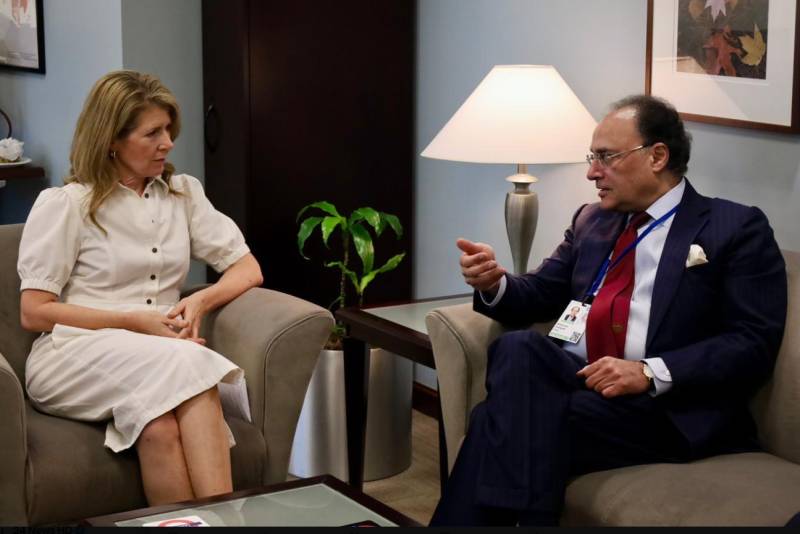

Federal Minister for Finance and Revenue Senator Muhammad Aurangzeb held a productive meeting with US Deputy Treasury Secretary on the sidelines of the World Bank–IMF Spring Meetings in Washington, D.C, it was reported on Saturday.
The Finance Minister shared an overview of Pakistan’s macroeconomic stabilization, its planned re-entry into international capital markets, and its external debt management strategy.
He highlighted key investment opportunities in Pakistan’s minerals and energy sectors, and briefed the Treasury leadership on progress and prospects in digital and virtual asset regulation.
Both sides discussed avenues for cooperation and collaboration in energy, mineral development, and strengthening the anti-money laundering and countering the financing of terrorism (AML/CFT) framework.
The Finance Minister reaffirmed the depth and strength of bilateral economic engagement and underscored the importance of continued United States support for Pakistan’s programme with the International Monetary Fund (IMF).
Meeting with UK minister
Finance Minister Aurangzeb also held an important meeting with Jenny Chapman, Baroness Chapman of Darlington, Minister for International Development and Africa, United Kingdom in Washington.
At the outset, the Finance Minister reaffirmed Pakistan’s longstanding relationship with the United Kingdom. On the macroeconomic front, he highlighted that Pakistan has achieved a current account surplus for the first nine months of the fiscal year and reiterated the government’s firm commitment to meeting all fiscal targets by the end of June.
He also acknowledged the external support received from the Kingdom of Saudi Arabia. The minister noted that Pakistan has returned to international capital markets for the first time in four years through a bond issuance.
Addressing the energy price shock after US-Iran war, he outlined the government’s policy response, including expenditure reduction and austerity measures, full price transmission, targeted subsidies, and direct disbursement into digital wallets.
He further informed that a Staff-Level Agreement has been successfully concluded with the IMF, with Executive Board approval expected shortly. He underscored the government’s focus on structural reforms, including rationalization of the tax system, reduction in energy sector costs, and addressing elevated financing costs.
On climate resilience, the minister noted that during the most recent floods, Pakistan—owing to improved fiscal buffers—was able to finance disaster relief entirely from its own resources, without recourse to international pledges.
He also informed that Pakistan has developed a forward-looking National Disaster Management Centre equipped with AI and satellite technology.
He raised population growth as one of the most critical long-term development challenges facing Pakistan, noting that it features as one of the three key verticals in the World Bank’s ten-year Country Partnership Framework for the country.
The meeting concluded with the minister acknowledging the contribution of the United Kingdom’s Foreign, Commonwealth & Development Office (FCDO).
Meeting with JICA Senior Vice President
Finance Minister Aurangzeb also held a productive meeting with Shohei Hara, Senior Vice President of the Japan International Cooperation Agency (JICA) in Washington.
The Finance Minister welcomed JICA’s resumption of its lending portfolio with Pakistan after a prolonged pause and appreciated the identification of a water supply scheme in Faisalabad, Punjab, as the first project under the resumed Yen loan portfolio. He noted that the grants programme is progressing well, with previously long-standing bottlenecks having been largely resolved in coordination with the Pakistani side.
He expressed concern that Pakistan’s net disbursement from JICA remains negative. Both sides agreed on the need to reverse this trend through the resumption of active lending. He expressed keen interest in leveraging Japan’s extensive experience in the social sector, particularly in health and education, and flagged interest in exploring financing arrangements by combining JICA financing with contributions from other sources to maximize development impact in line with the Government’s broader development agenda.
The minister assured JICA of full support in resolving issues of manpower shortages at the Pakistan Institute of Medical Sciences (PIMS) and security scanners at Karachi Port, where one unit remains non-operational due to maintenance and spare parts constraints. He also thanked JICA for its support to Pakistan’s ongoing peace efforts.
Meeting with AIIB President
Finance Minister Aurangzeb also held a productive meeting with Zou Jiayi, President of the Asian Infrastructure Investment Bank (AIIB) in Washington.
During the meeting, the minister congratulated Zou Jiayi on assuming the office and appreciated AIIB’s robust engagement in Pakistan through an ongoing portfolio of approximately US$1.7 billion, with an additional US$1 billion in the pipeline. Aurangzeb highlighted Pakistan’s recent return to international capital markets, including the launch of a Eurobond through private placement after a gap of four years, describing it as an important validation of the country’s macroeconomic stabilization efforts.
He also referred to Pakistan’s inaugural Panda bond issuance as a landmark initiative aimed at diversifying financing sources.
The minister briefed the AIIB President on the economic implications of the ongoing regional situation, particularly its impact on Pakistan’s energy supply chain. He further outlined Pakistan’s broader development frameworks, including the 10-year Country Partnership Framework (CPF) with the World Bank, focused on population, climate, and fiscal priorities, as well as the 5-year Country Partnership Strategy (CPS) with the Asian Development Bank (ADB).
Aurangzeb invited AIIB to align its engagement with Pakistan’s infrastructure priorities and strategic development focus. He appreciated the Bank’s multi-year rolling lending pipeline, noting that it would enable a more programmatic and structured implementation of projects over a three to five-year horizon.
Both sides acknowledged that Pakistan’s disbursement performance with AIIB has lagged behind that of other multilateral partners, including the World Bank and ADB. In this context, the minister informed that the Prime Minister has constituted four dedicated working committees to address key project implementation bottlenecks, including compliance, land acquisition, disbursement, and procurement.
Reaffirming the government’s commitment to improving institutional processes, Aurangzeb emphasized efforts to enhance implementation efficiency and reduce delays in project execution.
Meeting with Citibak reps
Finance Minister Aurangzeb also held a productive meeting with representatives of Citibank.
During the meeting, the minister informed the Citi team that Pakistan has successfully concluded a Staff-Level Agreement with the IMF.
Aurangzeb noted that Pakistan has met its external obligations in a timely manner, including the repayment of US$1.4 billion on its Eurobond during the current month. He also acknowledged the continued and steadfast financial support extended by the Kingdom of Saudi Arabia.
On capital market developments, the minister informed that Pakistan has successfully re-entered international capital markets with a Eurobond issuance – its first in four years -reflecting renewed investor confidence in the country’s economic outlook.
He further apprised the Citi team of progress on Pakistan’s inaugural Panda bond issuance, noting that regulatory submissions have been completed and approval is being actively pursued with a view to completing the issuance in May.
Aurangzeb outlined Pakistan’s broader Global Medium Term Note (GMTN) strategy, which envisages diversified issuances across multiple instruments, including Eurobonds, Sukuk, and rupee-linked, dollar-settled bonds.
He appreciated the detailed and structured capital markets strategy presented by Citibank and advised the team to maintain close coordination with Pakistan’s Debt Management Office (DMO) to support ongoing and future market engagements. Concluding the meeting, Senator Aurangzeb appreciated Citibank’s longstanding presence in Pakistan and expressed a strong desire to further reinvigorate and deepen the partnership.
World Bank Roundtable
Finance Minister Aurangzeb also participated in a roundtable titled “Delivering Social Protection Digitally: Lessons and Innovations from Pakistan, Middle East and North Africa,” organized by the World Bank in Washington.
The roundtable featured presentations on two interconnected themes: Pakistan’s Digital Public Infrastructure (DPI) journey and the digital transformation of the Benazir Income Support Programme (BISP). Opening the session, the Finance Minister drew a compelling parallel between COVID-19, described as the largest demand shock in recent history, and the ongoing Middle East conflict, which he characterized as the largest supply shock.
He noted that countries that invested early in governance and technology were better positioned during COVID-19, and that Pakistan is now reaping similar dividends from its digital infrastructure as it navigates the current energy supply shock.
He highlighted that targeted digital subsidies for two-wheelers, public transport, and small farmers are being disbursed seamlessly through an established digital payments ecosystem already in place.
His key message was that digital social protection is not merely a payment mechanism, but a vehicle for financial inclusion and economic empowerment.
By enabling beneficiaries, particularly women, to access formal bank accounts and transact digitally, Pakistan is building the foundation for long-term economic participation and greater documentation of the informal economy.
Meeting with S&P Global reps
Finance Minister Aurangzeb also held a constructive meeting with representatives of S&P Global Ratings.
During the meeting, the Finance Minister confirmed that Pakistan has successfully concluded a Staff-Level Agreement with the IMF.
Aurangzeb informed that Pakistan has met its external obligations in a timely manner, including the repayment of USD 1.4 billion on its Eurobond during the current month. He also highlighted additional financial support from the Kingdom of Saudi Arabia, including a USD 3 billion facility and the extension of an existing USD 5 billion deposit from an annual rollover to a three-year term through 2028, further strengthening the country’s external position.
The minister noted that Pakistan has successfully re-entered international capital markets with the launch of a Eurobond through private placement after a gap of four years, priced at just under 7 percent, reflecting renewed investor confidence in the country’s macroeconomic trajectory. He outlined Pakistan’s medium-term Global Medium Term Note (GMTN) strategy, which envisages diversified issuances across multiple instruments, including Eurobonds, Sukuk, and rupee-linked, dollar-settled bonds, aimed at broadening the investor base and mitigating foreign exchange risks.
Aurangzeb also briefed S&P Global on progress towards Pakistan’s inaugural Panda bond issuance, noting that regulatory submissions have been made and approval from the National Association of Financial Market Institutional Investors (NAFMII) is awaited.
On the evolving regional situation, he highlighted the government’s focus on managing the immediate economic impact through measures to secure energy supply chains, optimize pricing and logistics, and provide targeted digital subsidies to vulnerable segments of the population.
Concluding the meeting, Aurangzeb expressed confidence that Pakistan’s improved macroeconomic fundamentals and continued reform momentum present a strong case for a rating upgrade.